
Lieferung heute & morgen

Qualitätsgarantie

Willkommens-Angebote freischalten: KOSTENLOSE Lieferung | Bis zu 80 % RABATT | Kostenlose 30-Tage-JoyPlus-Testphase
App herunterladen
A sudden loss of tyre pressure on the way to work or a flat tyre at the start of a family holiday—situations like these are more than just an annoyance. A portable cordless compressor promises a quick fix and freedom from the nearest petrol station. However, the market is flooded with devices whose performance claims are often more marketing than reality. Before you make a purchase, it's crucial to understand the common pitfalls that can lead to a useless device and unnecessary expense.
As your Joybuy Product Recommendation Officer, I'm here to help you separate the wheat from the chaff. We'll shine a light on the critical features that distinguish a reliable compressor from an unreliable one.
Many devices advertise impressive numbers, but the devil is in the details. Two issues in particular frequently lead to buyer's remorse:
To avoid a bad purchase, you should focus on three objective technical parameters. These determine the real-world usability and reliability of your device.
A good air compressor for car tyres needs balanced performance. The maximum pressure, often stated in Bar or PSI, must be sufficient to inflate your tyres to the manufacturer's recommended value (usually between 2.2 and 2.8 Bar). Just as important is the air flow rate, measured in litres per minute (L/min). It determines how quickly the tyre inflates.
The choice of power source depends on how you plan to use it.
Modern devices offer more than just hot air. Features that significantly increase their utility include:
Based on these objective criteria, we have identified a few models from our range that represent a suitable solution for specific user groups.
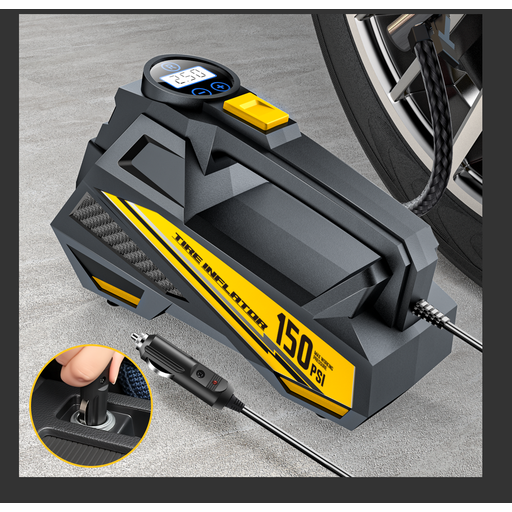
Why This Fits Their Persona: Ideal for drivers who want a straightforward and always-ready tool for the glove compartment. The focus is on reliability in a breakdown, not on cordless convenience for everyday use.
This model completely bypasses the battery trap. Since it's powered directly from the vehicle's 12V socket, there are no concerns about battery life or performance degradation in the cold.
Continuous power supply for reliable performance. Digital display with auto-shutoff function for precise inflation.

Why This Fits Their Persona: Perfect for users who want a versatile device for cars, motorcycles, and bicycles, and who appreciate the convenience of cordless operation. The power bank function is a practical bonus for on-the-go use.
The dual-power function provides a safety net: if the large 6000mAh battery ever runs out, the compressor can simply continue to operate via the car's 12V socket.
High battery capacity for multiple uses, flexible power supply (Battery + 12V), and a useful power bank function.

Why This Fits Their Persona: For drivers seeking a multifunctional emergency tool that goes beyond just inflating tyres. Safety and preparation for unforeseen events are the top priorities here.
This device clearly positions itself as an emergency multi-tool. It avoids the pure performance trap by defining its value through additional, potentially life-saving features like an emergency hammer and seatbelt cutter.
Combines a capable cordless compressor with an integrated emergency hammer and seatbelt cutter for enhanced safety in an emergency.
We have compiled a complete, up-to-date list of products that fully meet these strict selection criteria and safety regulations.
Can a cordless compressor inflate a completely flat car tyre? Yes, most high-quality models can. However, it takes significantly longer than just topping up and puts a heavy strain on the battery. A powerful portable compressor with an air flow rate over 25 L/min and a battery of 4000 mAh or more can inflate a standard car tyre from 0 to 2.5 Bar in about 7-10 minutes. For corded 12V models, this is generally not a problem.
How accurate are the digital pressure gauges? Accuracy can vary. For brand-name products, the deviation is usually small (often ±0.1 Bar). It is still good practice to double-check the pressure with a separate, calibrated tyre pressure gauge after inflation, especially before long journeys. However, the auto-shutoff feature is a significant advantage over analogue gauges, which can be difficult to read.
How long does the battery last and how should it be stored? The lifespan of a lithium-ion battery depends on its charge cycles. To maximise its life, the battery should not be stored completely empty or full for extended periods. A charge level between 40% and 80% is ideal for storage. Avoid leaving the compressor in a hot car during summer or in freezing temperatures during winter, as extreme temperatures can damage the battery.