
Lieferung heute & morgen

Qualitätsgarantie

Willkommens-Angebote freischalten: KOSTENLOSE Lieferung | Bis zu 80 % RABATT | Kostenlose 30-Tage-JoyPlus-Testphase
App herunterladen
A sudden drop in tyre pressure can bring any journey to an unexpected halt. A reliable cordless compressor in your boot offers peace of mind and independence from the nearest petrol station. However, the market is flooded with devices whose performance claims are often more marketing than reality. As your Joybuy Product Recommendation Officer, I'll help you identify the crucial features and make an informed choice based on facts, not advertising slogans.
Many buyers focus on big numbers and attractive designs, but the devil is in the details. These three points often lead to disappointment and a useless device:
To avoid a bad buy, you should focus on objective technical data. These three criteria are crucial for the performance and reliability of a cordless compressor.
The maximum pressure, often advertised as 150 PSI (approx. 10.3 bar), is a common marketing figure. It indicates the theoretical pressure the device can reach. In practice, however, this value is less relevant than the air flow rate, measured in litres per minute (L/min). This determines how quickly a tyre is inflated. A device with high maximum pressure but a low flow rate will work very slowly. For car tyres, a flow rate of at least 20 L/min is a good benchmark to avoid excessively long waits.
Battery capacity, measured in milliampere-hours (mAh), is the most direct indicator of endurance. A cordless compressor with a capacity below 4000 mAh is primarily suitable for bicycles or for topping up the pressure in car tyres. For fully inflating an empty car tyre or for use on multiple vehicles, models with 6000 mAh or more are a more robust choice. Also, look for modern charging ports like USB-C. Alternatively, corded models operate via the vehicle's 12V socket (cigarette lighter). These offer unlimited runtime as long as the engine is running but are less flexible.
A good electric tyre inflator should do more than just pump air. The following features significantly enhance its everyday utility:
Instead of making a one-size-fits-all recommendation, we have identified models that are tailored to specific user profiles.
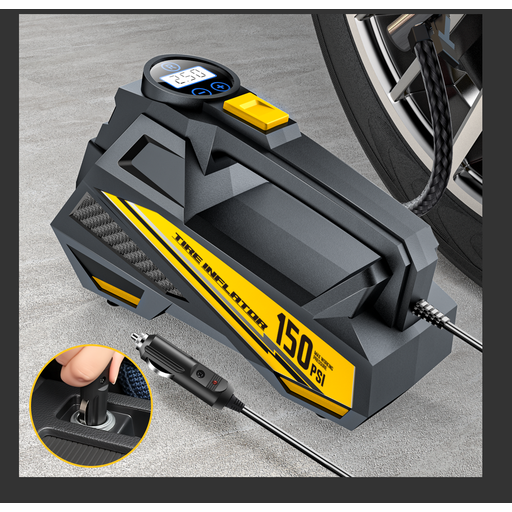
Why This Fits Their Persona: Ideal for drivers who want a reliable emergency solution in their car and don't want to worry about a dead battery. Perfect for the glove compartment or boot.
This model completely bypasses the battery trap. By connecting directly to the vehicle's 12V socket, its performance is consistent and not dependent on a limited battery capacity.
Unlimited runtime while the engine is on; compact design for easy storage; includes auto-shutoff and a digital display.
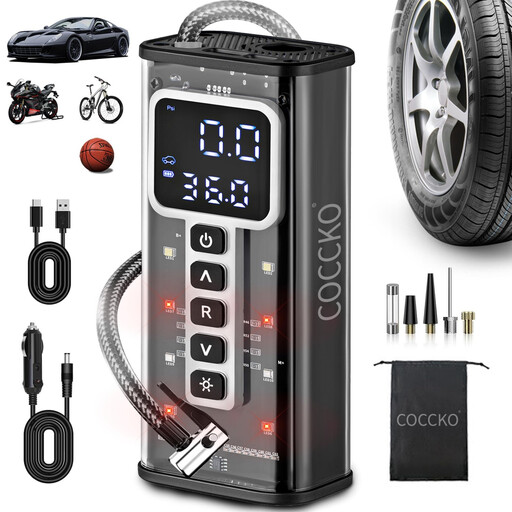
Why This Fits Their Persona: Perfect for commuters and families who need a flexible, cordless solution for cars, motorbikes, bicycles, and balls. Compact enough for a backpack or the car.
With a 6000 mAh battery, this model offers a solid capacity that's sufficient for multiple uses. The dual-sided vents aid cooling and reduce the risk of overheating.
Good balance of performance (35 L/min) and portability; 5 preset modes; also functions as a power bank for smartphones.
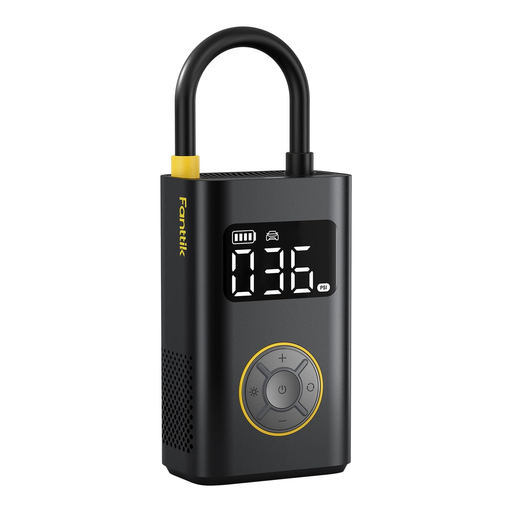
Why This Fits Their Persona: For users who value speed, thoughtful design, and smart features. Ideal for frequent use, camping, or as a high-quality tool in the garage.
The device features an active cooling system and a long battery life of up to 23 minutes of continuous operation. The auto-off function when not in use prevents accidental discharge.
Very fast inflation time (e.g., 1 minute to go from 30 to 35 PSI on a compact car tyre); integrated hose and accessory storage; large display that is easy to read even in sunlight.
We have compiled a complete, up-to-date list of products that fully meet these strict selection criteria and local safety regulations.
Yes, powerful models with a high air flow rate (over 25 L/min) and a large battery capacity (at least 6000 mAh) can do this. However, it takes significantly longer than using a stationary air pump at a petrol station—expect it to take 8 to 15 minutes per tyre, depending on the tyre size and the device. With weaker models, the battery may not last for a full inflation, or the device may need to cool down in between.
The runtime heavily depends on the capacity (mAh) and the application. As a good rule of thumb: a fully charged compressor with 5000-6000 mAh should be able to top up four car tyres by 0.3-0.5 bar each or fully inflate 8-10 bicycle tyres. For infrequent top-ups, a single charge can often last for several months, as the self-discharge rate of modern lithium-ion batteries is low.
Accuracy is a critical but difficult-to-verify feature. A good practice is to occasionally compare the pressure displayed by the cordless compressor with a calibrated, separate tyre pressure gauge. Models with a specified accuracy of ±0.1 bar (or ±1.5 PSI) generally offer sufficient precision for personal use. The auto-shutoff feature is only as good as the sensor that measures the pressure.