
Lieferung heute & morgen

Qualitätsgarantie

Willkommens-Angebote freischalten: KOSTENLOSE Lieferung | Bis zu 80 % RABATT | Kostenlose 30-Tage-JoyPlus-Testphase
App herunterladen
A reliable cordless drill driver is the cornerstone of any toolkit. Whether you're assembling furniture, mounting shelves, or tackling more demanding renovation jobs, choosing the right tool can be overwhelming. The technical spec sheets are often long, and the differences between models aren't always obvious at first glance.
This article serves as your guide. We'll introduce objective criteria to help you with your selection and present a range of models for different applications. Our goal is to provide you with the information you need to make an informed decision for your next project.
Before you decide on a model, it's important to understand a few technical basics. These three points will help you better assess a tool's performance and suitability.
Modern cordless drill drivers are often equipped with a brushless motor. Unlike conventional motors with carbon brushes, these operate purely electronically.
For occasional, simple screwdriving tasks, a tool with a brushed motor may suffice. However, for regular use and more demanding jobs, a brushless motor is a worthwhile investment.
Voltage, measured in volts (V), is an indicator of the tool's general performance class. Common classes include 18V or 24V. A higher voltage level generally allows for more demanding work.
Torque, measured in Newton-metres (Nm), describes the tool's rotational force.
Look for an adjustable torque clutch (e.g., 18+1 settings). It prevents screws from being driven too deep or screw heads from being damaged.
The decision depends on whether you already own tools from a specific manufacturer.
Here is a selection of three tools that cover different needs and use cases.
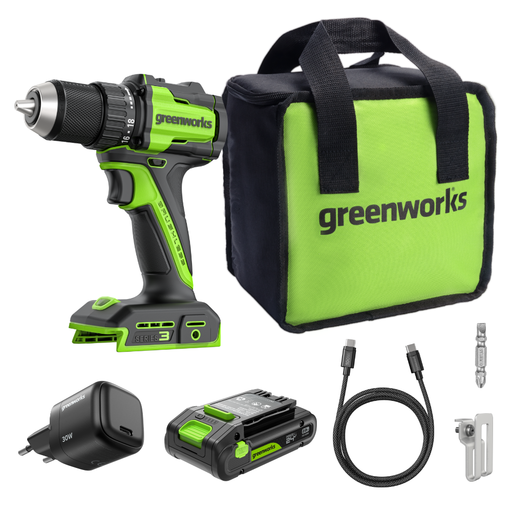
Why It Stands Out: This model from Greenworks combines an efficient brushless motor with a well-designed 24V system. A special feature is the included USB-C battery, which can also be used as a power bank (12,000 mAh) to charge mobile devices. This makes it a versatile companion not just in the workshop, but on the go as well.
Pros:
Who Is It For? Ideal for DIY enthusiasts who are looking for a versatile and ready-to-go cordless drill driver kit for projects around the house and garden.
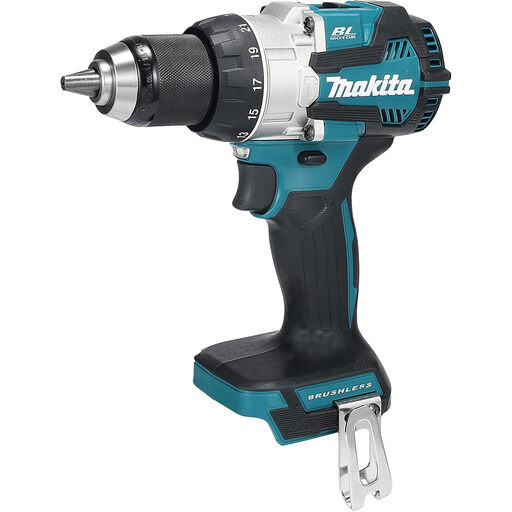
Why It Stands Out: The Makita DHP489Z is a robust cordless hammer drill driver for demanding tasks. Its selectable hammer function allows for drilling into masonry and brick. With XPT (eXtreme Protection Technology), the tool is also protected against dust and splashing water, increasing its durability under job site conditions.
Pros:
Who Is It For? An excellent choice for ambitious DIYers and professional tradespeople who already own Makita 18V batteries and need a powerful, durable tool for a wide range of materials. Note that this is a bare tool sold without a battery and charger.
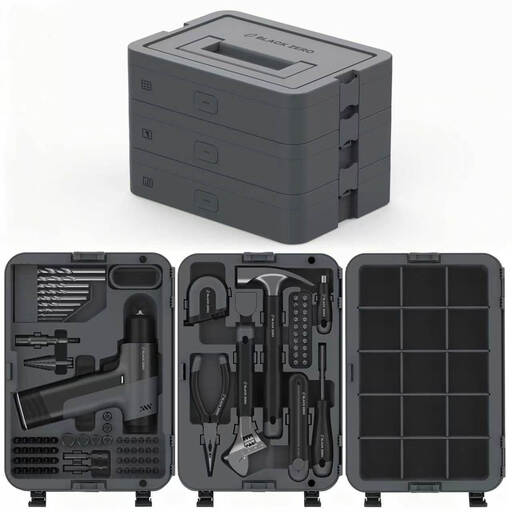
Why It Stands Out: This kit from BLACKZERO is more than just a cordless drill. It's a complete, mobile workshop setup in a well-designed, three-layer tool case. In addition to the 16V drill driver, the set includes a comprehensive selection of hand tools—from pliers and screwdrivers to a tape measure.
Pros:
Who Is It For? Ideal for beginners, apartment dwellers, or as a practical gift. Anyone looking for a comprehensive and tidy solution for all common DIY tasks, who doesn't yet own any tools, will find this a cohesive package.
Didn't find the right model for you yet? There is a wide variety of other tools for special requirements, from ultra-compact drivers to highly specialised professional machines.
? Explore our full range of hammer drill drivers and find the perfect tool for your next project.
A standard cordless drill driver is designed for drilling in wood, metal, and plastic, as well as for screwdriving. A cordless hammer drill driver also has a selectable hammer function. This creates rapid, axial impacts that make it easier to drill into harder materials like brick or masonry. For concrete, however, a rotary hammer is usually required.
For everyday tasks like furniture assembly or drilling in softwood, 20-40 Nm is generally sufficient. If you regularly drive large screws (e.g., in timber construction) or drill into hardwood and metal, you should consider a model with 50 Nm or more. An adjustable torque limit is more important than the absolute maximum value to avoid damaging materials.
Yes, in most cases. A brushless motor offers higher efficiency (longer battery life), a longer tool lifespan, and often more power in a more compact design. For users who use their tool regularly, the extra cost for brushless technology is a worthwhile investment in reliability and performance.