
Lieferung heute & morgen

Qualitätsgarantie

Willkommens-Angebote freischalten: KOSTENLOSE Lieferung | Bis zu 80 % RABATT | Kostenlose 30-Tage-JoyPlus-Testphase
App herunterladen
A cordless drill driver should drive screws securely, drill clean holes and perform reliably in everyday use. In practice, however, poor purchases often happen not because of a lack of power, but because of unclear information about what’s included in the box, an unsuitable voltage or an incompatible battery system.
Before you buy, it’s worth taking a close look at the technical specifications and how you plan to use the tool. A compact cordless drill driver for assembling furniture needs different features from a machine intended for regular drilling into masonry.
Labels such as “Solo” or “Tool Only” often mean that only the tool itself is supplied. This applies, for example, to the Makita DHP489Z and the Makita DDF487Z. Both models are designed for the Makita 18 V LXT system, but according to the product details, they are sold without a battery or charger.
If you don’t already own a compatible battery system, you should factor in the additional cost of a battery, charger and possibly a carry case. A cordless drill driver kit can therefore be more economical for beginners, even if the bare-tool price initially seems higher.
Maximum torque is given in newton metres, or Nm for short. A higher value can be helpful for larger screws or tougher materials. However, for delicate furniture panels, a finely adjustable clutch is often more important than the highest possible peak figure.
The speed, number of gears, ergonomics and weight also affect how practical the tool is to use. A heavy machine can tire you out more quickly during overhead work, while a very compact model may reach its limits with demanding drilling tasks.
A cordless hammer drill driver combines normal drilling and screwdriving with a hammer action. This can be useful for lighter work in masonry. For hard concrete surfaces, depending on the material and drill diameter, a rotary hammer with a suitable SDS chuck is often the more appropriate choice.
Also, check whether the manufacturer distinguishes between drilling performance in wood, metal and masonry. Such details are far more helpful than vague marketing claims.
An 18 V cordless screwdriver generally offers more power reserves than a 12 V model, but it is often larger and heavier. For furniture assembly, shelving and small repairs, a 12 V model is often sufficient. A 16 V machine can offer a middle ground.
What really matters is compatibility: batteries and chargers from different systems cannot automatically be used interchangeably. So check the exact name of the battery platform. Examples from the range include:
Torque describes the twisting force. A multi-stage clutch helps you drive screws in a controlled manner. Two gears allow you to adapt to the task: a low speed with higher torque for screwdriving, and a higher speed for drilling.
One example is the Bosch EasyDrill 18V-38 with 20 torque settings, two gears and a stated maximum speed of 1,630 rpm. According to its product data, the Makita DHP489Z has two gears, up to 1,800 rpm and a maximum torque of 73 Nm.
A 10 mm keyless chuck is suitable for many typical DIY tasks. A 13 mm chuck can accept larger bits, provided the tool and the intended use are designed for it.
Useful features include:
With a drill driver supplied with battery and charger, you should also check the charging time, the battery capacity in Ah and the number of batteries included.
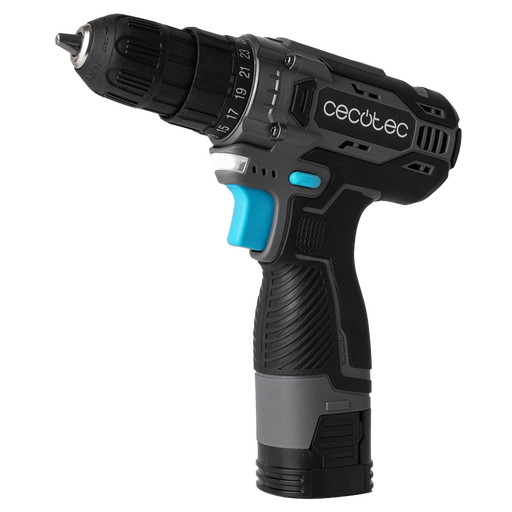
Why this product suits the profile: This kit is aimed at users who want to get started straight away with multiple accessories and two batteries.
According to the product description, the battery, charger, case and accessories are all included. This removes the need to search for a separate battery system.
38 Nm, two gears, 25+1 torque settings, LED light and two batteries, each with 2.0 Ah.
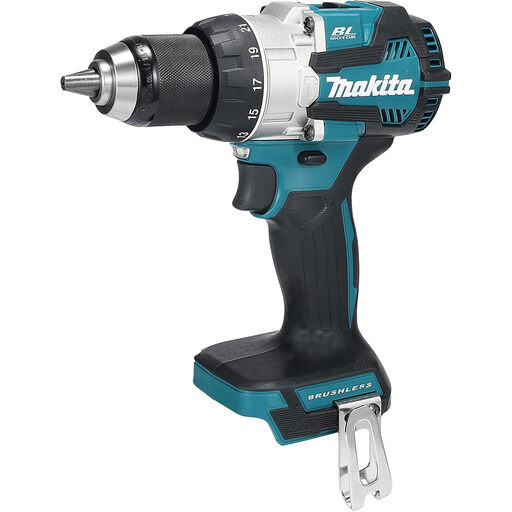
Why this product suits the profile: This model is designed for users who already own a Makita 18 V LXT battery system and need a tool for regular drilling or screwdriving.
The product data clearly states that the battery and charger are not included. This allows buyers to continue using their existing LXT batteries.
73 Nm maximum torque, 13 mm chuck, brushless motor, two gears, LED light and XPT protection against dust and water.
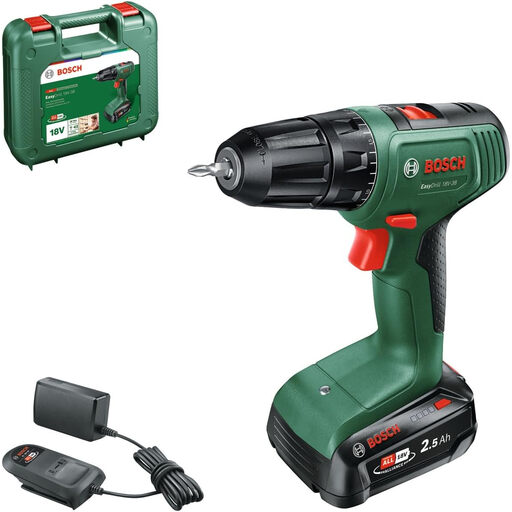
Why this product suits the profile: This kit combines an 18 V drill driver with a battery and the Bosch POWER FOR ALL system for various household tasks.
The 20 torque settings make controlled screwdriving easier. In addition, the battery and charger are included in the kit; however, system compatibility should still be checked before purchase.
38 Nm, two gears, 10 mm keyless chuck, LED light and stated drilling capacities of 30 mm in wood and 10 mm in steel.
We have put together a complete, regularly updated list of products that fully meet these strict selection criteria and the safety regulations in force in the EU.
Only use compatible batteries and chargers from the intended system. Lithium-ion batteries should not be opened or exposed to high heat, moisture or mechanical damage. Remove the battery before carrying out maintenance or changing the drill bit.
When drilling, safety glasses and, depending on your working environment, hearing protection are essential. The workpiece should be securely fixed. Before you start, check that the drill bit is firmly seated in the chuck and that there may be cables running behind the wall.
For wood and metal, an adjustable drive, two gears and a suitable chuck are important. Also pay attention to the maximum drilling diameters stated by the manufacturer. For occasional work, a 12 V or 16 V machine is often sufficient; for larger screws and longer use, an 18 V model can make sense.
The runtime depends on the battery capacity, the material, the drill diameter, the torque and how you work. The figure given in Ah describes the capacity, but on its own it doesn’t allow an exact runtime prediction. A second battery reduces interruptions during longer projects.
A brushless motor can, by design, suffer less wear on the motor contacts and is often used in tools intended for regular use. However, for occasional assembly work, a model with a conventional motor can be perfectly adequate. What really matters is how often you’ll use it, the battery system, the weight and the availability of spare batteries.