
Lieferung heute & morgen

Qualitätsgarantie

Willkommens-Angebote freischalten: KOSTENLOSE Lieferung | Bis zu 80 % RABATT | Kostenlose 30-Tage-JoyPlus-Testphase
App herunterladen
A cordless drill driver needs to reliably drive screws, prepare drill holes, and feel comfortable in your hand when you’re assembling furniture or carrying out repairs. Product descriptions often highlight high torque figures, extensive bit sets and powerful batteries, while important details can be less obvious. If you only focus on the biggest number, you might end up with a tool that’s too heavy, too weak, or not properly equipped for your needs.
The stated maximum torque in Newton metres (Nm) describes the force under specific conditions. On its own, it doesn’t tell you how precisely a tool handles small screws or what its actual drilling performance is like. For furniture assembly and screwing into wood, multiple torque settings are often more important than a single peak value.
An electric screwdriver for electronics, on the other hand, needs significantly less power. A cordless driver that’s too powerful can damage small threads, plastic housings or screw heads if it doesn’t have a finely graduated adjustment.
“Cordless drill” or “cordless drill driver set” doesn’t automatically mean the battery and charger are included. The Makita DDF487Z, for example, is explicitly supplied as a bare tool only. You’ll need to have a battery and charger already, or buy them separately.
Even with compact models, battery capacity, charging port and run-time figures can vary. A capacity of 2,000 mAh isn’t directly comparable to a 12-volt or 18-volt rating. Voltage describes the system, while capacity gives an indication of the stored charge.
A set with 48 or 90 accessories looks comprehensive, but it’s only practical if it includes the profiles and sizes you actually need. Look for PH, PZ, Torx, slotted and hex bits, as well as a suitable chuck. Some products explicitly mention bits made from S2 steel. Even so, the bit type must match the screw to prevent slipping and damaged screw heads.
For controlled screwing, torque settings and a finely adjustable speed are crucial. A two-speed gearbox typically separates slower work with higher power from faster drilling. A model like the Bosch EasyDrill 18V-38 offers 20 precision torque settings, 38 Nm and speeds of 0–430 and 0–1,630 rpm.
A more powerful brushless cordless drill driver can be useful for wood, metal or masonry. The CONENTOOL model states 50 Nm, two speed ranges up to 1,850 rpm and three functions: screwing, drilling and hammer drilling. However, such a tool isn’t automatically the best choice for delicate work.
Check before you buy:
The Bosch EasyDrill 18V-38 is part of the 18V POWER FOR ALL system. This can be appealing for households that already have other tools in this system. The Greenworks DD345 works with the 24V POWERALL system and, according to the product details, is supplied with a 2 Ah battery and charger.
An integrated LED light helps when working inside cupboards, under worktops or in poorly lit areas. However, an LED doesn’t replace safe task lighting. Grip design, weight and balance are equally important. A heavy tool can become tiring during longer assembly jobs, while a mini cordless screwdriver may struggle with large wood screws.
For smartphones, cameras, laptops and watches, a precision screwdriver, low torque settings and small bits are essential. A standard cordless drill driver is usually unnecessarily powerful for these tasks.
The following selection groups tools by use case and the product data provided. The information comes from the respective product descriptions.
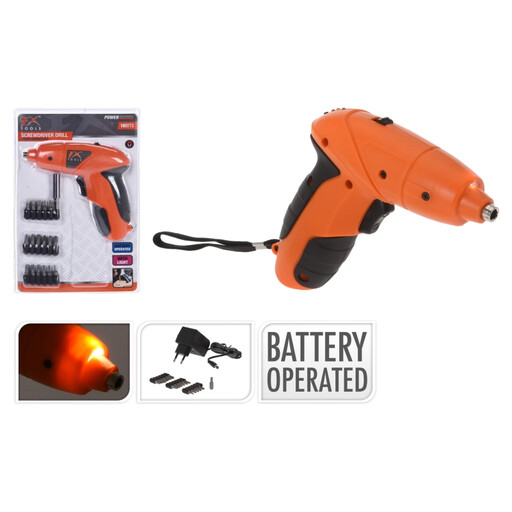
Why this product fits the profile: For occasional furniture assembly, simple repairs and everyday screwing, a compact cordless screwdriver with basic equipment is sufficient. It includes 18 interchangeable bits and a rechargeable battery.
The package contents clearly state the battery and bits are included. The integrated charge indicator shows the battery level, and the LED light helps when working in darker areas.
18 bits, integrated LED light and a rechargeable 600 mAh Ni-MH battery in a lightweight design.
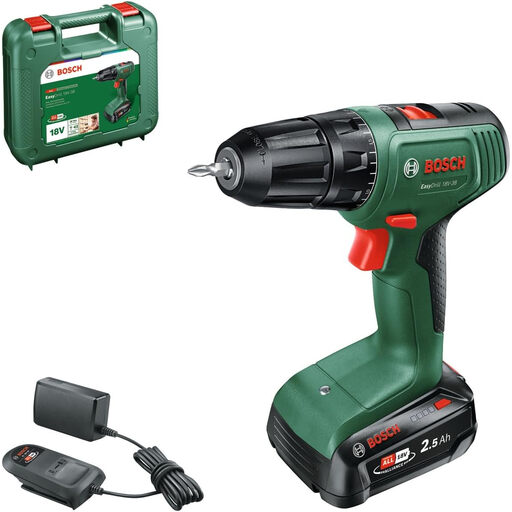
Why this product fits the profile: This cordless drill driver is aimed at users who want a versatile tool for the home, wood, metal and plastic, and who value an established battery system.
The technical specifications list 20 torque settings, two gears and a 1.5 Ah battery. This makes it easier to assess the equipment before buying.
38 Nm, 10 mm keyless chuck, LED work light and compatibility with the 18V POWER FOR ALL system.
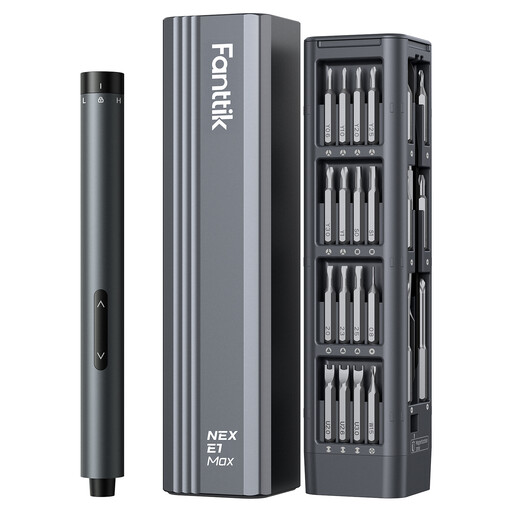
Why this product fits the profile: For electronics, cameras, laptops, watches and small repairs, a mini cordless screwdriver with low torque settings is more suitable than a large cordless drill.
The electric power can be set to 0.05 or 0.2 Nm. This reduces the risk of overtightening delicate screws with too much force.
50 magnetic bits, USB-C charging port, magnetic storage system and additional manual torque up to 3 Nm according to the product specifications.
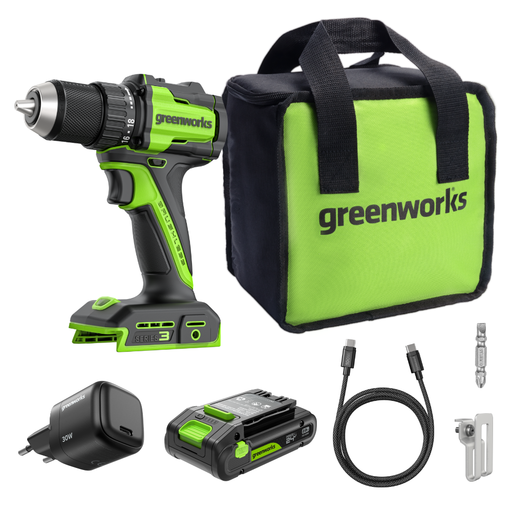
Why this product fits the profile: This model is designed for users with regular screwing and drilling needs, including furniture assembly, woodworking and drilling into steel or masonry.
The product data states torque, speeds, drilling diameters, and that the battery and charger are included. This makes the actual package contents clearer to check.
Brushless motor, 45 Nm, 18+1 settings, LED light, 2 Ah battery and charger included.
We’ve put together a full, regularly updated list of products that fully meet these strict selection criteria and the safety regulations in force in the EU.
For furniture assembly, adjustable torque, forward and reverse, an LED light and a suitable range of bits are important. A compact tool is sufficient for light furniture. For frequent use or larger wood screws, a 12- or 18-volt model with several torque settings and a replaceable battery is more practical.
Run time depends on battery capacity, torque, material and working method. Figures like “number of screws per charge” are always tied to specific screw sizes and conditions. For regular work, replaceable batteries or a second battery are useful. With built-in batteries, the charging port should match your existing charging accessories.
The electricity consumption when charging is usually a small cost factor compared to the purchase price and battery lifespan. More important are a suitable charger, correct storage and replacing a worn-out battery. Lithium-ion batteries should be kept dry, protected from extreme heat and charged according to the manufacturer’s instructions. Damaged batteries must not go in household waste but should be taken to an appropriate collection point.