
Lieferung heute & morgen

Qualitätsgarantie

Willkommens-Angebote freischalten: KOSTENLOSE Lieferung | Bis zu 80 % RABATT | Kostenlose 30-Tage-JoyPlus-Testphase
App herunterladen
A cordless drill driver should drive screws securely, drill clean holes and perform reliably in everyday use. In practice, however, poor purchases often result not from a lack of power, but from unsuitable features. A compact electric screwdriver, for example, is fine for assembling furniture but can quickly reach its limits with larger drilling jobs. Conversely, a powerful cordless screwdriver may be unnecessarily heavy for small repairs.
Before you buy, it's worth watching out for three common pitfalls:
Torque, measured in Newton-metres (Nm), describes the force a cordless screwdriver can apply to drive a screw. For furniture, shelving and light repairs, a low to medium range is often sufficient. For hard materials, long screws or larger drill bits, you'll want more in reserve.
What really counts is the combination of torque and control:
So when choosing a cordless drill driver for DIY, don't just look at the maximum figure. Details on speed, settings and material limits are just as important.
Battery capacity is given in Ah or mAh. For real-world runtime, the voltage also matters. You can roughly work out the stored energy from voltage and capacity. For example, an 18 V battery with 2 Ah offers a different energy reserve to a 12 V battery with 1.5 Ah.
Before you buy, check the following:
A drill driver with battery and charger is usually the simplest option for beginners. If you already have system batteries, a bare tool can be more economical. The Makita DHP489Z, for instance, is sold without a battery or charger, making it aimed at buyers who already use the 18 V LXT system.
A 10 mm or 13 mm keyless chuck determines which drill bits and screwdriver bits you can use. A tool-free chuck makes quick changes much easier. For drilling in wood and metal, a standard cordless drill driver is fine. For masonry, a cordless hammer drill driver with a hammer action can be useful.
Other things to consider include:
A brushless cordless drill driver can, by design, have less motor wear. Even so, you should weigh up the concrete details on torque, battery and warranty conditions more heavily than general marketing claims.
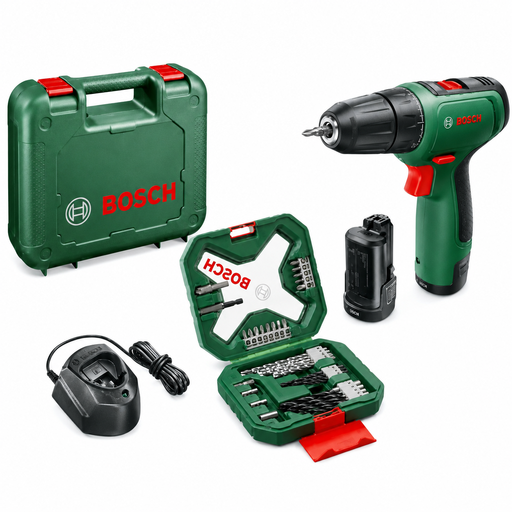
Why this product fits the profile: According to the product details, this 12 V model comes with a 1.5 Ah lithium-ion battery, charger and a 34-piece bit and drill set. That makes getting started with assembly and DIY tasks much easier.
The battery, charger and accessories are explicitly listed as included. That saves you having to hunt for compatible basic components later on.
Compact 12 V design, tool-free chuck system and a 34-piece set for typical household tasks.
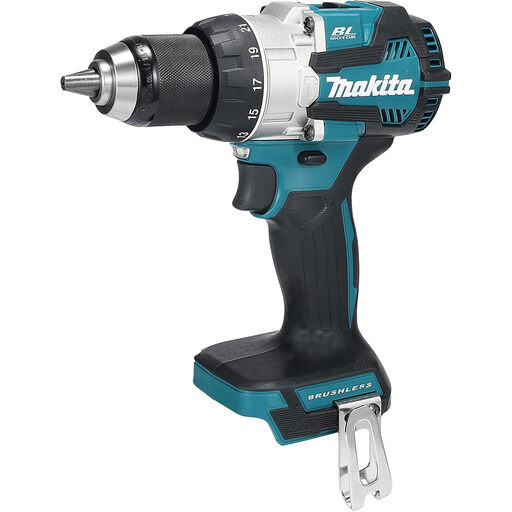
Why this product fits the profile: According to the product description, this model offers 18 V, 73 Nm maximum torque, a 13 mm chuck and a hammer drilling function. It's ideal for users who already own the Makita 18 V LXT battery system.
The voltage, torque, speed and chuck size are all clearly stated. Just bear in mind: the battery and charger are not included.
Brushless motor, two-speed gearbox, LED light and, according to the supplier, XPT protection against dust and water.
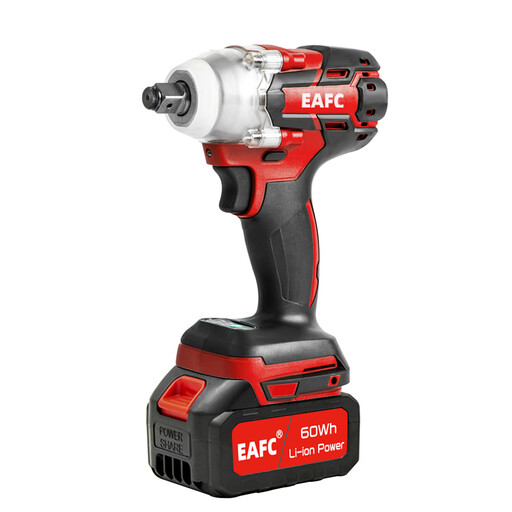
Why this product fits the profile: This electric screwdriver is described as a high-torque impact wrench with 200 Nm, aimed at work on M10 to M24 bolted connections as well as vehicle and tyre jobs.
The product data clearly states the square drive, battery details and forward/reverse control. This is more of a high-torque wrench than a universal drill driver.
200 Nm according to the product specs, brushless motor, LED work light and a 60 Wh lithium-ion battery with USB charging cable.
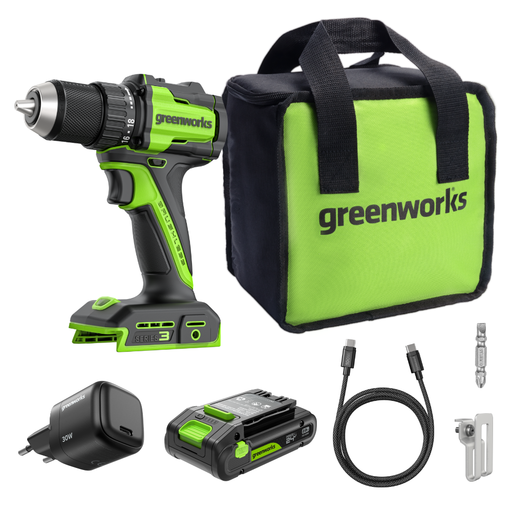
Why this product fits the profile: According to the product data, this tool combines 45 Nm, 18+1 settings, two speed ranges and a 2 Ah battery with charger. It's suitable for furniture, wood, steel and specified masonry work.
The stated drilling limits of 30 mm in wood and 10 mm in steel give you a clear benchmark. The battery and charger are listed as included.
Brushless motor, 0–450 and 0–2,000 rpm, LED light, carry case and compatibility with the Greenworks 24 V system.
We've put together a full, regularly updated list of products that fully meet these strict selection criteria and the safety regulations in force in the EU.
Before drilling, secure the workpiece and make sure the correct bit or drill is firmly clamped in place. Wood, metal and masonry each require different settings. For delicate surfaces, a lower torque setting is advisable. When drilling into mineral materials, you may need safety goggles and ear protection.
Lithium-ion batteries should be charged according to the manufacturer's instructions. Damaged, swollen or unusually hot batteries must not be used. In the UK, dispose of them at designated collection points, not in your household waste. Always remove the battery before changing bits, cleaning or carrying out maintenance.
For assembling furniture, putting up shelves and smaller repairs, a 3.6 V to 12 V tool is often enough. What matters most is a finely adjustable torque clutch, the right bits and an ergonomic handle. For very long or hard screws, a more powerful model may be useful.
Runtime depends on voltage, capacity, material, torque and how you work. A 2 Ah battery offers more energy reserve than a 1.5 Ah battery at the same voltage. A general figure in minutes is only meaningful if the manufacturer describes a specific usage test.
The electricity used for charging is usually negligible compared to the overall cost. What matters more is battery wear, replacement batteries and whether the charger and battery are included in the set. A compatible battery system can make it easier to buy additional tools, but it does lock you into that particular platform.