
Lieferung heute & morgen

Qualitätsgarantie

Willkommens-Angebote freischalten: KOSTENLOSE Lieferung | Bis zu 80 % RABATT | Kostenlose 30-Tage-JoyPlus-Testphase
App herunterladen
A cordless drill driver set can make furniture assembly, repairs and smaller renovation jobs much easier. At the same time, the offers vary considerably when it comes to battery voltage, torque, accessories and charging equipment. A high number on the packaging does not automatically mean the set is right for your needs.
Three common pitfalls frequently lead to poor purchases:
Battery voltage is given in volts. A 12V drill driver is often suitable for shelves, furniture, cabinets and light drilling work. An 18V drill driver typically offers more reserves for larger screws and more demanding drilling tasks. However, voltage alone is not enough as a comparison value.
Also pay attention to the maximum torque in Newton metres (Nm). A higher value can be helpful for larger screws or harder materials. For precise screwdriving, a finely graduated torque limiter is also important. It reduces the risk of damaging screw heads or delicate workpieces.
A two-speed gearbox is practical: the slower gear supports controlled screwdriving, while the faster gear is better suited for drilling. Figures such as 0–430 and 0–1,630 rpm describe the no-load range and not automatically the speed under load.
A tool-free quick-release chuck makes changing between bits and drill bits easier. The clamping range should match your planned uses. A 10 mm chuck is common on compact devices and covers many jobs in wood, plastic and thinner metal.
Check the maximum drilling diameters stated by the manufacturer. For the Bosch EasyDrill 18V-38, for example, up to 30 mm in wood and 10 mm in steel are specified. Such values are reference points for suitable applications; they do not replace choosing the right drill bits and securely fixing the workpiece.
Capacity is given in ampere-hours (Ah). A 1.5 Ah battery is lighter and can be sufficient for short tasks. Two 2.0 Ah batteries are more practical for longer jobs because one battery can be charged while the other is in use.
Check whether the battery and charger are included in the delivery. With a tool case containing a drill driver, the accessories should be sensibly put together: bits, wood and metal drill bits, socket wrenches and an extension can expand the range of use. For regular users, a compatible battery system is also interesting, as one battery can potentially be used with other devices on the same platform.
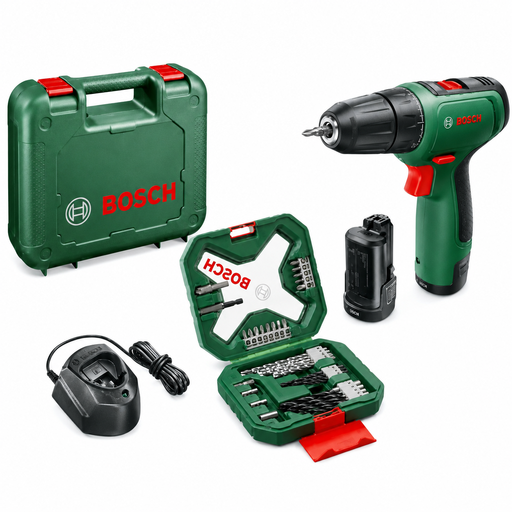
Why this product fits the profile: The compact 12V model with a 1.5 Ah lithium-ion battery and 34 accessories is designed for light DIY tasks and occasional household repairs.
The clearly stated battery voltage, capacity and number of accessories make assessment easier without relying solely on a high piece count.
12V lithium-ion battery, 1.5 Ah, quick-release chuck and a 34-piece bit and drill bit set.
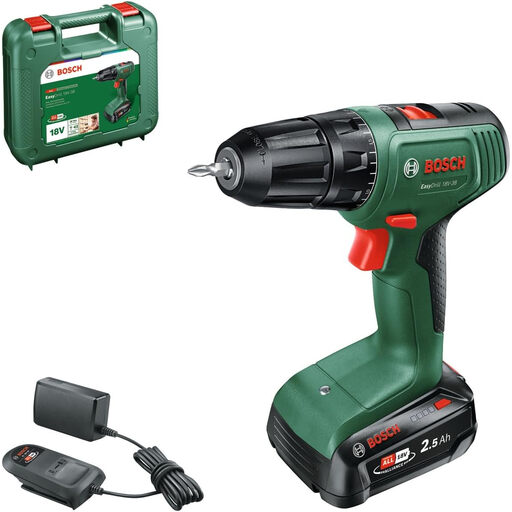
Why this product fits the profile: For homeowners and regular DIY enthusiasts, the 18V device offers defined performance data, two gears and 20 torque settings.
The 38 Nm, 20 torque settings and separate speed ranges make the application limits clearer than a pure voltage figure.
38 Nm, 0–430/1,630 rpm, LED work light, 10 mm quick-release chuck and compatibility with the 18V POWER-FOR-ALL system.
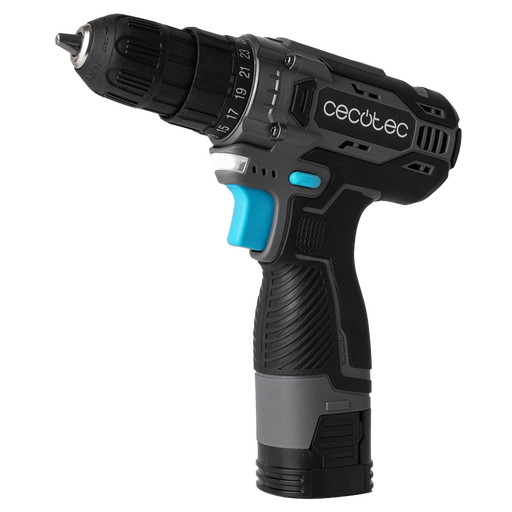
Why this product fits the profile: The kit is aimed at users who need socket wrenches, an extension, and wood and metal drill bits alongside the drill driver.
Two batteries of 2.0 Ah each are specified; this makes it easier to organise work during longer tasks than with just one battery.
38 Nm, up to 1,500 rpm, 25+1 torque settings, LED work light and accessories including bits, socket wrenches, and wood and metal drill bits.
We have put together a complete, regularly updated list of products that fully meet these strict selection criteria and the safety regulations in force in the EU.
Before buying and using for the first time, you should check the instruction manual, the scope of delivery and the information about the charger. For work with a cordless drill, safety goggles and, if there is corresponding noise, suitable ear protection are part of the basic equipment. The workpiece should be securely fixed.
Lithium-ion batteries must not be opened, damaged, heated above 50 °C or disposed of in household waste. Use only the intended charger or a system approved by the manufacturer. Store the battery and device in a dry, frost-free place with clean contacts.
For many furniture assemblies, light screwdriving tasks and small drill holes in wood or plastic, a 12V drill driver can be sufficient. What matters are the available torque, the torque settings and suitable bits. For larger screws or frequent drilling work, a 16V or 18V model may be more sensible.
The runtime depends on battery capacity, material, drill diameter, torque and working method. A 1.5 Ah battery is lighter, while 2.0 Ah offers more energy reserve. An exact runtime cannot be reliably derived from a product specification without standardised working conditions.
For household use, bits in common sizes, wood and metal drill bits, an extension and, if necessary, socket wrench inserts are useful. Check not only the number of pieces, but also their sizes, material suitability and safe storage in the case.