
Lieferung heute & morgen

Qualitätsgarantie

Willkommens-Angebote freischalten: KOSTENLOSE Lieferung | Bis zu 80 % RABATT | Kostenlose 30-Tage-JoyPlus-Testphase
App herunterladen
A cordless drill set can make furniture assembly, repairs and drilling tasks much easier. At the same time, unclear voltage ratings, unsuitable accessories or weak batteries can quickly lead to a poor purchase. What really matters is not the number of bits on the packaging, but the combination of torque, battery capacity, chuck type and the right application.
This buying guide shows what DIY enthusiasts, homeowners, hobby craftspeople and professional users should look for before making a purchase. The technical details for the products featured correspond to the respective product information.
A higher voltage can indicate a greater power range, but on its own it says little about actual suitability. A 12V cordless drill is often compact and handy, while an 18V cordless drill usually offers more reserves for larger drilling diameters or longer use. Torque, gearbox, motor and battery also play a role.
Figures such as “21V” should also be read carefully. What matters is whether the voltage refers to the nominal voltage or a maximum charging voltage. For comparison, you should therefore always consult the full technical specifications.
A tool set for household and DIY with 30, 50 or more pieces sounds versatile. But what really counts is whether the included bits and drill bits match the screw heads and materials you plan to use. A cordless drill with bits should cover at least common Phillips, slotted, Torx and hex profiles. For drilling, the sizes and materials of the wood and metal drill bits are also important.
With a cordless drill set with case, the case should not only store accessories but also provide tidy, secure organisation. Loose parts are more easily lost in everyday use.
The capacity in Ah describes the amount of charge stored, not automatically the actual working time. A 2.0 Ah battery can drain faster in a more powerful cordless drill driver than a smaller device during light screwdriving tasks. What is practically relevant, therefore, is also the charging time, the number of batteries and the availability of a spare battery.
Torque is given in Newton metres (Nm) . It describes the force with which a drill driver can turn a screw. For furniture assembly and light repairs, lower values are often sufficient. For thicker wooden components, larger screws or more demanding work, higher torque reserves are sensible.
Torque settings help you adapt the force to the material. A low setting reduces the risk of damaging screw heads or over-stressing soft materials. The highest setting should not be used permanently for every application.
A keyless chuck allows you to change bits and drill bits without tools. Common sizes are 10 mm or 13 mm. The maximum capacity must match the drill bits you use.
Two speed ranges are practical in everyday use: a low speed supports controlled screwdriving and work with higher torque. A higher speed is more suitable for drilling in appropriate materials. Information on drilling performance should always be considered separately by material, such as wood or metal.
Check whether the battery and charger are included in the delivery and whether the battery is compatible with other tools from the same system. A drill driver with battery is ready to use straight away, whereas so-called bare units can incur additional purchase costs.
Important precautions apply to lithium-ion batteries: do not open, do not damage, do not expose to high heat and only charge with the designated charger. During work, suitable eye protection and, for noisy applications, hearing protection are advisable. An electric screwdriver should not be used in damp areas or near flammable substances.
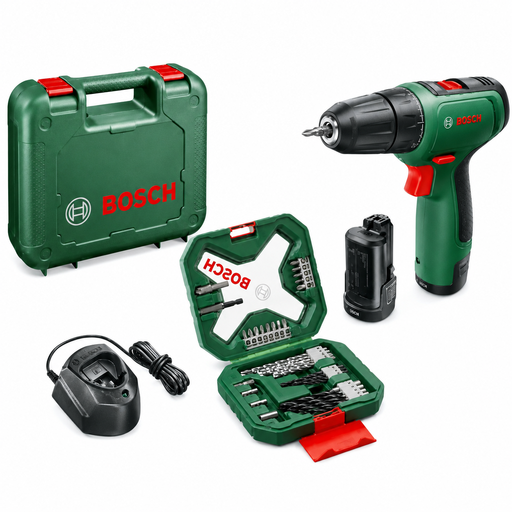
Why this product fits the profile: The compact 12V device with a 1.5 Ah lithium-ion battery is suitable for furniture assembly, smaller drilling tasks and general household repairs.
The 34 accessories and the keyless chuck reduce the need for additional purchases for typical DIY tasks.
12V system, 1.5 Ah battery, adjustable torque and multilingual instructions.
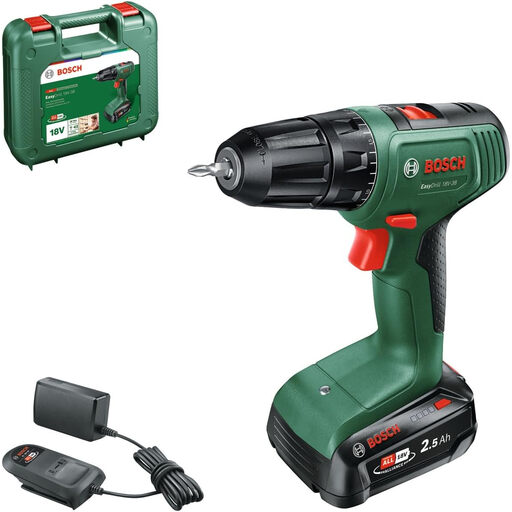
Why this product fits the profile: This cordless drill driver combines 18V, 38 Nm maximum torque, two gears and 20 torque settings for versatile work in wood, metal and plastic.
The clearly stated speed ranges of 0–430 and 0–1,630 rpm make it easier to assign to screwdriving and drilling tasks.
10 mm keyless chuck, LED work light and compatibility with the POWER FOR ALL 18V system.
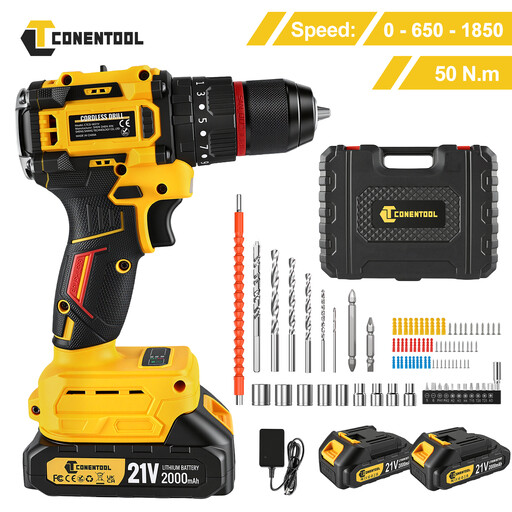
Why this product fits the profile: For frequent work, a brushless motor, three functions, 50 Nm torque, two 21V batteries and extensive accessories are available.
Two batteries can reduce interruptions during work. The three operating modes separate screwdriving, drilling and hammer drilling by application.
0–650/0–1,850 rpm, 25+3 torque settings, LED and 90-piece accessory set.
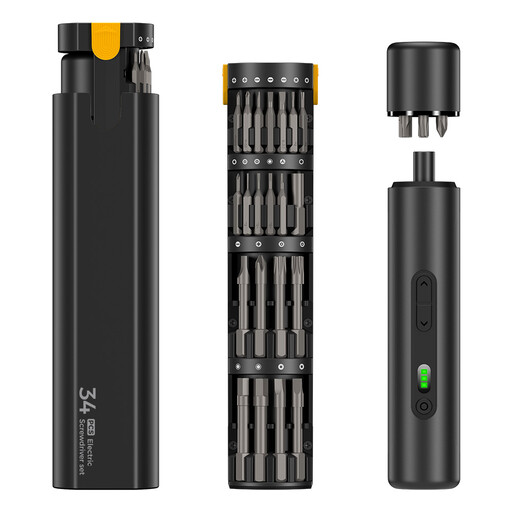
Why this product fits the profile: The 3.7V device with 26 bits is designed for light screwdriving tasks, furniture assembly and smaller repairs where compact dimensions are important.
The torque range of 1.2 to 3 Nm is clearly limited and prevents the device from being mistaken for a more powerful drill driver.
26 bits, magnetic storage case, 1,500 mAh battery and up to 60 minutes of continuous operation according to the product specification.
We have put together a complete, regularly updated list of products that fully meet these strict selection criteria and the safety regulations in force in the EU.
For furniture assembly, a compact 12V cordless drill set or an electric screwdriver with several torque settings is often sufficient. What matters is a finely adjustable torque, a suitable bit set and good handling. For frequent drilling in wood or metal, a cordless drill driver with higher torque offers additional reserves.
The runtime depends on battery capacity, material, torque and working method. A 1.5 Ah battery is designed for lighter tasks, while 2.0 Ah can offer more energy reserves. For longer jobs, a set with two batteries is practical. The actual runtime may differ from the manufacturer's specifications depending on the load.
A cordless hammer drill driver is useful if, in addition to screwdriving and normal drilling, you also occasionally need to drill into masonry. For concrete or continuous heavy construction work, however, a specialist tool designed for that purpose may be necessary. Before buying, check the stated function, drilling performance and suitable drill bits.