
Lieferung heute & morgen

Qualitätsgarantie

Willkommens-Angebote freischalten: KOSTENLOSE Lieferung | Bis zu 80 % RABATT | Kostenlose 30-Tage-JoyPlus-Testphase
App herunterladen
A cordless electric air pump can be a handy addition for your car, bike, campsite or travels. It works without a mains socket and, depending on its design, can fit in your boot, rucksack or glove compartment. However, cordless air pumps vary considerably in pressure, airflow, battery life and ease of use.
If you focus only on claims such as “150 PSI” or “fast inflation”, you could end up buying a pump that isn’t right for your needs. Our selection explains which specifications matter before you buy and which models suit different uses.
PSI indicates the maximum pressure a pump can reach. It tells you little about how quickly it can inflate a car tyre or whether it’s suitable for inflating several tyres in a row. A 150 or 160 PSI model may be designed for bike tyres and balls, while for car tyres the combination of airflow, motor power and permitted operating time is what really matters.
A cordless air pump gives you flexibility, but it needs regular charging. Battery capacity alone isn’t enough to compare models. Charging time, stated operating time and overheating protection are also important. If you want to inflate several car tyres, look for a model with sufficient continuous output or an additional 12-volt power supply.
Automatic shut-off stops the pump when it reaches the pre-set target pressure. This reduces the risk of accidentally overinflating a tyre, but you should still keep an eye on the display and check that the valve connection is secure. Readings can also vary. Always follow the vehicle or bike manufacturer’s recommended tyre pressure.
For bike tyres, balls and smaller inflatables, a compact electric bike pump is often enough. Car tyres, on the other hand, need greater airflow and a robust motor. Airflow is usually given in L/min, or for smaller devices in L/min or L/MIN. A high maximum pressure and a high airflow are two different things.
A 150 PSI air pump can be versatile, but many cars need a much lower tyre pressure. What matters is whether the pump can reliably reach the recommended pressure and how long it takes.
A digital tyre inflator should clearly show both the current and pre-set pressure. Multiple units, such as PSI, BAR and kPa, are useful, as vehicle manufacturers in Germany often specify pressure in bar. A clear display is especially handy in the dark or in direct sunlight.
Before you start, set the target pressure according to the manufacturer’s recommendations. Check car tyre pressure when the tyres are cold wherever possible, as heat can affect the reading.
Look out for:
The CE marking is relevant for the European market, but it isn’t a quality mark for pressure accuracy, speed or durability. Also check whether the product comes with a German-language instruction manual and clear manufacturer or importer details.
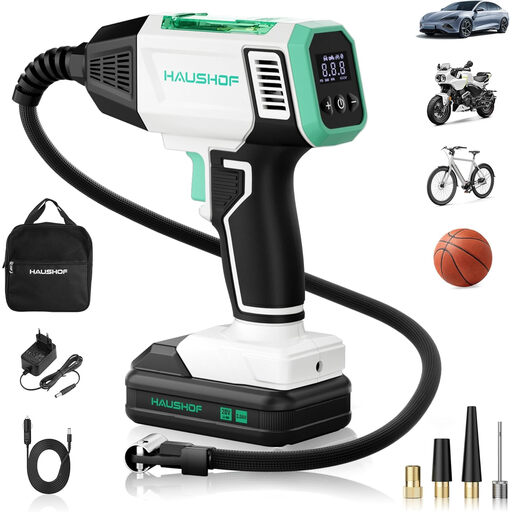
Why this product suits this use: The pump combines cordless operation with a 12-volt cable, making it a good choice for occasional trips, camping and inflating a range of items.
The extra cable option reduces reliance on battery life during longer sessions.
150 PSI, 22 L/min, four pre-set modes, manual adjustment and a digital display.
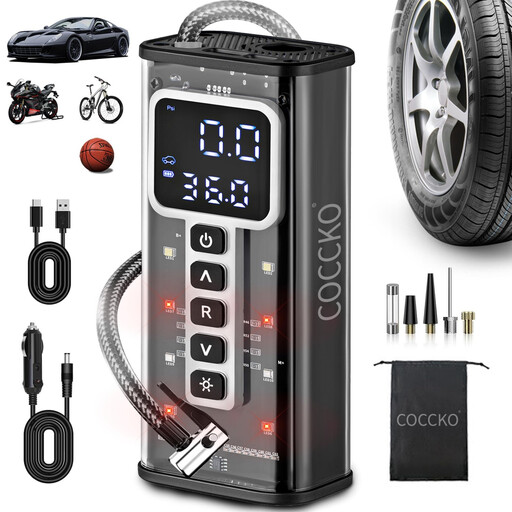
Why this product suits this use: With a 6000-mAh battery, LCD display and five operating modes, this model is designed for anyone who wants one device for their car, motorbike, bike and balls.
The display shows both the current and target pressure, while automatic shut-off stops pumping once the pre-set pressure is reached.
Maximum pressure of 10,3 bar, 35 L/min, a 3-m cable and three LED modes. According to the product specifications, it takes about a minute to inflate a 215/55-R17 tyre to 33 PSI.

Why this product suits this use: This portable compressor is a good option for anyone who regularly switches between cars, SUVs, bikes and balls, and needs a high-pressure rating.
Its stated 100% continuous operation addresses a limitation of many small battery-powered devices. You should still follow the instructions to check that it’s suitable for your needs.
160 PSI, 132 W maximum power, weighs 1,47 kg and comes with adapters for Presta valves, balls and tapered nozzles.

Why this product suits this use: This model is specifically designed for bikes, making it a good fit for road, mountain and e-bike riders who want to travel light.
The product information clearly states that it’s for bike use only, helping you avoid choosing it for car tyres.
150 PSI, 5000-mAh battery, Presta and Schrader valves, automatic shut-off and a stated run time of up to 25 minutes.
We’ve put together a complete, regularly updated list of products that meet these strict selection criteria and fully comply with the safety regulations in force in the EU.
Run time depends on battery capacity, tyre pressure, temperature and how hard the pump is working. Smaller devices are often designed for topping up pressure or inflating bike tyres, while larger models can handle several uses. As well as battery capacity, check the stated charging time and how long the pump can operate continuously.
Yes, if the model is designed for this purpose. Check that it’s specifically stated as suitable for car tyres, and look at its airflow, maximum pressure and whether it has a 12-volt cable. Models designed exclusively for bikes shouldn’t be used to inflate car tyres.
The electricity used for charging is usually modest relative to how often you use the pump. Running costs depend on how often you charge it, battery capacity and your electricity tariff. Battery life, the availability of spare parts and proper storage are more important factors in the overall cost.