
Lieferung heute & morgen

Qualitätsgarantie

Willkommens-Angebote freischalten: KOSTENLOSE Lieferung | Bis zu 80 % RABATT | Kostenlose 30-Tage-JoyPlus-Testphase
App herunterladen
A powerful cordless impact wrench can make seasonal tyre changes or demanding assembly jobs significantly easier. However, the market is flooded with technical specs and marketing promises that complicate the selection process. False assumptions about torque or battery compatibility can quickly lead to a purchase you'll regret. As your Joybuy Product Recommendation Officer, I'll help you identify the critical features and find a tool that truly meets your needs.
Before we dive into the technical details, let's clear up three common misconceptions that often lead to disappointment.
To make the right purchasing decision, focus on the following three core technical aspects.
Torque, measured in Newton-metres (Nm), is the critical metric for an impact wrench's performance.
Most high-performance models operate on an 18V impact wrench battery system. This voltage offers a good balance of power and handling.
The tool anvil is the interface between the impact wrench and the socket. The most common standard is the 1/2-inch square drive. This size offers broad compatibility with most standard socket sets for automotive and industrial use.
Here are some recommendations tailored to different user profiles that take the previously mentioned pitfalls into account.
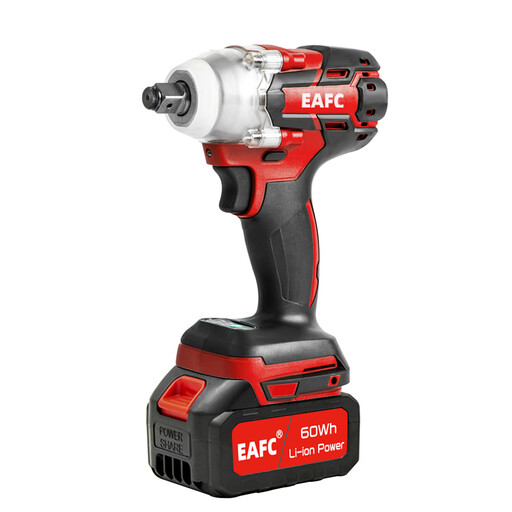
Why This Fits Their Persona: Ideal for seasonal tyre changes and light-duty fastening jobs around the house. This model is supplied as a complete set with a battery and charging cable, so there are no hidden follow-up costs.
The 200 Nm of torque is realistically rated for passenger car tyre changes and doesn't create false expectations. As a complete kit, it bypasses the battery cost trap.
Brushless motor for a longer service life. Its low weight and compact design make it easy to handle.
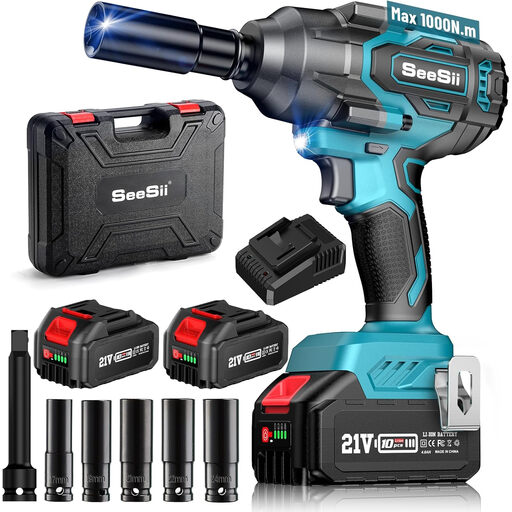
Why This Fits Their Persona: For DIYers who regularly work on their cars and need to loosen stubborn bolts on suspension or engine components. The high torque provides plenty of reserve power for demanding tasks.
The set includes two 4.0 Ah batteries and a fast charger, enabling uninterrupted work. The torque figures are transparently stated with 1000 Nm of loosening and 800 Nm of tightening torque.
Comprehensive accessory kit with five sockets and a carrying case. Three speed settings for precise power control.
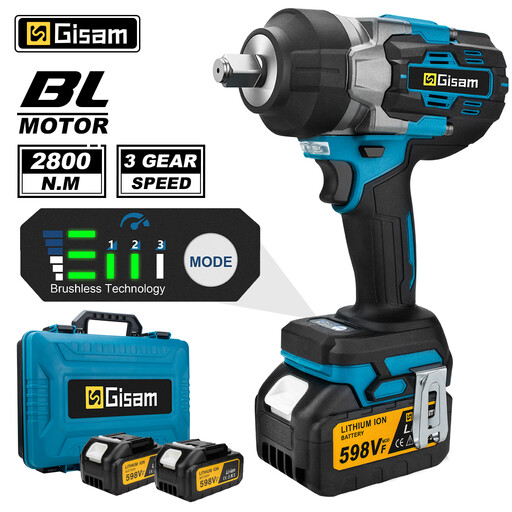
Why This Fits Their Persona: Designed for professional users in workshops or on construction sites who need maximum power for truck tyres or heavy steel construction. Compatibility with Makita 18V batteries is a crucial advantage for pros who have already invested in this system.
It directly addresses the need for battery compatibility, thus avoiding expensive duplicate purchases. The extremely high torque of 2800 Nm is designed for heavy-duty applications and is not just a marketing figure.
Compatible with common Makita 18V B-series lithium-ion batteries. Multiple speed and torque settings, including a reverse auto-stop function for controlled operation.
We've compiled a complete, up-to-date list of products that fully meet these strict selection criteria and local safety regulations.
For changing tyres on a standard passenger car, a tightening torque of 120 Nm to 180 Nm is usually sufficient. An impact wrench with a maximum tightening torque of 200 Nm already offers enough reserve power. It is crucial to always check and final-tighten the wheel nuts with a calibrated torque wrench to the manufacturer-specified torque setting after using the impact wrench.
In most cases, batteries are not cross-brand compatible. Each manufacturer uses its own battery system with a proprietary design and electronics. However, some third-party manufacturers offer models that are explicitly advertised as compatible with the battery systems of major brands like Makita. Pay close attention to the product description, which lists the compatible battery series (e.g., Makita 18V LXT B-series).
A cordless impact wrench is specialised for generating high torque to loosen and tighten bolts and nuts. It has a 1/2-inch square drive for sockets. A hammer drill driver is a combination tool for driving screws and drilling, including into hard materials like masonry. It uses a chuck to hold drill bits and driver bits and produces axial impacts (along the drilling axis), whereas an impact wrench produces tangential (rotational) impacts. For changing tyres, only an impact wrench is suitable.