
Lieferung heute & morgen

Qualitätsgarantie
App herunterladen
Kategorien
Selecting a cordless impact wrench requires an analysis of technical parameters tailored to the specific application. Factors like torque, motor design, and battery capacity are crucial for the tool's efficiency and performance in heavy-duty fastening tasks, particularly for tire changing or industrial assembly. This article highlights the essential criteria for an objective evaluation and presents a selection of models with varying performance profiles.
The performance of an electric impact wrench is determined by the interplay of several technical components. An informed decision requires careful consideration of the following specifications.
Torque, measured in Newton-metres (Nm), is the key metric for an impact wrench's power. A distinction is made between tightening torque and loosening torque (also known as nut-busting torque). In practice, loosening torque is often more critical, as it defines the force available to break free stubborn or corroded fasteners. For changing tires on a passenger car, values starting from 400 Nm are generally sufficient. For commercial vehicles, agricultural machinery, or industrial applications, a significantly high torque of 1000 Nm or more is required.
Modern professional cordless impact wrenches are predominantly equipped with a brushless motor. This technology offers several physical advantages over traditional brushed motors:
The battery system is the heart of any cordless tool. Voltage (V) is an indicator of the device's fundamental power class, with 18V or 21V systems being common. Capacity (Ah) indicates how long the battery can deliver energy under load before needing a recharge. For professional and time-intensive applications, a capacity of 4.0 Ah or more is recommended. The inclusion of a second battery is also advisable to minimise downtime.
The anvil determines which sockets can be used with the impact wrench. In the automotive sector, the 1/2-inch impact wrench with a square drive has become the standard. This size offers high stability and is compatible with most common socket sets for lug nuts and other high-stress fasteners.
Based on the technical criteria above, we present three models suited for different requirement profiles due to their specifications.
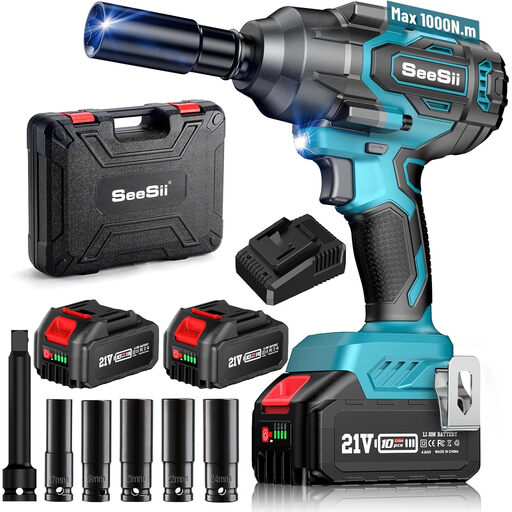
Why we recommend this product: This model offers a balanced combination of power, features, and material quality. With 1000 Nm of loosening torque, it is well-equipped for demanding tasks in the automotive sector, including on light commercial vehicles. Its construction, featuring a tungsten steel anvil and an ABS plastic housing, is designed for high durability in daily workshop use. The tool is delivered as a complete cordless impact wrench kit, making it ready to use out of the box.
Pros:
Who it's for: This kit is suitable for ambitious DIY mechanics and professional users in automotive workshops who need a reliable and versatile tool for daily tire changes and repair work.
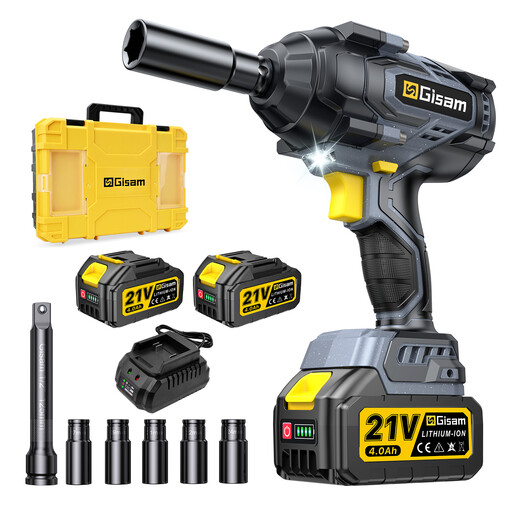
Why we recommend this product: The GISAM impact wrench is designed for maximum power delivery. With 1800 Nm of torque and a high speed of up to 4000 RPM, it targets users who regularly work on heavy vehicles like trucks or in industrial assembly. The four-speed setting allows for precise control despite the immense power. Its independence from a compressed air supply makes it a flexible alternative to pneumatic impact wrenches.
Pros:
Who it's for: This model is primarily designed for professional use in truck repair shops, heavy commercial vehicle tire services, the construction sector, and industry where maximum breaking torque is required.
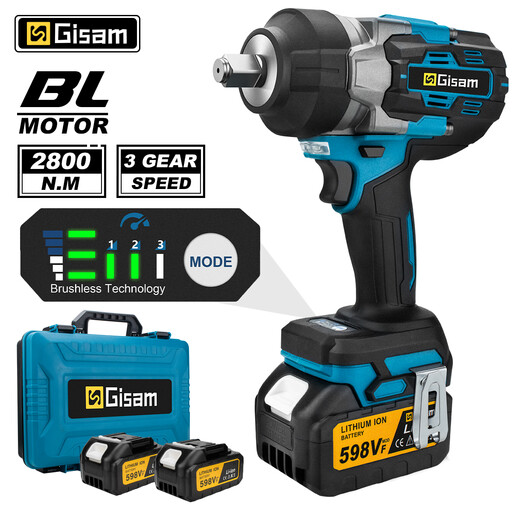
Why we recommend this product: With a maximum torque of 2800 N.M, this tool represents the pinnacle of the performance range. Its key feature is compatibility with the popular Makita 18V LXT battery system (e.g., BL1850B, BL1840B). Users who have already invested in this battery ecosystem can integrate the tool into their collection without buying additional batteries and chargers. The brushless motor and robust construction are designed for extreme loads.
Pros:
Who it's for: Professional users in heavy industry, steel construction, agricultural engineering, or the construction sector who already use Makita 18V batteries and require a cordless solution with maximum power.
If the models presented don't exactly meet your requirements, you can find a broader selection of tools with different performance specs and features in our main category. There, you can filter specifically for other specifications. Discover our entire range of cordless drivers.
1. How much torque does a cordless impact wrench need for changing tires? For a standard passenger car, lug nuts are typically tightened to 110-150 Nm. To reliably loosen them, especially after a long time or in case of corrosion, a loosening torque of at least 300-400 Nm is recommended. For SUVs and light trucks, 500 Nm or more is a safe bet.
2. What is the advantage of a brushless motor in an impact wrench? A brushless motor operates without the physical contact of carbon brushes, which eliminates friction and wear within the motor. This results in higher energy efficiency (longer battery runtime per charge), a longer tool lifespan, and less heat generation during intensive use.