
Lieferung heute & morgen

Qualitätsgarantie

Willkommens-Angebote freischalten: KOSTENLOSE Lieferung | Bis zu 80 % RABATT | Kostenlose 30-Tage-JoyPlus-Testphase
App herunterladen
A cordless impact wrench can loosen wheel nuts, speed up assembly work and reach awkward spots without a power cable. However, models vary considerably in torque, drive type, battery system and what’s included in the box. So a high figure on the packaging alone tells you little about whether a tool is right for your vehicle or workshop.
If you’re looking to buy a cordless impact wrench, there are three common pitfalls to avoid:
Torque is measured in newton metres, or Nm for short. A high-torque impact wrench can make it easier to loosen stubborn fasteners. But always consider the figure alongside other details:
For car wheel nuts, a 200 Nm tool may be enough, depending on how tightly they’re fastened. Vans, lorries, construction work or heavily corroded fixings may call for more power in reserve. That doesn’t mean a more powerful tool is automatically right for every job.
An impact wrench is no substitute for a calibrated torque wrench. After starting and tightening wheel bolts with the tool, check them using the torque specified by the vehicle manufacturer. An electric torque wrench is an alternative only if it’s specifically designed for accurate torque measurement and the intended application.
A 1/2-inch square drive with a 12.7 mm fitting is standard for working on car wheels. It takes compatible impact-rated sockets. Don’t use ordinary chrome vanadium sockets unless they’re approved for use with impact wrenches.
A 1/4-inch hex drive, as found on the Makita TW060DZ, is designed for bits and compact screwdriving jobs. According to the product description, this model has 60 Nm of torque, an LED work light and a 12-volt CXT battery connection. It’s therefore better suited as a compact impact driver than as a conventional impact wrench for car wheels.
If you’re buying an impact wrench with a battery and charger, check the contents carefully. Important details include:
A brushless motor is designed to operate without carbon brushes. However, claims such as “longer service life” or “more power” should be treated as manufacturer claims, rather than assumed to apply to every use.
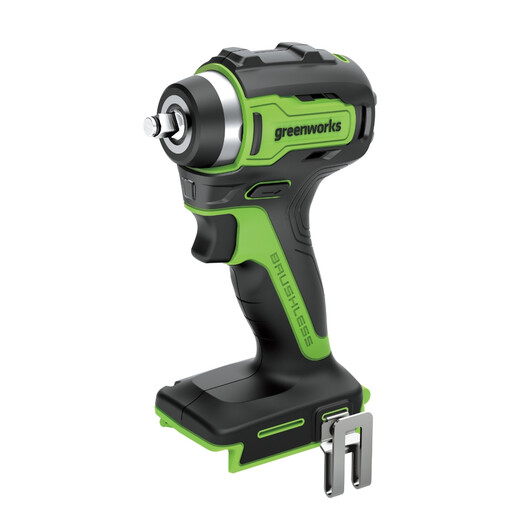
Why it suits this type of buyer: This model is aimed at people who already use the Greenworks 24-volt battery system and want a compact tool for DIY, construction or occasional vehicle maintenance.
The product description clearly states that the battery and charger aren’t included. This makes it easier to work out the full cost before you buy.
According to the product description: brushless motor, 200 Nm, 1/2-inch square drive, LED work light and a weight of 0.95 kg.
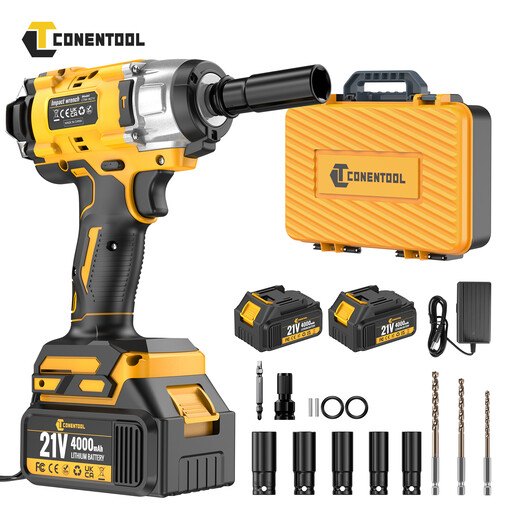
Why it suits this type of buyer: This kit is worth considering if you want a 1/2-inch drive, several sockets and a complete portable set-up for the garage, assembly jobs and vehicle maintenance.
The kit includes a battery, charger, five sockets, an adapter and a storage bag. That makes it easier to see what you’re getting than with a bare tool.
According to the product description: up to 800 Nm, three speed settings, a 21 V 4.0 Ah battery and five sockets ranging from 17 to 24 mm.
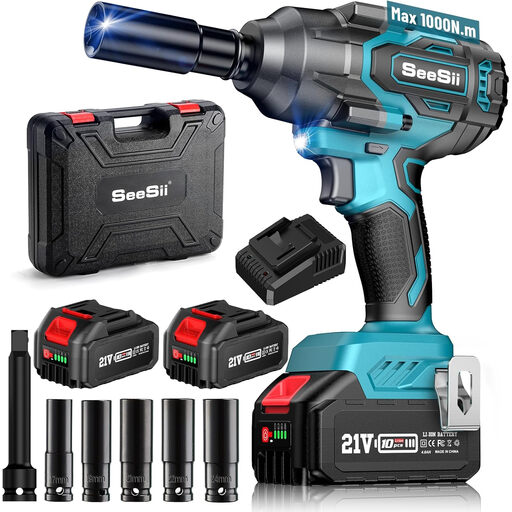
Why it suits this type of buyer: Two batteries and a 1/2-inch drive make this kit a good option for frequent work on vehicles, building sites, scaffolding or larger fasteners.
The specs distinguish between 1000 Nm of loosening torque and 800 Nm of tightening torque. This helps prevent the maximum figure from being taken at face value.
According to the product description: two 21 V batteries, each with a capacity of 4.0 Ah, three settings, a fast charger, five sockets and an extension bar.
We’ve put together a comprehensive, regularly updated list of products that meet these strict selection criteria and fully comply with the safety regulations in force in the EU.
Before use, check the sockets, square drive and battery for damage. Wear safety glasses and ear protection, remove the battery before changing accessories and only use the tool in dry conditions. When working on wheels, we recommend using a suitable torque wrench for the final tightening.
Ongoing costs depend mainly on the battery system. If you already own compatible batteries, a bare tool can save you money. If you’re buying into a new system, factor in the battery, charger and, if needed, spare batteries. Having two batteries reduces downtime while one is charging, especially if you use the tool frequently.
It can quickly start and snug up wheel nuts. However, you should finish tightening them to the specified torque using a suitable torque wrench. The tool’s maximum rating isn’t an automatic torque setting for every vehicle.
Runtime depends on battery capacity, torque setting, material, temperature and how long you use the tool at a time. A 4.0 Ah battery generally offers more energy in reserve than a smaller battery at the same voltage. It’s not possible to give a reliable estimate of working time without standardised conditions.
The drive determines which sockets you need: a 1/2-inch square drive takes compatible 1/2-inch impact sockets. With a 1/4-inch hex drive, use suitable bits or adapters. Also check the socket size, such as 17, 19, 21 or 24 mm, and only use accessories designed for impact use.