
Lieferung heute & morgen

Qualitätsgarantie

Willkommens-Angebote freischalten: KOSTENLOSE Lieferung | Bis zu 80 % RABATT | Kostenlose 30-Tage-JoyPlus-Testphase
App herunterladen
A cordless LED table lamp with a battery is ideal for many situations: as a bedside lamp in the bedroom, a decorative light source in the living room, a table lamp for the patio, or as portable lighting when camping. Going without a mains cable gives you flexibility, but it also brings a few selection criteria to consider.
Not every battery-powered table lamp is suitable for every use. A short battery life, an unsuitable protection rating, or awkward controls can limit its usefulness after a short time. The following points will help you distinguish marketing claims from relevant product features.
A figure like "4,000 mAh" sounds impressive at first. However, it doesn't tell you on its own how long the lamp will actually shine. Brightness level, LED power, and control all affect run time too. More meaningful are concrete figures such as "up to 80 hours at the lowest brightness setting".
For everyday use, you should also check how long recharging takes and whether a suitable charging cable is included. A rechargeable table lamp with USB-C can often be conveniently charged using existing power adapters, power banks, or laptop ports.
An outdoor table lamp needs an appropriate IP rating. With IP44, the housing is protected against solid objects larger than 1 mm and against splashing water from any direction. This does not mean the lamp is fully waterproof or that it can be left out in the rain permanently.
For balconies, gardens, and patios, it's therefore important to follow the manufacturer's instructions. A sheltered spot under a roof is usually more sensible than an unprotected position in heavy rain.
Some dimmable table lamps only offer two or four fixed brightness levels. That may be enough for general room lighting, but it's less flexible than a stepless adjustment. The controls also differ: touch control, rotary knob, or push button each have their own pros and cons.
A touch table lamp responds quickly and doesn't need a protruding switch. However, a rotary dial can be more practical with damp fingers or outdoors. Before buying, you should also check whether the lamp remembers the last setting you chose.
Brightness is often given in lumens. For decorative lighting on the dining table or patio, moderate values are often sufficient. If the portable LED lamp is also to be used for reading or working, a higher light output and suitable light distribution are relevant.
Colour temperature is given in Kelvin:
Models with multiple colour temperatures, for example 3,000 K, 4,000 K, and 5,000 K, can be better adapted to different activities.
Pay attention to the run time at the brightness you actually want. A figure given for the lowest setting is not the same as the maximum operating time at full brightness. For occasional evening meals, a compact battery may be enough. For camping, long garden evenings, or daily use, a larger capacity makes sense.
A USB-C port makes powering the lamp easier. Nevertheless, check whether the charging cable is included and what charging time the supplier states. Built-in batteries must not be opened or replaced by yourself.
A non-slip base reduces the risk of the lamp sliding on smooth table surfaces. A heavy base can be useful in the dining room or on the balcony, while a carry handle makes mobile use easier.
For outdoor use, you should consider the stated IP rating. A lamp without a declared protection rating should not be used on the patio or in the garden. Even with IP44, remember: do not submerge, do not leave it exposed to the weather unprotected for long periods, and follow the care instructions.
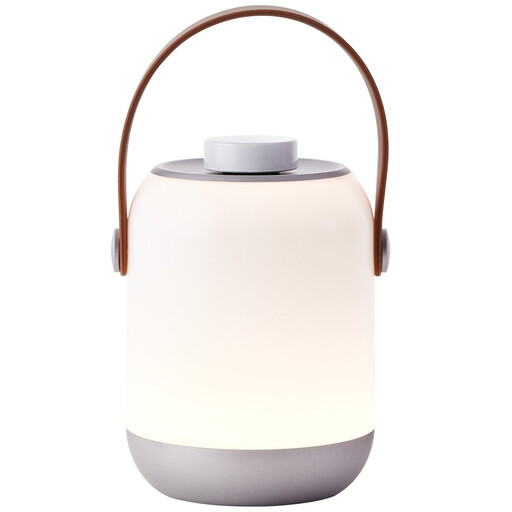
Why this product suits the profile: This compact battery-powered table lamp offers 200 lumens, warm white light at 3,000 K, and a dimmable function for simple everyday situations indoors and outdoors.
The technical specifications clearly state brightness, colour temperature, dimming function, and IP44 protection rating. This makes it easier to assess the intended use.
200 lumens, 3,000 K, dimmable, compact dimensions, and rechargeable battery.

Why this product suits the profile: This lamp combines touch control, three colour temperatures, and a flexible lamp neck. It is suitable for a desk, bedside table, and indoor spaces.
The colour temperatures of 3,000 K, 4,000 K, and 5,000 K are clearly stated. This makes it easier to choose between warm and more neutral light.
400 lumens, three colour temperatures, touch dimming, flexible neck, and 2 x 1,800 mAh battery capacity.

Why this product suits the profile: With 4,000 mAh, a carry handle, and IP44 protection, this lamp is suitable according to the product details for the patio, camping, dining table, and bedroom.
The protection rating is stated as IP44 and should therefore be understood as splash-proof, not as permission to submerge. The run time is given for the lowest brightness level.
4,000 mAh battery, up to 80 hours at lowest brightness, four touch levels, and 360-degree light output.
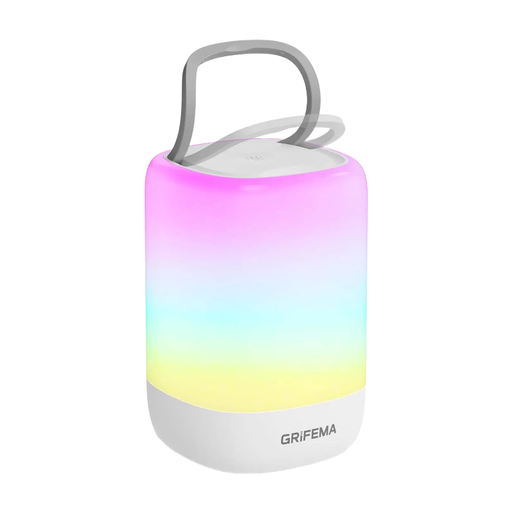
Why this product suits the profile: This compact lamp offers warm white light, seven RGB colours, a timer, and USB-C charging. This makes it suitable for a child's room, bedroom, and mobile use.
The battery life is stated as up to 15 hours, rather than just promising a vague "long run time". There is no information about an IP rating for outdoor areas; it should only be used there in a sheltered spot.
USB-C port, 1,500 mAh lithium-ion battery, stepless dimming from 5 to 100 per cent, and 30-minute timer.
We have put together a complete, regularly updated list of products that fully meet these strict selection criteria and the safety regulations in force in the EU.
That depends on the battery capacity, brightness level, and LED power. Product specifications often refer to the lowest brightness setting. A lamp with 4,000 mAh can, according to the supplier, shine significantly longer at low brightness than at maximum power. For a realistic comparison, you should always consider the run time and the corresponding brightness level together.
That depends on the IP rating. With IP44, there is protection against splashing water, but not against submersion. An LED table lamp for the patio or balcony should additionally be placed under a roof or in a sheltered spot. Models without a declared IP classification are intended primarily for dry indoor spaces.
LEDs require comparatively little electrical power during operation. The running costs depend on the wattage, charging frequency, and electricity tariff. A lamp with 2 to 4 watts only uses a limited amount of energy per charging cycle. For a precise estimate, you can multiply the stated power by the daily usage time.