
Lieferung heute & morgen

Qualitätsgarantie

Willkommens-Angebote freischalten: KOSTENLOSE Lieferung | Bis zu 80 % RABATT | Kostenlose 30-Tage-JoyPlus-Testphase
App herunterladen
A high-quality cordless polisher can be the difference between a dull, scratched finish and a mirror-smooth surface. But the market is flooded with tools whose marketing promises often shine brighter than the results they deliver. As a Joybuy Product Recommendation Officer, I'll help you identify the crucial features and avoid common purchasing traps. This will enable you to make an informed decision for your projects, whether it's car detailing or furniture restoration.
Many well-intentioned purchases end in frustration because essential details were overlooked. Pay close attention to these three points to avoid disappointment:
To make the right choice, let technical specifications—not marketing slogans—be your guide. Here are the three most important criteria to check before you buy.
The voltage, specified in volts (V), is an indicator of the motor's fundamental power. A 12V polisher offers a good balance of power, weight, and handling, making it ideal for home use. Even more important, however, is the battery capacity, measured in amp-hours (Ah). It determines how long you can work on a single charge. A value of 2.0 Ah is a solid standard for most projects. Models that include two batteries enable a seamless workflow without long, forced breaks.
Variable or multi-step speed control is essential. Different tasks require different speeds: low speeds for applying wax, medium for high-gloss polishing, and higher speeds for removing scratches. With an orbital polisher, the orbit size is also crucial. It describes the size of the polishing pad's oscillating movement. A larger orbit (e.g., 15 mm) ensures faster correction on large surfaces, while a smaller orbit (e.g., 3–8 mm) offers more control on small or curved surfaces.
Whether you're looking for a polisher for cars or a polisher for furniture, you'll be holding the tool for extended periods. A low weight (ideally under 1 kg without the battery) and an ergonomic design are critical for working precisely and without fatigue. Also, pay attention to the included backing plates. A combination of a larger plate (approx. 75–80 mm) for flat areas and a smaller one (approx. 50 mm) for hard-to-reach spots makes a mini polisher especially versatile.
Based on the objective criteria above, we have identified a few models that are well-suited for specific user profiles.
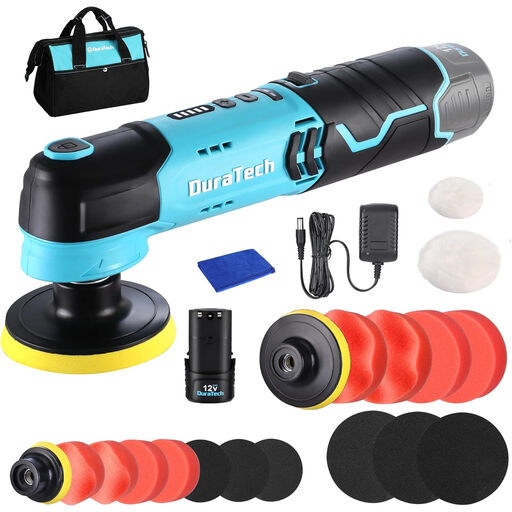
Why This Fits Their Persona: Ideal for users who need maximum flexibility for complex shapes. Perfect for detailed car care on bumpers and pillars, as well as for restoring furniture with many corners and edges.
Avoids the accessory trap with a comprehensive kit featuring two backing plate sizes (50 mm and 80 mm) and various polishing pads. The 5-speed control minimises the risk of paint damage.
High Versatility: Two backing plates for large surfaces and tight spots. Lightweight: At only 810 g, the tool is very manageable and allows for precise work without causing fatigue quickly.
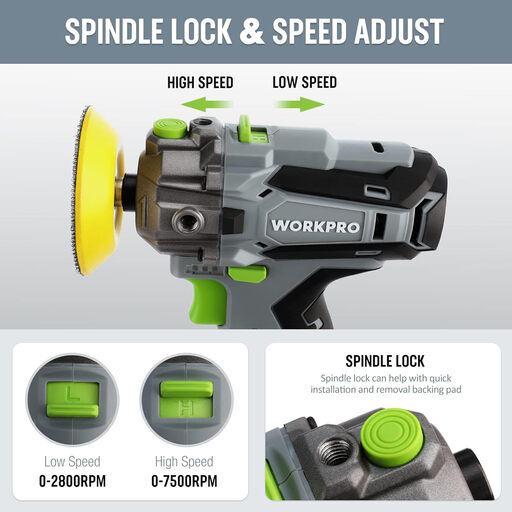
Why This Fits Their Persona: Designed for users who tackle larger projects and value uninterrupted work. Ideal for full vehicle detailing or polishing larger wood and metal surfaces.
Effectively solves the battery trap: Two 2.0 Ah batteries and a 1-hour fast charger ensure near-continuous operation and prevent long waiting times.
High Efficiency: The high speed of up to 7500 RPM and two speed settings allow for rapid work progress. Minimal Downtime: Thanks to the two batteries and fast charger, a charged battery is always ready to go.
All tools featured here are designed for use in Germany and use an EU plug. We have compiled a full list of products that meet strict selection criteria and safety regulations.
A battery's runtime depends on its capacity (in Ah) and the selected speed. A standard 2.0 Ah battery typically allows for about 30 to 45 minutes of continuous work. For larger projects like polishing an entire car, a model with a second battery included is highly recommended to bridge charging times.
The risk of damage is significantly lower with an orbital polisher than with a purely rotary machine. The eccentric motion generates less focused heat, which greatly reduces the risk of "holograms" or a burnt clear coat. As a safe practice for beginners, it's best to start on an inconspicuous area with a low speed and a soft polishing pad.
A combination of different sizes is ideal. A larger plate with a diameter of 80 mm to 125 mm is well-suited for large, flat surfaces like the roof, bonnet, or doors. For tighter, more complex areas such as bumpers, A-pillars, or around the side mirrors, a mini polisher with a smaller plate (50 mm to 75 mm) is essential to work on all spots with precision.