
Lieferung heute & morgen

Qualitätsgarantie

Willkommens-Angebote freischalten: KOSTENLOSE Lieferung | Bis zu 80 % RABATT | Kostenlose 30-Tage-JoyPlus-Testphase
App herunterladen
A glossy, flawless finish is the goal for many vehicle owners. A cordless polisher promises maximum flexibility to achieve this goal without restrictive cords. However, the market is flooded with options whose marketing claims often obscure more than they clarify. Before you make a decision, it's crucial to understand the common pitfalls that can lead to unsatisfactory results or unnecessary expenses.
This guide will help you understand the key technical features and make an informed choice for your paint care needs.
The selection can quickly become overwhelming. Many devices advertise impressive specs, but not all are relevant in practice. Pay close attention to these three points to avoid a bad purchase:
To find the right cordless polisher for your needs, you should understand three core parameters. These determine how well the device is suited for tasks like car polishing, waxing, or removing scratches.
The movement of the polishing plate is the most important distinguishing feature.
The freedom of a cordless polisher depends directly on its power system.
These two factors determine which areas of the vehicle the polisher is best suited for.
Based on the criteria above, we have identified several models suitable for different needs and experience levels.
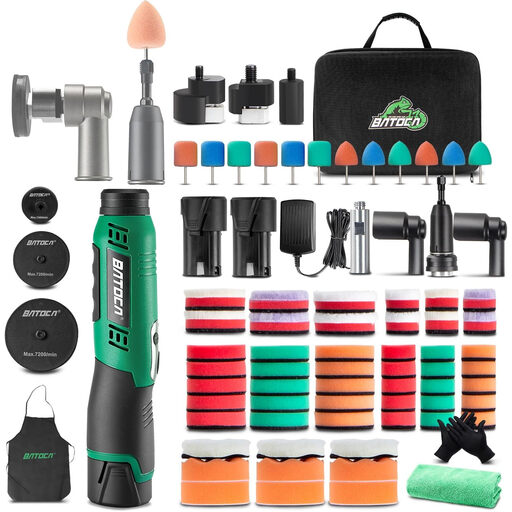
Why This Fits Their Persona: Ideal for users who demand the highest precision for detail work. This tool can tackle complex areas like emblems, door handles, wheels, and trim pieces that are inaccessible to larger machines.
Sidesteps the trap of incomplete accessories. The set includes multiple backing plates (25mm, 50mm, 75mm), extensions, and different orbital drives (3mm + 12mm), eliminating the need to buy extra parts for detail work.
The switchable dual-action system (rotary and orbital) offers maximum flexibility for various correction and finishing tasks in a single, compact device.
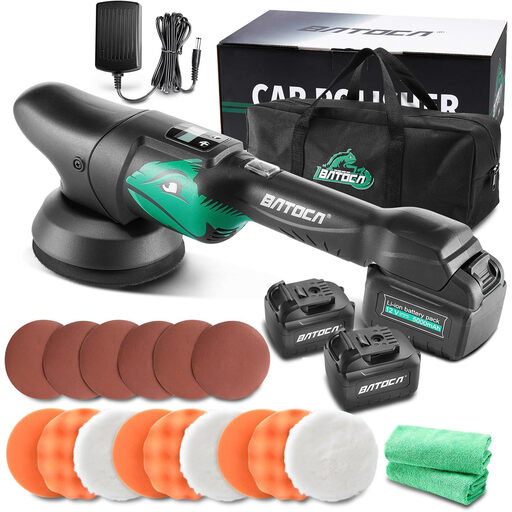
Why This Fits Their Persona: Perfect for users seeking a reliable and easy-to-use machine for regular maintenance of the entire vehicle. The orbital motion is safe for beginners, while the power is sufficient for most polishing and waxing jobs.
Counters the trap of short battery life. The set includes two powerful 5.0Ah batteries, which, according to the manufacturer, provide a runtime of about 60 minutes per battery, ensuring continuous work on the entire vehicle.
The LCD screen displaying speed and battery level offers excellent control and visibility during operation, which is especially helpful for beginners.
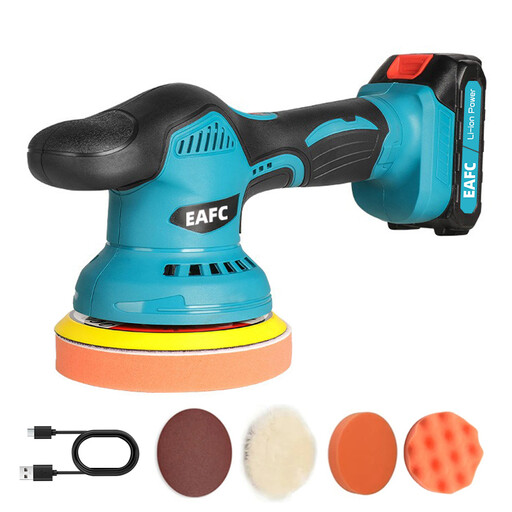
Why This Fits Their Persona: A functional solution for users who need a versatile machine for occasional car polishing and other household tasks without a large budget. Its simple handling makes it accessible for various projects.
Avoids the trap of overpriced features by focusing on the essentials. It offers a solid basic setup with adjustable speed and a standard polishing plate (125 mm) at a competitive price.
The 8 adjustable speed levels (2800-5500 RPM) provide good adaptability for different materials, from car paint to furniture or floors.
We have compiled a complete, real-time list of products that fully satisfy these strict selection criteria and UK safety regulations.
The actual runtime heavily depends on the applied pressure, the selected speed, and the battery capacity (Ah). During intensive polishing with high pressure, a 2.0Ah battery might last about 20-30 minutes. Models with larger 4.0Ah or 5.0Ah batteries can last 45-60 minutes or more. For detailing an entire vehicle, a set with at least two batteries is recommended.
An orbital polisher is primarily designed for removing light to medium paint defects like swirl marks, fine scratches, and oxidation. For very deep scratches that reach the primer, a rotary polisher with an aggressive cutting compound is more effective. However, this requires significant experience. For most DIY users, the combination of an orbital machine and a suitable polish is sufficient to dramatically improve the paint's appearance.
A conventional brushed motor uses carbon brushes to transfer power, which leads to friction, heat generation, and wear. A brushless motor is electronically controlled and has no wearable brushes. This results in higher efficiency (longer battery life), a longer motor lifespan, less noise, and better power delivery under load. For a long-term investment, a brushless motor is the more robust technology.