
Lieferung heute & morgen

Qualitätsgarantie

Willkommens-Angebote freischalten: KOSTENLOSE Lieferung | Bis zu 80 % RABATT | Kostenlose 30-Tage-JoyPlus-Testphase
App herunterladen
A high-quality cordless polisher is an indispensable paint care tool for anyone who values a flawless vehicle finish. However, the market is saturated with devices whose marketing promises often fail to deliver in practice. Inaccurate claims about battery runtime or incomplete accessory kits quickly lead to frustration and additional costs.
This guide, created by the Joybuy Product Recommendation Officer, will help you identify the crucial features. We'll show you what to look for to make an informed decision and find a tool that precisely meets your paint correction needs.
Before you invest, you should be aware of the typical pitfalls that often only become apparent after the purchase.
To avoid these pitfalls, focus on three core technical aspects. These determine the performance, safety, and versatility of your polisher.
The operating principle of the drive is the most important factor for the polishing result and application safety.
The performance of the battery system is critical for practical usability. Pay attention to two values:
The dimensions of the backing plate and the machine's orbit (or "throw") define its range of application.
Here are some product recommendations tailored to the specific needs of vehicle enthusiasts.
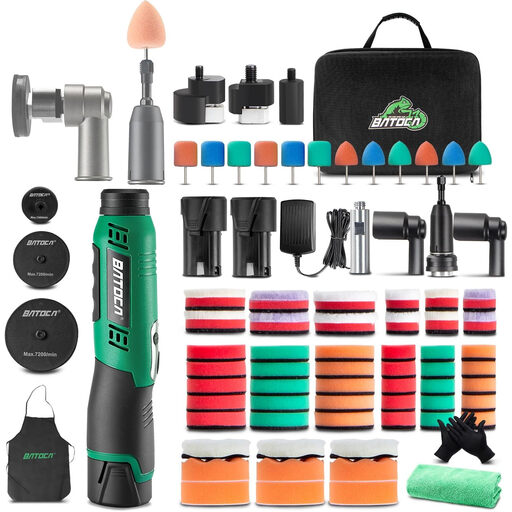
Why This Fits Their Persona: Ideal for users who demand the highest precision in their paint care. The switchable system and small backing plates enable work on hard-to-reach areas like door handles, spoilers, or wheels that are inaccessible with standard machines.
This kit bypasses the incomplete accessory trap with a comprehensive set including three backing plate sizes, two eccentric adapters (3mm & 12mm), and various polishing cones. The two included 2.0Ah batteries solve the problem of unrealistic runtime claims and enable uninterrupted work.
The switchable dual-system (Rotary & Orbital) offers maximum flexibility for both correction and finishing work. The extensive accessory package makes it a complete, out-of-the-box solution for detailing.
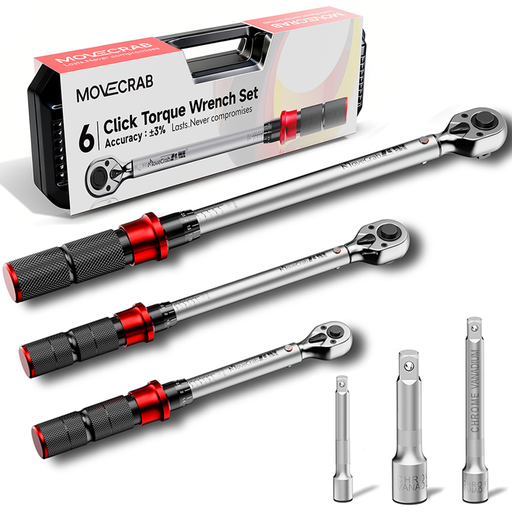
Why This Fits Their Persona: For users who, in addition to paint care, also perform mechanical work themselves, such as wheel changes or engine repairs. Precise torque is essential here for safety and function.
This set avoids the trap of hidden costs. It covers all common drive sizes with three wrenches and adapters. Each wrench comes with an individual calibration certificate, which objectively verifies the advertised precision and makes cheap, inaccurate tools redundant.
Offers high accuracy of ±3% over a wide torque range (5-220 N.m). The robust construction from Cr-V steel and the clearly legible scale ensure durability and precise application.
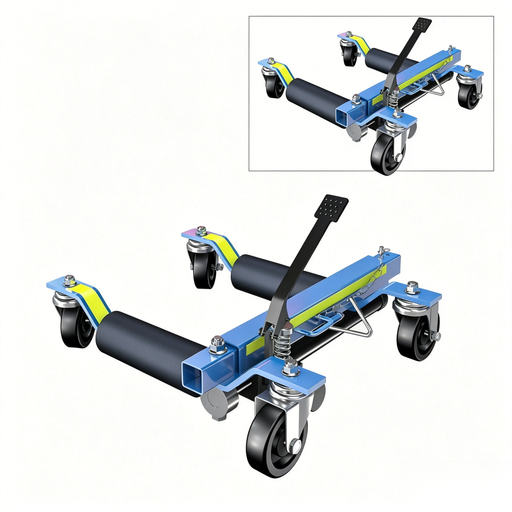
Why This Fits Their Persona: Perfect for users who want to effortlessly and precisely position vehicles in their garage or workshop, whether for detailing, repair, or space-saving storage. It significantly simplifies maneuvering in tight spaces.
This tool bypasses the safety and reliability pitfalls of many lifting systems. The mechanical ratchet pedal is immune to the typical problems of hydraulic systems like oil leaks or pressure loss. The full-surface reflective strips increase visibility and thus operational safety in poorly lit environments.
The high load capacity of up to 680 kg (1500 lbs) per unit and the smooth-rolling universal casters allow most vehicles to be moved with minimal effort. The foot pedal operation is simple and energy-saving.
We have compiled a complete, up-to-date list of products that fully meet these strict selection criteria and safety regulations.
The actual runtime heavily depends on the battery capacity (Ah), the selected speed, and the applied pressure. Under realistic working conditions, you can expect a runtime of about 20 to 30 minutes from a 2.0 Ah battery. For this reason, a kit with a second, swappable battery is essential for fluid, uninterrupted work.
The risk of paint damage with a cordless dual-action polisher is significantly lower than with a pure rotary tool. The orbital motion greatly reduces heat buildup on the surface, which minimizes the danger of "burning" the paint. It is therefore the recommended choice for beginners and for all finishing work. Nevertheless, you should always work with care and without excessive pressure.