
Lieferung heute & morgen

Qualitätsgarantie

Willkommens-Angebote freischalten: KOSTENLOSE Lieferung | Bis zu 80 % RABATT | Kostenlose 30-Tage-JoyPlus-Testphase
App herunterladen
The idea is tempting: an automatic pool cleaner that independently cleans the pool floor, walls, and even the waterline without any tangled cords. A cordless pool robot promises just that—more time to relax and less time spent on tedious manual pool maintenance. But the market is flooded with devices making bold advertising claims that often fail to deliver in practice.
As your Joybuy Product Recommendation Officer, I'll help you spot the typical marketing traps and make an informed decision. Before you invest, you should know the three most common pitfalls that lead to disappointment and unnecessary expense.
To avoid a bad buy, you should focus on objective technical parameters. These three features are crucial for the performance and longevity of your cordless pool robot.
A high-performance pool robot with intelligent navigation doesn't rely on chance. Look for devices that use systematic cleaning patterns (e.g., S-shaped or N-shaped paths) to ensure complete coverage. Separate, selectable cleaning modes are also crucial. A good robotic pool vacuum should offer at least the following options:
The ability to specifically use the pool robot for walls and waterline is a clear sign of a high-quality model.
The battery's capacity, measured in milliampere-hours (mAh), and the resulting runtime are directly linked to the size of your pool. A cordless battery-powered pool robot for small above-ground pools can manage with 60–90 minutes. For medium to large pools (over 50 m?), a runtime of at least 120 minutes is recommended, especially if the walls are to be cleaned as well.
Note: Wall climbing is more energy-intensive and shortens the runtime. A device with a long runtime of 150 minutes or more provides the assurance that even large pools can be completely cleaned in a single cycle. Also, pay attention to the charging time—models with a fast-charging function are ready to go again in 2–3 hours.
The effectiveness of a pool robot depends heavily on its filtration system. A large, easy-to-clean filter basket saves you from frequent emptying. The filtration fineness, specified in microns (?m), determines what particle size is captured. A value around 180 ?m is a good all-around rating for leaves, sand, and finer debris.
Also, check for compatibility with your pool surface. While most robots are suitable for vinyl liner pools, smoother surfaces like tile or fibreglass pools require special brushes (e.g., made of PVA foam) or treads for optimal grip.
Based on the objective criteria mentioned, we have identified a model that is particularly well-suited for a specific type of user.
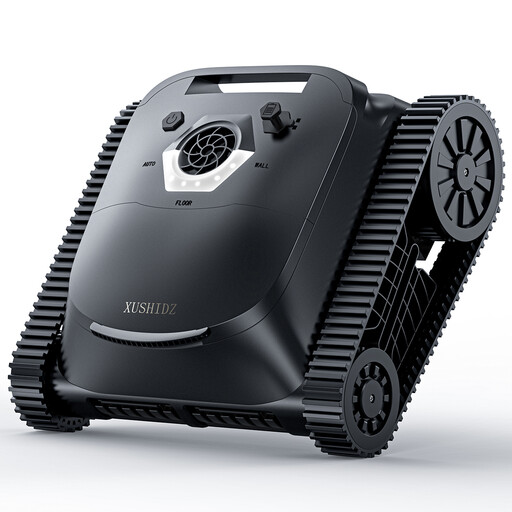
Why this model fits: With a runtime of up to 180 minutes and a designed cleaning area of 300 m?, this device is ideal for owners of large in-ground or above-ground pools who are looking for a no-compromise, fully automated cleaning solution. Its ability to reliably clean walls and the waterline meets the demands for a thorough, complete cleaning.
The device uses advanced navigation with four specific cleaning modes (Auto, Wall Only, Floor Only, Classic) instead of a purely random pattern. Three brushless motors and PVA rollers provide the necessary downforce and grip to effectively clean walls and the waterline. The specified 180-minute runtime is designed for demanding cleaning cycles.
Powerful Suction: Three motors generate a water flow rate of 21 m?/h. Short Charging Time: According to the manufacturer, the battery recharges quickly in about 2.5 hours.
The world of cleaning robots is diverse. If you want to discover more models or other types of smart helpers, we have a wide selection for you.
The actual battery life depends heavily on usage. The maximum runtime stated by the manufacturer usually refers to the floor-only cleaning mode in a clean pool. Activating the wall and waterline cleaning can increase energy consumption by 20–30%. For a 50 m? pool, you should plan for a real-world runtime of about 90–120 minutes for a complete cleaning (floor and walls).
Yes, many modern cordless battery-powered pool robots are also suitable as pool robots for above-ground pools with steel walls or rigid liners. The key is that the device has enough suction power and the right brushes or treads to grip the vertical walls. Models with PVA brushes often provide good adhesion. Pay attention to the manufacturer's specifications regarding compatibility with different pool types.
The frequency of use depends on how dirty the pool gets. During the swimming season, using it two to three times a week is recommended to keep the pool consistently clean. After a storm, during periods of high pollen count, or after a pool party, an additional cleaning cycle may be useful to promptly remove coarse dirt and debris.