
Lieferung heute & morgen

Qualitätsgarantie

Willkommens-Angebote freischalten: KOSTENLOSE Lieferung | Bis zu 80 % RABATT | Kostenlose 30-Tage-JoyPlus-Testphase
App herunterladen
As your Joybuy Product Recommendation Officer, I see countless products competing for your attention every day. Especially with devices like cordless pressure washers, it's difficult to separate marketing claims from actual performance. Many buyers are quickly disappointed because the device fails to deliver on its promises.
This guide is designed to help you avoid the typical pitfalls. We'll focus on the crucial features that distinguish a great device from a subpar one, enabling you to make an informed decision.
Before we dive into the important technical specs, let's highlight the three most common reasons for buyer's remorse. Understanding these will help you search for a suitable model more effectively.
To avoid the pitfalls mentioned above, you should check three core parameters before buying. These determine the real-world usability and longevity of your device.
These two values are inextricably linked and define the cleaning performance.
The battery's performance is the heart of any cordless device. The total energy is measured in Watt-hours (Wh) and is calculated by Voltage (V) multiplied by Amp-hours (Ah). A higher Watt-hour number generally means a longer runtime. Look for models with batteries that offer a capacity of at least 4.0 Ah at a voltage of 20V or more to ensure a practical runtime of 20–30 minutes.
A good cordless pressure washer is distinguished by its versatility. The most important features here are:
Here are some product recommendations tailored to different user profiles and their requirements.
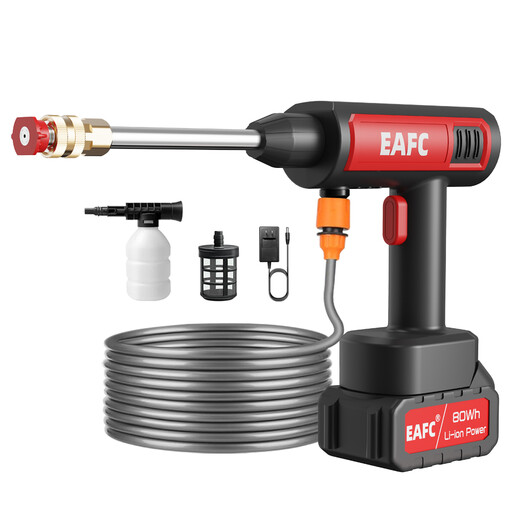
Why it's a great fit: Ideal for users in rental apartments or without a fixed water and power connection who need a flexible solution for washing their car, balcony, or bicycle. Its compact design and self-priming function make it a versatile companion.
This model focuses on realistic performance specs for typical mobile cleaning tasks. The lithium-ion battery is designed for a practical runtime, and the suction function is engineered for drawing water from a bucket.
A complete package including a battery, charger, adjustable nozzle, and foam sprayer. The self-priming function from buckets or other containers offers maximum flexibility.
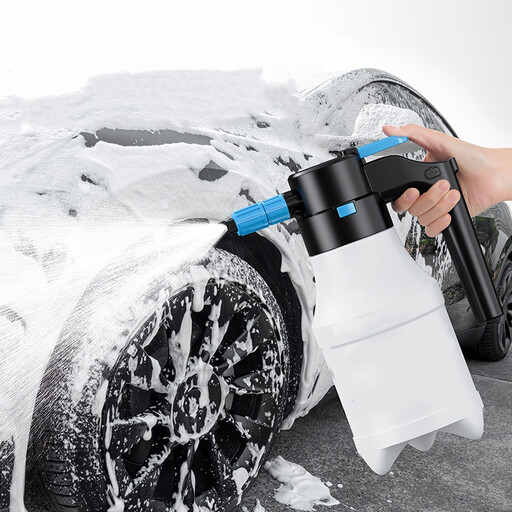
Why it's a great fit: Perfect for car enthusiasts looking for a quick and easy solution to apply cleaning foam or for targeted cleaning of smaller areas. It replaces tedious manual pumping and is ideal for pre-washing or spraying plants.
This device isn't a pressure washer and doesn't pretend to be. It's a specialised electric pressure sprayer that does exactly what it's designed for: evenly distributing liquids as foam or a fine mist at the touch of a button.
Electric, one-touch operation with no manual pumping required. The adjustable brass nozzle allows you to switch from a fine mist to a solid stream or foam.
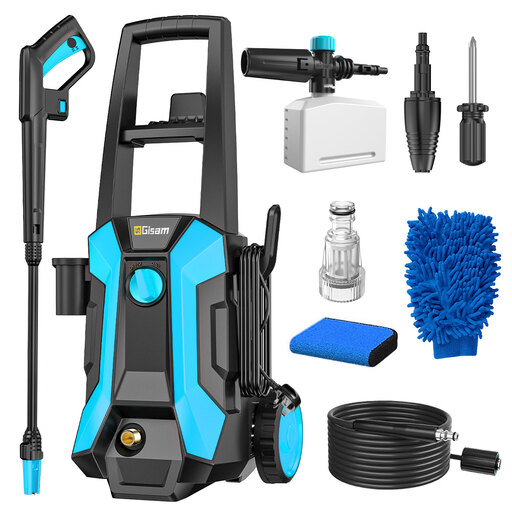
Why it's a great fit: For homeowners who need maximum cleaning power for demanding tasks like cleaning large patios, driveways, or facades and have access to a power outlet and water tap. Here, power takes priority over portability.
As a corded device, it completely bypasses the battery trap, delivering constant, high power with no time limit. The high working pressure of 180 Bar and water flow rate of 480 l/h are designed for heavy-duty cleaning jobs.
Very high cleaning performance thanks to the 2200W motor. The integrated hose reel and 8-metre long hose provide a large operating radius and tidy storage.
For optimal vehicle care, the right cleaning foam is crucial. We've curated a selection of products that are ideal for use with foam sprayers and pressure washers.
The actual runtime heavily depends on the model, battery capacity (in Ah), and the selected working pressure. In continuous operation at full power, most batteries last between 15 and 30 minutes. For longer jobs, it's advisable to get a model with a swappable battery or purchase a second one.
Yes, most models are designed for this. This feature is called "self-priming." It's important that the included intake hose has a filter to protect the pump from debris. Before the first use, the hose often needs to be completely filled with water to prevent air in the system and to start the suction process.
For light to medium dirt, like green buildup on wooden decks or loose debris on stone slabs, the pressure of many cordless devices (approx. 20-40 Bar) is sufficient. However, for heavily weathered or very dirty stone patios, a more powerful, corded model with higher working pressure and water flow rate may be more efficient.