
Lieferung heute & morgen

Qualitätsgarantie

Willkommens-Angebote freischalten: KOSTENLOSE Lieferung | Bis zu 80 % RABATT | Kostenlose 30-Tage-JoyPlus-Testphase
App herunterladen
A cordless pressure washer is practical when there is no power socket nearby: on a parking space, in the garden, on the patio or when washing your car away from home. However, models vary considerably in terms of pressure, water supply, battery life and the accessories included. A high wattage figure on the product page is therefore not enough to judge how suitable a device is for everyday use.
Before buying, households, car owners, gardeners and campers should avoid three common purchasing misconceptions in particular.
Figures such as 30, 50 or 65 bar usually describe the maximum achievable value under specific conditions. In practice, the water flow rate per minute, battery charge, nozzle and hose routing also affect the result. High pressure can also be unsuitable for delicate surfaces such as car paintwork, plants or painted fences.
The stated runtime often applies to a specific pressure or spray mode. When cleaning continuously at higher pressure, the actual operating time may be shorter. Buyers should check whether one or two batteries are included, how long the charger takes and whether replacement batteries are available.
A pressure washer with a foam sprayer, filter, extension tube and several nozzles can be used for a wide range of tasks. However, what matters is whether the connections are compatible and whether the water supply is designed to come from a bucket, a water tank or directly from a tap. A filter protects the pump from coarse particles, but it is not a substitute for a clean water source.
For car washing, the highest pressure is not automatically the best option. An adjustable nozzle makes it easier to switch between a wider water jet for large surfaces and a more concentrated jet for stubborn dirt. For plants and delicate materials, you should choose the lowest suitable pressure.
The product specifications should state at least the following:
A battery-powered water cleaner with 25 to 65 bar, as specified for the Gisam model, offers a wider adjustment range than a device with just one fixed setting. These figures are supplied by the manufacturer and should be checked against your intended use.
A portable pressure washer does not necessarily require a fixed water connection. Many models draw water through a hose from a bucket or another suitable source. This requires a working filter, a securely sealed connection and a system that has been fully purged of air.
For a device without a water-stop function, you should only connect it directly to a tap if this is expressly provided for in the instructions. According to the product information, the Gisam model should not be connected directly to a tap. Seawater is generally unsuitable as a water source because of the risk of corrosion.
A battery-powered pressure washer should be checked before every use for cracks, damaged cables, loose connections and an intact hose. Keep the battery away from water. After cleaning, remove any residual water and moisture from the device and water inlet, particularly when there is a risk of frost.
You should also look for:
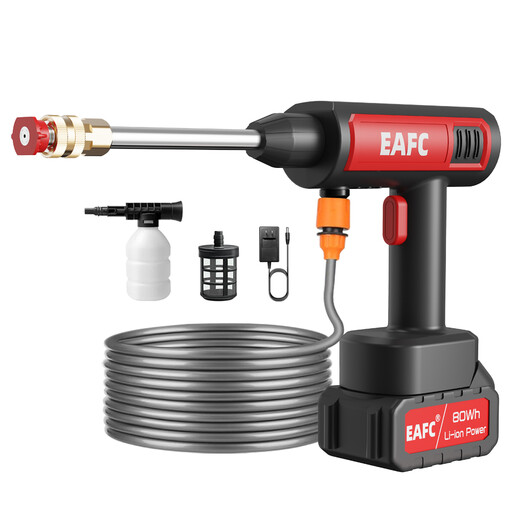
Why this product suits this profile: This compact device is designed for occasional car washing, cleaning balconies and floors, and watering tasks. It can draw water from a container.
The description mentions water supply from a bucket or through self-priming, and highlights possible causes such as air in the system, a kinked hose or an empty battery.
Cordless operation, a lithium battery and applications for cars, the home, the garden and watering.
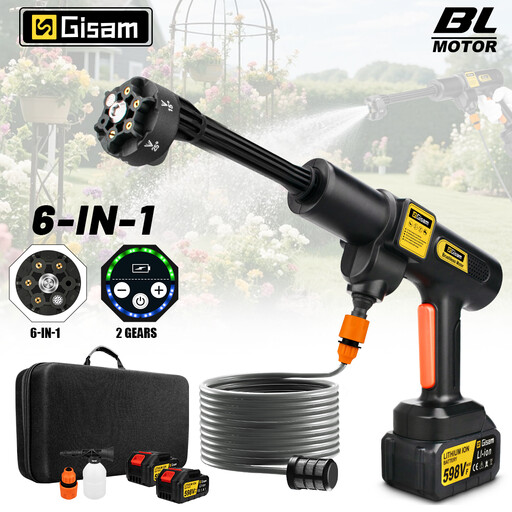
Why this product suits this profile: Two batteries, a 5-metre hose, a foam sprayer and several nozzles are ideal for users who regularly switch between cleaning cars, patios and gardens.
The stated pressure range of 25 to 65 bar allows the device to be adjusted for different surfaces. The filter is designed for drawing water from suitable containers.
Two batteries, each with a stated runtime of up to 45 minutes in low-pressure mode, plus a 6-in-1 nozzle and a rotary nozzle.
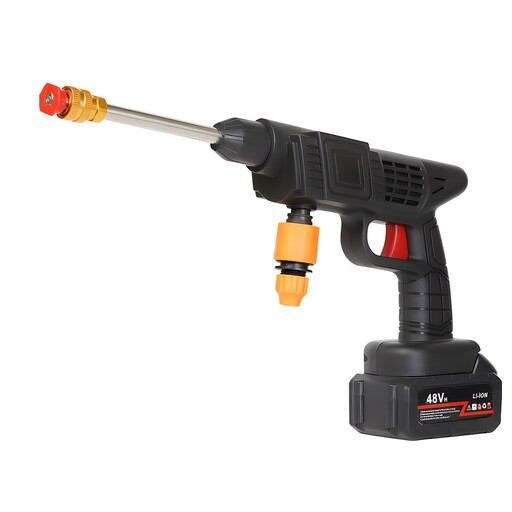
Why this product suits this profile: This model is described as including a 5-metre water hose, adjustable nozzle, filter and foam container for vehicles, patios, windows, lawns and pools.
The product name states 1500 W, while the technical specifications list 300 W, 24 V, 30 bar and approximately 40 minutes of battery runtime. This discrepancy should be clarified against the current product page before purchase.
Lithium battery, screw-on hose connection, charging indicator and an extensive range of accessories including a foam container and adapter.
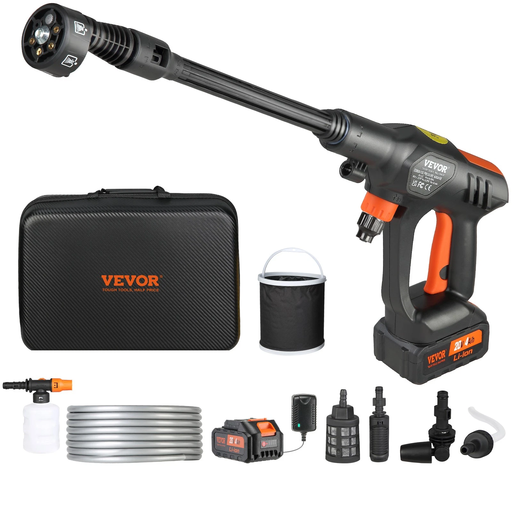
Why this product suits this profile: The automatic continuous-spray function and supplied extension wands are suitable for mobile cleaning tasks on fences, in gaps in walls and in hard-to-reach areas.
A safety lock is designed to prevent unintentional starting. According to the product description, it must be unlocked before use and activated again afterwards.
250 W, 21 V, up to 50 bar and a stated flow rate of 4 litres per minute; accessories and charger included.
We have put together a complete, regularly updated list of products that fully meet these strict selection criteria and the safety regulations applicable in the EU.
The ongoing costs of a battery-powered pressure washer mainly come from electricity for the charger, water, cleaning products and, where applicable, replacement batteries. A device with two batteries can enable longer periods of use, but it also increases the purchase price. When using the foam sprayer, only a suitable cleaning product at the specified dilution should be used.
After every use, the following sequence is recommended:
Many mobile models are designed to self-prime from a bucket, water tank or another container. The hose, filter and connection must be fitted correctly for this to work. If there is no water flow, purging the system of air as described in the operating instructions will often help. Whether a direct connection to a tap is permitted depends on the model.
Runtime depends on the pressure setting, nozzle, water flow rate and battery capacity. Manufacturer specifications usually refer to a particular operating mode. A second battery or a model with a replaceable battery is useful for longer cleaning jobs. After use, the battery should not be stored in a damp place and should only be charged with the supplied charger.
Yes, a portable pressure washer can be suitable for washing cars, provided that the pressure and distance are controlled carefully. Use a wide nozzle setting, keep a sufficient distance from the paintwork and avoid concentrated jets around seals, films or damaged areas. A pressure washer with a foam sprayer can assist with pre-washing, but it does not replace gentle rinsing and drying.