
Lieferung heute & morgen

Qualitätsgarantie

Willkommens-Angebote freischalten: KOSTENLOSE Lieferung | Bis zu 80 % RABATT | Kostenlose 30-Tage-JoyPlus-Testphase
App herunterladen
A cordless pressure washer is a handy tool when there’s no mains socket or outdoor tap nearby. Many models can draw water from a bucket, water butt or cistern, making them ideal for cars, bikes, garden furniture, balconies and campsites. However, these machines differ significantly in pressure, water flow, battery life and accessories.
If you only focus on a high bar rating, you could end up with a device that’s unsuitable for delicate surfaces or that quickly runs out of steam on longer jobs. The points below will help you avoid the most common buying mistakes.
The pressure rating in bar describes the force at which the water exits the nozzle. For car care, bicycles or plants, a controlled, gentler setting is also important. A high maximum pressure can damage paintwork, grout, wooden surfaces or plants if used at the wrong distance.
The flow rate in litres per hour is equally important. A machine with high pressure but low water volume can be slower on larger areas. So you should consider both pressure and flow rate together.
Battery life depends on factors such as pressure setting, battery capacity, water temperature and work intervals. Manufacturers’ figures often refer to specific operating modes. For a realistic comparison, buyers should check:
With a cordless pressure washer, an extra battery can be useful if you plan to clean several bikes, patio sets or larger outdoor areas one after another.
A cordless pressure washer doesn’t automatically work with every water source. The suction hose must be correctly connected and bled of air before use. Water from buckets, cisterns or water butts should be clean and as free as possible from sand, leaves and small stones.
A filter on the suction hose reduces the risk of debris entering the pump. Seawater or liquids containing cleaning residues are not suitable for these machines. On models without a water-stop function, you should also avoid connecting them directly to a tap unless the manufacturer’s instructions say otherwise.
For a pressure washer for your car and bike, adjustable nozzles or multiple spray patterns are helpful. A wide spray jet is better for larger surfaces, while a concentrated jet can be used for spot cleaning. On painted surfaces, keep a safe distance and use an appropriate setting.
Models with a 5-in-1 or 6-in-1 nozzle offer several spray patterns. Such a feature increases flexibility, but it doesn’t replace checking the actual pressure ranges. If you’re looking for a pressure washer for the garden and patio, also pay attention to hose length and handling.
A portable pressure washer is often used in places where long cables would be a nuisance. The total weight, including the battery, hose and water accessories, has a big impact on comfort. A lightweight machine is practical for quick cleaning jobs on the car or when camping; for larger areas, battery swaps and ergonomics can matter more than a particularly compact design.
A pressure washer with a foam sprayer can distribute cleaning solution on vehicles or garden furniture. Before use, check whether the foam container needs rinsing with clean water and whether the machine needs to prime the water first. On some models, the foam sprayer only works properly once the water supply is fully established.
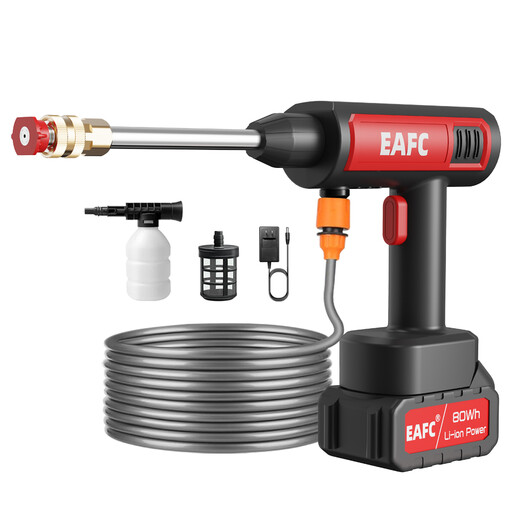
Why this product fits the profile: This portable cleaning gun is designed for occasional jobs on the car, bike, around the house or for watering plants, and can draw water from a bucket.
The product description mentions bleeding the system and possible causes of low pressure. This makes troubleshooting easier when using it from a container.
Cordless design, water suction from a bucket and included foam sprayer according to the product specifications.
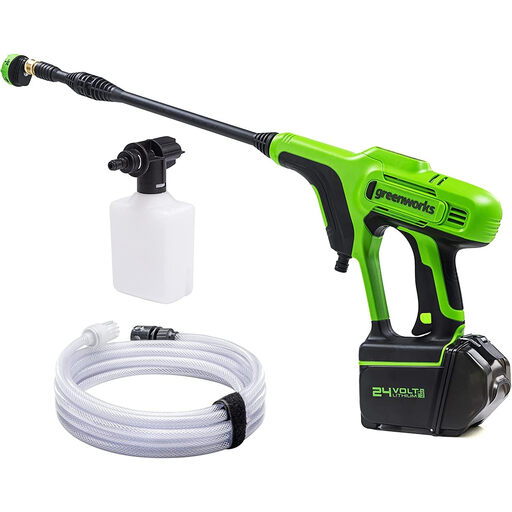
Why this product fits the profile: The 24-volt system is aimed at users who already own compatible Greenworks batteries or who value a system with clearly defined technical specifications.
The specifications state 24 bar, 180 l/h, a 6-metre hose and a 5-in-1 nozzle. This lets you check pressure, reach and spray options before buying.
300-watt motor, 180 l/h flow rate, 6-metre hose and compatibility with Greenworks 24-volt batteries according to the product data.
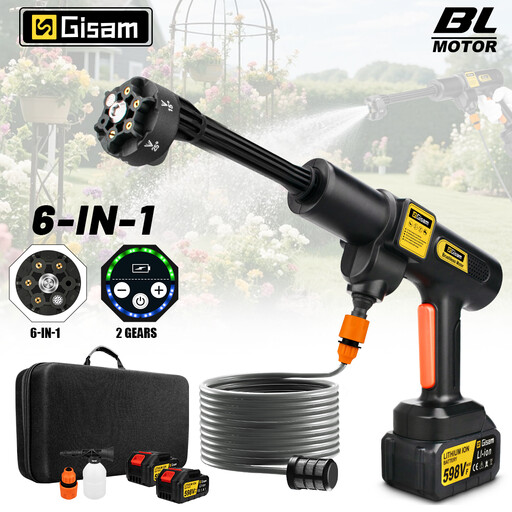
Why this product fits the profile: Two batteries, multiple nozzles and a filter make it interesting for camping, car care, garden work and changing locations.
The adjustable range from 25 to 65 bar allows you to adapt to different tasks, according to the product information. The water filter addresses the risk of particles in alternative water sources.
Two batteries, 5-metre hose, 6-in-1 nozzle, 180-degree nozzle and water filter as supplied.
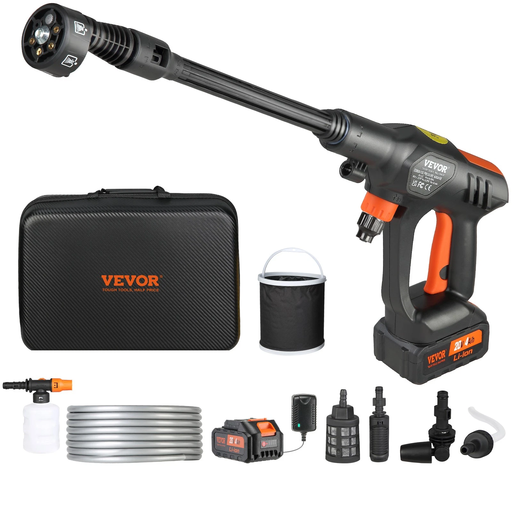
Why this product fits the profile: This model is designed for mobile cleaning tasks with various attachments, such as on walls, fences or hard-to-reach spots.
A safety lock and an automatic continuous spray function address accidental switching on and the need to hold the start button down continuously.
250-watt drive, 21-volt battery, stated pressure of 50 bar and several accessories according to the product description.
We’ve put together a full, regularly updated list of products that fully meet these strict selection criteria and the safety regulations in force in the EU.
Before each use, check the housing, hose, filter, battery and connections for visible damage. Never direct the water jet at people, animals, electrical devices or the machine itself. Remove the battery before cleaning or maintenance work.
After use, we recommend the following routine:
Many portable models are designed to draw water from a bucket, water butt or another clean source. To do this, the hose must be fully submerged, the filter correctly fitted and the system bled of air if necessary. Check the instruction manual to see whether a direct connection to a tap is permitted.
There’s no single fixed runtime. The pressure setting, flow rate, battery capacity and breaks all affect consumption. Figures such as a runtime of up to 45 minutes at a low pressure setting should be treated as a manufacturer’s guideline. For longer jobs, a spare battery can extend the working time.
The ongoing costs mainly consist of electricity for charging the battery, water and possibly cleaning solution. The electricity consumption depends on the battery capacity and how often you charge it. So when choosing a model, don’t just consider the purchase price – also factor in the battery system, charger, spare battery and available spare parts.