
Lieferung heute & morgen

Qualitätsgarantie

Willkommens-Angebote freischalten: KOSTENLOSE Lieferung | Bis zu 80 % RABATT | Kostenlose 30-Tage-JoyPlus-Testphase
App herunterladen
Maintaining trees and shrubs is a fundamental task in any garden, but annual pruning can quickly become a physical strain. Manual pruners require significant effort, and working on hard-to-reach branches without a ladder can be unsafe. A cordless pruner offers an efficient and effort-saving alternative.
As your Joybuy Product Recommendation Officer, I have analyzed market data to give you a clear overview of functional models. This guide is designed to help you make an informed decision based on technical features, not marketing promises. We will examine the crucial criteria and present a selection of tools for various applications.
Choosing the right tool depends on the specific needs of your garden. Three main factors are crucial: cutting capacity, reach, and the battery system.
The maximum cutting capacity, specified in millimeters (mm), determines how thick of a branch the tool can cut. For trimming ornamental shrubs or roses, models with a capacity of up to 25 mm are often sufficient. However, if you are maintaining fruit trees or plants with harder wood, a pruner for thick branches with a cutting capacity of 30 mm or more is a wise choice. Check the typical branch diameter in your garden to select a tool that won't be pushed to its performance limits.
The design of the tool significantly impacts comfort and safety during work.
The heart of any cordless tool is its drive system. The battery capacity, measured in ampere-hours (Ah), and the voltage (V) determine the runtime. For larger gardens, models that come with two batteries are advantageous as they allow for uninterrupted work.
Another important aspect is the motor type. Brushless motors are often more durable, lower-maintenance, and more energy-efficient compared to conventional brushed motors, which translates to longer battery life per charge.
Based on the criteria mentioned, we have compiled a selection of tools that cover different needs—from a versatile pole pruner to a specialized saw for particularly thick branches.
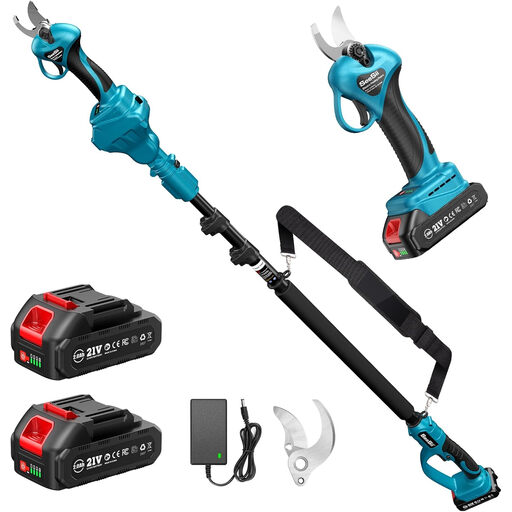
Why this model stands out: This model's strength lies in its 2-in-1 functionality. It can be used as a compact handheld pruner or as a pole pruner with the included telescopic pole. This offers maximum flexibility for gardens with varying plant heights.
Advantages:
Who is it for? This model is ideal for garden owners who need to maintain both low shrubs and tall fruit trees and are looking for a versatile solution to avoid using ladders.
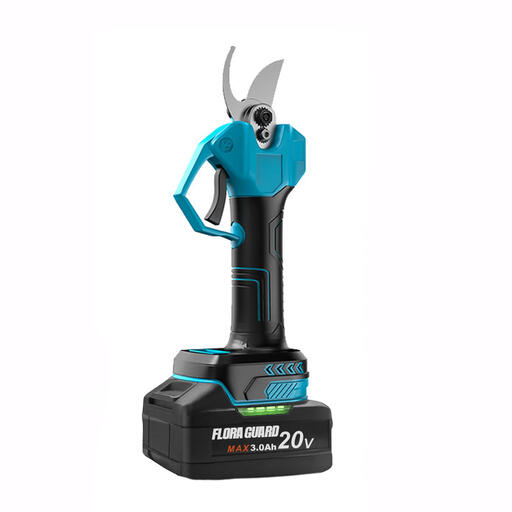
Why this model stands out: The Flora Guard pruner focuses on one core competency: powerful cuts in a handheld format. With a cutting capacity of 35 mm, it is remarkably powerful for a handheld electric pruning shear and is well-suited for demanding pruning tasks.
Advantages:
Who is it for? Users who need a powerful and handy solution for pruning thick branches on fruit trees, vines, or robust shrubs will find this a suitable tool.

Why this model stands out: When the capacity of a cordless tree pruner is no longer sufficient, this mini cordless chainsaw comes into play. It is designed for quickly and efficiently sawing branches and logs up to 15 cm, making it a sensible addition for more extensive gardening tasks.
Advantages:
Who is it for? This tool is intended for users who regularly need to remove thick branches or cut firewood and require a more powerful device than a pruner.
The world of power tools is diverse and offers the right device for every task. If the models presented here don't exactly meet your requirements, or if you'd like a broader overview of garden tools, you can find a larger selection in our power-tools category.
The required cutting capacity depends on the type of your plants. For most ornamental shrubs and young trees, a capacity of 25–30 mm is sufficient. For pruning old fruit trees or hardwoods, a model with a capacity of 35 mm or more is recommended to avoid overloading the tool.
A cordless pruner is designed for precise, clean cuts that are important for the health of the plant (e.g., when pruning fruit trees). A mini cordless chainsaw, on the other hand, is used for the rapid removal of thicker branches or for sawing wood, where cutting speed and power are the priority, not the quality of the cut.
Clean the blades of sap and debris after each use. Then, dry the blades and apply a light machine oil to prevent rust. If the cutting performance diminishes, the blades should be sharpened with a suitable sharpening stone. Always remove the battery before performing any maintenance to prevent accidental start-up.