
Lieferung heute & morgen

Qualitätsgarantie

Willkommens-Angebote freischalten: KOSTENLOSE Lieferung | Bis zu 80 % RABATT | Kostenlose 30-Tage-JoyPlus-Testphase
App herunterladen
A cordless ratchet wrench set promises to significantly speed up tedious fastening jobs in hard-to-reach places, like in an engine bay or during furniture assembly. However, the market is flooded with tools whose real-world performance often fails to live up to their promises. Before you make a purchase, it's crucial to understand the typical pitfalls that lead to frustration and unnecessary expense.
This guide shows you what really matters and how to sidestep the three most common marketing traps to find a tool that genuinely makes your work easier.
To avoid a bad purchase, you should focus on three core technical features. These determine whether a cordless ratchet wrench is suitable for your projects or not.
Torque, measured in Newton-metres (Nm), is the most important metric for the tool's power. It indicates how much force the wrench can apply to loosen or tighten a bolt or nut.
Speed (RPM) is relevant for how fast you can work. A variable speed trigger allows for precise control, letting you start slowly and then increase the speed.
A powerful battery system is the heart of any cordless tool.
The most common drive size for this class of tool is the 3/8-inch cordless ratchet. This square drive offers high compatibility with most common socket sets. Make sure the set includes the accessories most important to you:
Here are some recommendations tailored to specific user profiles that meet the criteria mentioned above.
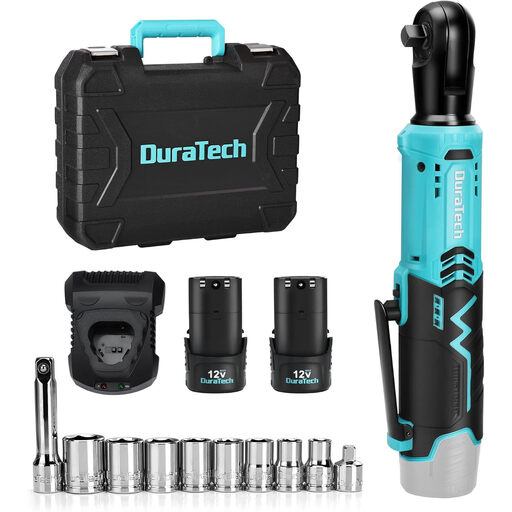
Why It's a Match: Ideal for general automotive maintenance and demanding DIY projects where both power and a complete kit for getting started right away are crucial.
With 65 Nm of torque, it provides enough power for automotive applications (Pitfall 1). The set includes two 2.0 Ah batteries and a fast charger (Pitfall 2), as well as a comprehensive accessory package including a case (Pitfall 3).
A well-balanced overall package combining high performance, a complete set of accessories, and two batteries for uninterrupted work.
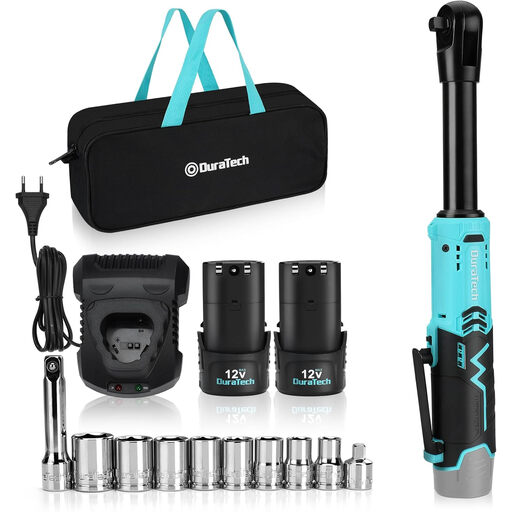
Why It's a Match: The extended design is specifically engineered for bolts located deep in engine bays, behind panels, or in other hard-to-reach areas where standard models can't reach.
It offers a powerful 60 Nm of torque and a complete kit with two batteries. Its special design solves the problem of reach, which is a hidden weakness of many standard tools.
The extended neck enables work in spots that would otherwise only be accessible manually and with great effort. The integrated LED light is especially useful here.
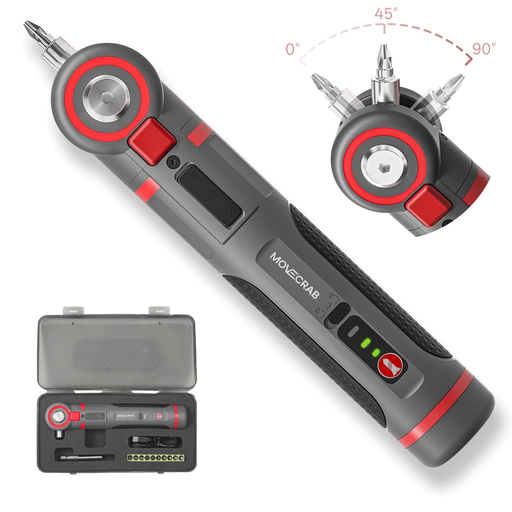
Why It's a Match: Perfect for repairing laptops, phones, or assembling small-scale furniture, where precision and control are more important than raw power. Note: This is a cordless screwdriver, not a ratchet wrench.
This tool is an example of choosing the right tool type for delicate tasks (avoiding Pitfall 1). The adjustable 3-5 Nm torque protects sensitive components from damage.
The adjustable angle (0°, 45°, 90°) allows for precise work even in awkwardly shaped housings. The three torque settings offer maximum control.
We have compiled a complete, up-to-date list of products that fully meet these strict selection criteria and rigorous safety standards.
For general work on a car, such as removing trim panels, brackets, or light engine accessories, 40–65 Nm is a good benchmark. However, for seized lug nuts or suspension components, a manual torque wrench or a more powerful impact wrench is still required. The cordless ratchet wrench primarily serves to speed up the process of fastening and unfastening after the bolt has been manually broken loose.
Not entirely. A cordless ratchet wrench is a supplement, not a complete replacement. For initially breaking very tight bolts loose and for final tightening to a precise torque value (e.g., with a cordless torque wrench with an auto-shutoff function or a manual torque wrench), you often need more force or precision than a standard cordless ratchet can provide. Its strength lies in being a huge time-saver when driving long bolts in or out.
Look for three features: First, the technology (Lithium-ion is the standard, as it has no memory effect and low self-discharge). Second, the capacity (at least 2.0 Ah for a decent runtime). Third, the inclusion of a second battery in the set and a fast charger that can deliver a full charge in about an hour. A battery level indicator on the tool itself is also a very useful feature.