
Lieferung heute & morgen

Qualitätsgarantie

Willkommens-Angebote freischalten: KOSTENLOSE Lieferung | Bis zu 80 % RABATT | Kostenlose 30-Tage-JoyPlus-Testphase
App herunterladen
As a Joybuy Product Recommendation Officer, I see every day how overwhelming the market for power tools can be. A new cordless screwdriver is supposed to make work easier, but the selection process often leads to frustration. Many tools promise more than they can deliver and end up gathering dust in a corner after a short time. This guide will help you identify the key features and avoid marketing traps, so you can find a tool that truly fits your needs.
Before we dive into the technical details, let's address two common problems that often lead to a bad purchase:
To make an informed decision, focus on three objective criteria. These determine whether a cordless screwdriver is suitable for your projects.
These two values define the tool's power and its area of application.
Battery technology is the heart of any cordless tool.
Not every cordless screwdriver has the classic pistol grip design. Depending on the application, specialised form factors can be much more practical.
Here are some models tailored to specific needs that avoid the pitfalls mentioned above.
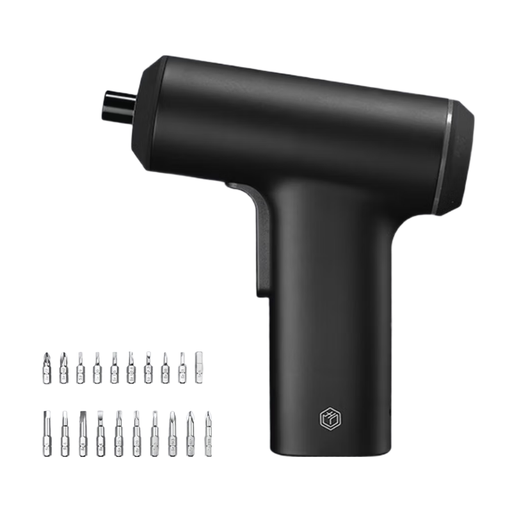
Why it's a good fit: Ideal for those who need a straightforward tool for assembling furniture or hanging pictures. It's lightweight, compact, and provides enough power (5 Nm) for everyday screwdriving tasks without being overkill.
This tool doesn't promise unrealistic performance. It focuses on a core competency—precise screwdriving with moderate force—and delivers it reliably. The included accessories are tailored to its intended use.
The integrated LED ring light provides shadow-free illumination of the work area, which increases precision in dark corners or inside cabinets. The 2000 mAh battery offers long runtime for typical projects.
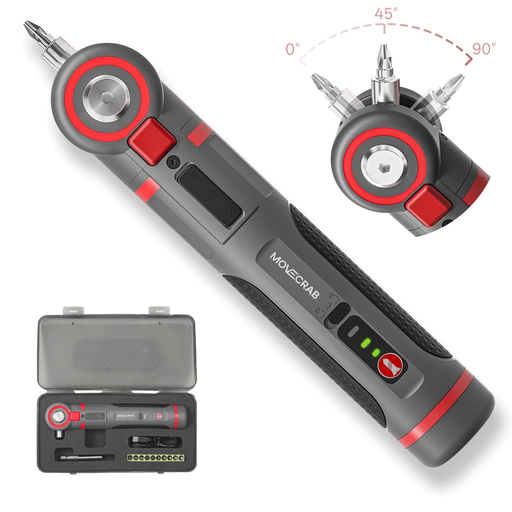
Why it's a good fit: Perfect for DIY enthusiasts who work on a variety of projects—from repairing laptops to assembling complex kits. The angle adjustability and selectable torque offer maximum flexibility.
Instead of being an inflexible "one-size-fits-all" tool, this model offers targeted adjustments. It solves the problem of standard cordless screwdrivers being useless in tight or awkward spaces.
The working angle is adjustable to 0°, 45°, and 90°. Additionally, the torque can be set to three levels (3, 4, and 5 Nm) to handle both sensitive electronics and more robust materials.
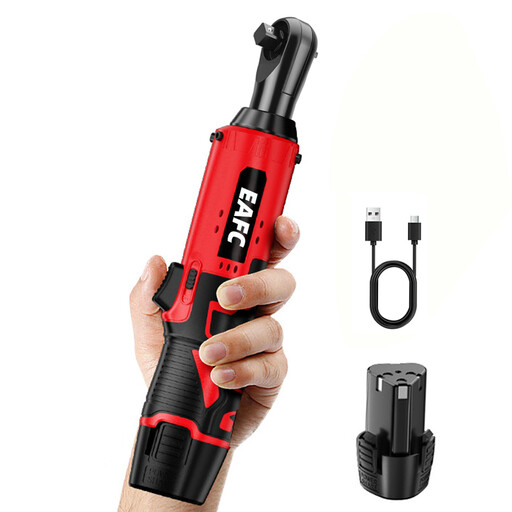
Why it's a good fit: This cordless ratchet wrench is designed for hobbyist car mechanics. It combines high torque with an extremely slim profile to make work in tight engine bays or on the chassis much easier.
Instead of being a general-purpose tool that fails at automotive tasks, this is a specialist. It solves the core problem of inaccessible bolts in tight spaces where a normal cordless screwdriver can't reach.
The maximum torque of 45 Nm is sufficient for many fastening tasks on a car. The head, which is only 3 cm thick, allows access to spots that are unreachable with standard tools.
Especially for work in corners and hard-to-reach places, a specialised tool can make all the difference. We have compiled a selection of products that are optimised for such tasks.
The runtime depends on the capacity (in Ah) and the load. A 2.0 Ah battery can last for several hours during light tasks like furniture assembly. For demanding jobs that require constant high torque, the runtime can be significantly shorter. For a long battery lifespan, it's advisable not to fully discharge it and to store it at room temperature.
This depends entirely on your use case:
Yes, this is possible with most models, provided they have a chuck and a sufficiently high speed (at least 1,000 RPM). Pure cordless screwdrivers with a bit holder are less suitable for this. For regular drilling, especially in masonry, a cordless drill or a rotary hammer is the better choice.