
Lieferung heute & morgen

Qualitätsgarantie

Willkommens-Angebote freischalten: KOSTENLOSE Lieferung | Bis zu 80 % RABATT | Kostenlose 30-Tage-JoyPlus-Testphase
App herunterladen
A cordless vacuum promises freedom and convenience in your housework. But the market is flooded with devices backed by grandiose marketing claims that often fail to deliver in practice. As a Joybuy Product Recommendation Officer, I see daily which features truly matter and which are just marketing fluff. Before you make a decision, you should know the most common pitfalls that lead to disappointment and unnecessary expense.
The three most common disappointments when buying a cordless vacuum are:
A closer look at the technical specifications and design is therefore essential to find a device that will be a reliable household assistant for the long term.
To avoid a bad purchase, you should focus on a few crucial technical features. These determine the actual performance and longevity of your new device.
A powerful cordless vacuum is not defined by a high Pascal number alone. The motor power, specified in Watts (W), is an equally important indicator of the device's ability to generate a consistently strong airflow. Modern, brushless motors are the preferred choice here, as they are more efficient, quieter, and significantly more durable than conventional motors. A good balance of motor power (e.g., 450W or more) and a well-thought-out nozzle design ensures that dirt and hair are effectively lifted and suctioned from the floor.
For a long-runtime vacuum, the battery capacity, measured in milliampere-hours (mAh), is crucial. A battery with 2200 mAh or more is a good baseline for cleaning larger areas. Pay attention to whether the specified runtime applies to the Eco mode or a medium mode. For apartments or houses over 150 m?, a swappable battery is also a significant advantage, as it can double the cleaning time when needed.
For allergy sufferers, a vacuum with a HEPA filter is essential. A multi-stage filtration system that includes a HEPA filter (High-Efficiency Particulate Air) is proven to capture up to 99.99% of the smallest particles like pollen, fine dust, and dust mite faeces. This ensures cleaner exhaust air.
For dog and cat owners, a special vacuum for pet hair with an anti-tangle brush is critical. V-shaped bristle arrangements or special combs in the floorhead guide hair directly to the suction channel, preventing it from wrapping around the brush roll. A lightweight vacuum with a well-balanced weight also makes it easier to handle on stairs or when cleaning furniture.
Instead of making a blanket recommendation, we have identified models that meet specific requirements and purposefully avoid the pitfalls mentioned earlier.
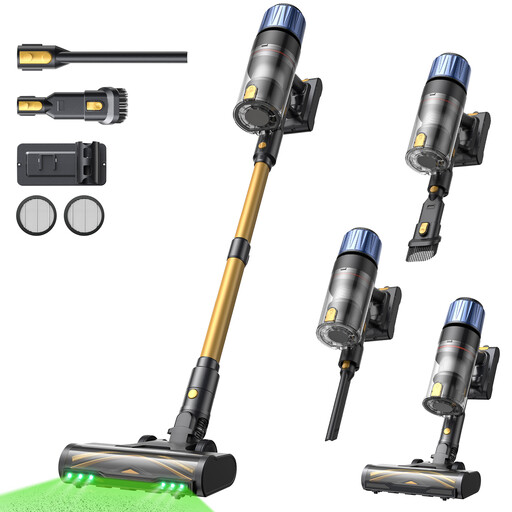
Why This Fits Their Persona: Ideal for users with large apartments or houses (up to 250 m?) who need uncompromising cleaning performance on various floor types. The smart display also provides full control over the cleaning status.
The stated 70-minute runtime in Eco mode is realistic for cleaning large areas, thanks to the 8-cell battery. The V-shaped anti-tangle brush minimises manual cleaning, while the 600W motor ensures consistently high suction power.
The combination of very high motor power (600W) and long battery life allows for a thorough deep clean in a single pass. The 6-stage HEPA system is also ideal for allergy sufferers.
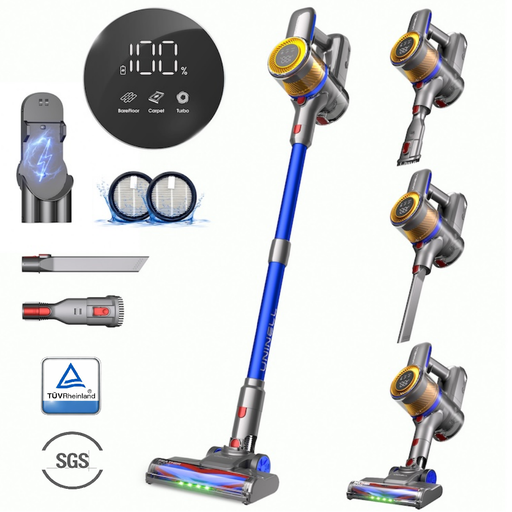
Why This Fits Their Persona: Designed for households where pet hair is a daily challenge. It offers strong performance and a specialised brush without breaking the bank.
The specially designed V-roller brush directly addresses the problem of tangled hair. The LED display shows the battery level as a percentage, preventing unpleasant surprises with runtime.
The focus on anti-tangle technology makes it an effective solution for pet owners. According to the manufacturer, its 50 dB operation is also comparatively quiet.
We have compiled a complete, real-time list of products that fully satisfy these strict selection criteria and UK safety regulations.
The actual runtime heavily depends on the selected suction mode. While 60–70 minutes are possible in Eco mode, the runtime in Turbo mode often drops to 10–20 minutes. For daily cleaning of hard floors, a medium mode is usually sufficient, offering a runtime of about 30–40 minutes. Check the battery capacity (mAh) and whether the battery is swappable to extend the runtime if needed.
For allergy sufferers or households with sensitive individuals, a HEPA filter is highly recommended. It filters the smallest particles from the exhaust air that would otherwise be redistributed into the room. Even for non-allergy sufferers, a good filtration system contributes to better air hygiene by capturing fine dust and other micro-pollutants.
This depends on the frequency of use and the type of dirt. It is recommended to empty the dustbin after each use. The filters (both the pre-filter and the HEPA filter) should be cleaned under running water every 2–4 weeks, according to the manufacturer's instructions. It is crucial that the filters are completely dry (for at least 24 hours) before being reinserted to prevent mould and odours. Replacing the HEPA filter is generally advisable every 6–12 months.