
Lieferung heute & morgen

Qualitätsgarantie

Willkommens-Angebote freischalten: KOSTENLOSE Lieferung | Bis zu 80 % RABATT | Kostenlose 30-Tage-JoyPlus-Testphase
App herunterladen
Choosing a new cordless vacuum can quickly become overwhelming. The market is filled with devices that promise impressive performance specs and innovative features. But not every claim delivers on its promise. As your Joybuy Product Recommendation Officer, I'll help you identify the crucial features and avoid marketing traps, so you can make an informed decision for your household.
A cordless vacuum offers undeniable flexibility, but the wrong choice leads to frustration: a battery that dies after 15 minutes, suction power that fails on pet hair, or a filter system that kicks up more dust than it captures. Let's look at the three most common pitfalls to avoid.
To avoid a bad purchase, you should focus on objective, verifiable performance features. These three criteria are crucial for daily use.
The actual cleaning performance is determined by suction power, measured in Pascal (kPa) or Airwatts (AW). Pascal indicates the negative pressure the device generates, while Airwatts describe the suction power at the nozzle. A vacuum with strong suction power for carpets and pet hair should have a value of at least 20 kPa. Modern, brushless motors often have an advantage here, as they generate high power more efficiently and with greater durability.
Pay attention to the battery capacity, specified in milliampere-hours (mAh), and the voltage (V). A higher capacity generally allows for a longer runtime. Look for manufacturer specifications on runtime in different power modes (e.g., Eco, Standard, Max). For an average-sized home (approx. 80 m?), a runtime of 30–40 minutes in standard mode is a good benchmark. A lightweight vacuum is also advantageous for cleaning stairs or higher areas without much effort.
A bagless vacuum cleaner is practical and saves on running costs. However, the filtration system is crucial. Models with multi-stage filtration, ideally including a HEPA (High-Efficiency Particulate Air) filter, capture up to 99.9% of fine dust particles and allergens. This is especially important for allergy sufferers and households with pets. Also, pay attention to the size of the dustbin (in litres) and ensure it can be emptied easily and hygienically.
Based on these objective criteria, we have identified a few models that are suitable for different user profiles and requirements.
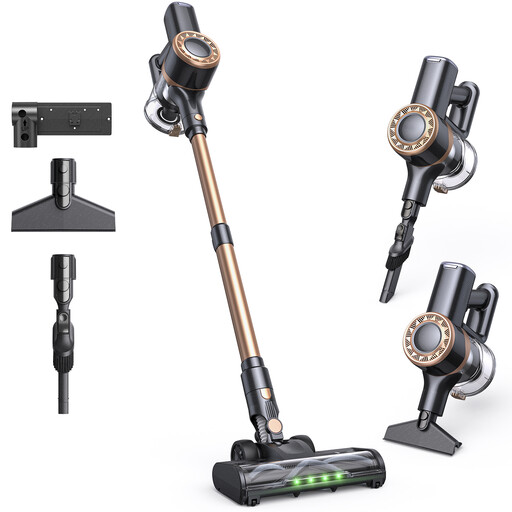
Why This Fits Their Persona: Ideal for small to medium-sized apartments. This model offers a solid set of basic features with good suction power for hard floors and light carpet cleaning. The freestanding design is practical as it doesn't require drilling for a wall mount.
The model bypasses the watt trap by clearly stating its suction power (up to 30 kPa) and avoids the runtime trap with a realistic specification of up to 35 minutes. The 5-stage filtration system is a solid feature in this price range to prevent secondary pollution.
Freestanding design for flexible breaks and easy storage. The anti-tangle brush reduces maintenance from hair.
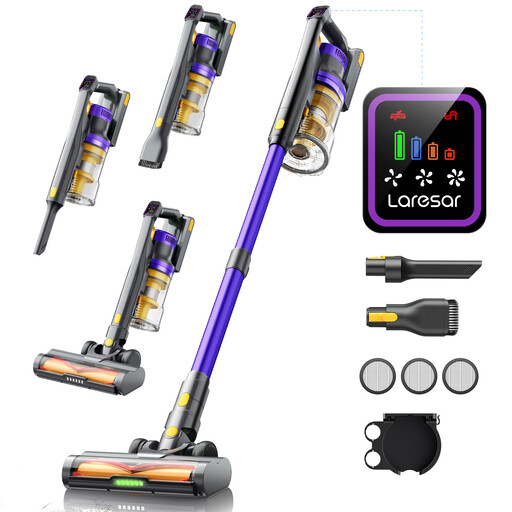
Why This Fits Their Persona: Designed for demanding cleaning tasks. The very high suction power of 55 kPa is ideal for removing deep-seated pet hair from carpets. The large 2-litre dustbin and long runtime of up to 60 minutes are perfect for larger households and families.
This model delivers an objectively measurable, very high suction power that goes far beyond vague wattage claims. The 7-stage HEPA filtration system directly addresses the need for clean exhaust air, which is crucial in households with allergy sufferers and pets.
Very high suction power (55 kPa) for deep cleaning. Large 2-litre dustbin reduces the frequency of emptying. Green LED for dust detection.
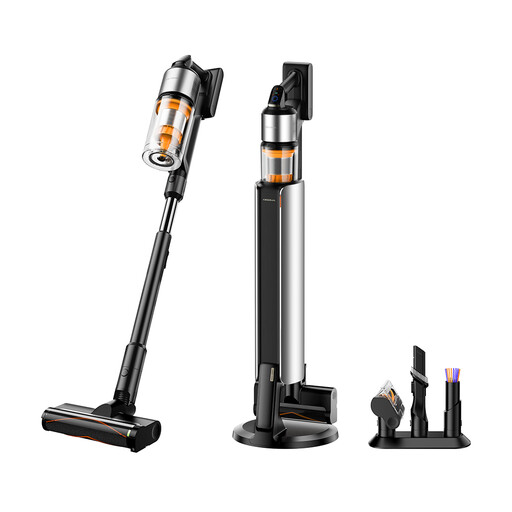
Why This Fits Their Persona: For users seeking maximum convenience and minimal maintenance. The 6-in-1 base station handles automatic dustbin emptying and charging. With a 70-minute runtime and a comprehensive accessory kit, it's an all-in-one solution for the entire house.
This system solves a practical problem that is often overlooked: constant manual emptying and maintenance. Instead of just advertising a single metric, it offers a well-thought-out overall concept that simplifies the entire cleaning process.
Automatic dust extraction and charging function in the base station. Long runtime of up to 70 minutes and a 9-stage filtration system.
We have compiled a complete, real-time list of products that fully satisfy these strict selection criteria and UK safety regulations.
The actual battery life heavily depends on the selected power level. The manufacturer's "up to X minutes" specification refers to Eco mode. For a realistic assessment, you should check the stated runtime in Standard or medium mode, as this is used for most everyday cleaning tasks. The battery capacity (in mAh) is also a good indicator of potential endurance.
A bagless vacuum cleaner can be very suitable for allergy sufferers, provided it has a high-quality, fully sealed filtration system with a HEPA filter. This system prevents captured allergens and fine dust particles from being released back into the room's air. Hygienic emptying of the dustbin is also important to minimise contact with dust.
kPa stands for kilopascal and is a unit of measurement for pressure. On a vacuum cleaner, it measures the negative pressure generated and is therefore a direct indicator of the suction power at the nozzle. Unlike the motor's wattage, which only indicates energy consumption, the kPa value describes the device's actual ability to pick up dirt and particles from the floor. A higher kPa value generally means stronger suction power.