
Lieferung heute & morgen

Qualitätsgarantie

Willkommens-Angebote freischalten: KOSTENLOSE Lieferung | Bis zu 80 % RABATT | Kostenlose 30-Tage-JoyPlus-Testphase
App herunterladen
The market for cordless vacuums is vast, and manufacturers' promises are often even more ambitious. A cordless vacuum promises flexibility and convenience, but not every model delivers. Many buyers quickly discover that suction power wanes, the battery doesn't last long enough to clean their entire home, or the device capitulates when faced with pet hair.
As your Joybuy Product Recommendation Officer, I'll help you distinguish crucial features from exaggerated marketing claims. This guide reveals the three most common traps when buying a cordless vacuum and what you should look for instead to find the right device for your household.
To avoid a bad buy, you should focus on objective technical specifications that match your specific needs.
Suction power, often specified in Pascals (Pa), describes the negative pressure the motor can generate. For everyday use, values between 20,000 Pa (20 kPa) and 30,000 Pa (30 kPa) are sufficient for most tasks on hard floors and low-pile carpets. If you need a vacuum with powerful suction for pet hair or high-pile carpets, models with 40 kPa or more are a worthwhile option.
Also, pay attention to the motor type. Modern devices use a brushless motor. Compared to conventional brushed motors, these are more durable, more energy-efficient, and typically operate more quietly.
Check the manufacturer's specified runtime for the standard mode, not just the eco mode. For an 80 m? home, a runtime of at least 30–40 minutes in standard mode should be expected. A key advantage is a swappable battery. It not only allows you to extend the cleaning time with a second battery but also enables easy replacement if the battery performance declines after a few years.
A good cordless vacuum cleaner should be designed as a bagless cordless vacuum and feature a multi-stage filtration system. A HEPA (High-Efficiency Particulate Air) filter is the standard here, filtering at least 99.9% of fine dust particles, pollen, and allergens from the exhaust air. This is particularly relevant for allergy sufferers and for cordless vacuums for pet hair.
Also, pay attention to the weight and ergonomics. A lightweight cordless vacuum with a handheld unit weighing under 1.5 kg prevents rapid arm fatigue. A flexible floorhead with LED lighting helps to spot dirt under furniture and in dark corners.
Here are some models that represent a considered choice for specific user profiles based on their technical specifications.
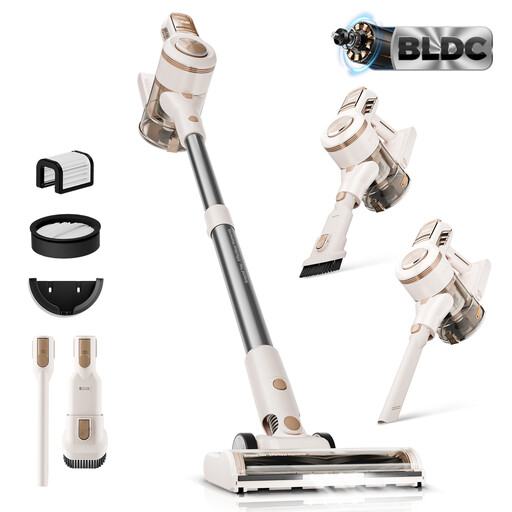
Why this model is a good fit: This device offers a solid balance of performance and price. With 45 kPa of suction power in high mode and up to 40 minutes of runtime in Eco mode, it is well-equipped for daily cleaning in small to medium-sized homes.
The spec sheet clearly states the runtimes for both suction levels (15 min on high, 40 min on low), which allows for realistic expectations and bypasses the "battery life trap."
The brushless motor ensures a longer lifespan and lower noise levels. The battery is also swappable, which increases flexibility.
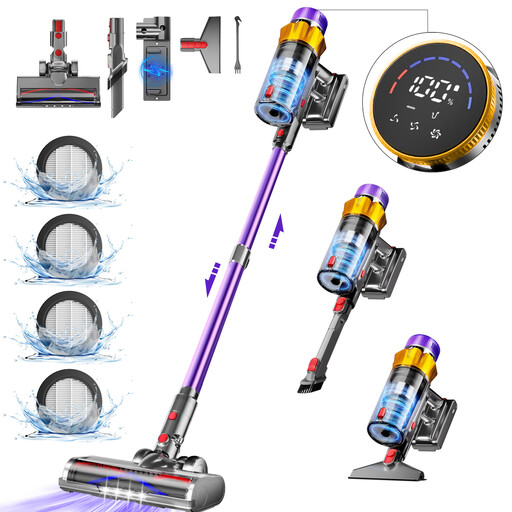
Why this model is a good fit: With a very high suction power of 65 kPa, an anti-tangle brush, and a 7-stage filtration system, this model is specifically designed for the challenges in households with pets and for allergy sufferers.
The multi-stage filtration system, which the manufacturer claims filters 99.99% of fine dust, directly addresses the "filtration trap" and ensures clean exhaust air. The V-shaped brush counteracts hair tangling, a common performance inhibitor.
The combination of a 70-minute runtime, a swappable battery, and a large 1.8-litre dustbin allows for extended, uninterrupted cleaning sessions.
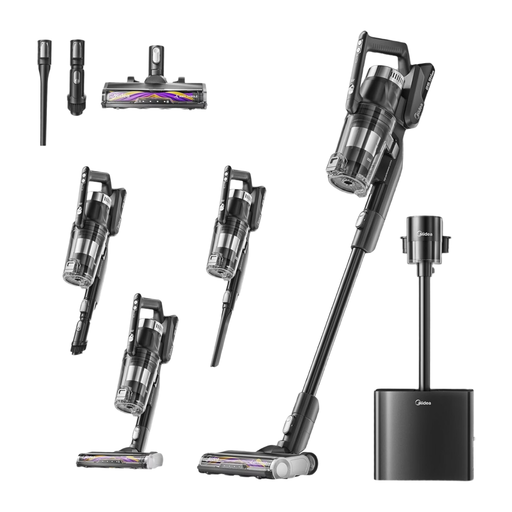
Why this model is a good fit: For users seeking maximum convenience. The auto-empty station automatically empties the vacuum's dustbin, minimising contact with dust and significantly simplifying handling. Ideal for large living spaces and a hygienic cleaning process.
The auto-empty station solves a core problem of many stick vacuums: the frequent and unhygienic emptying of the small dustbin. Furthermore, the long runtime of up to 70 minutes is realistically designed for large areas.
The automatic emptying function is the standout advantage. Combined with the anti-tangle brush and the 5-stage filtration system, the device offers a well-thought-out overall package.
We have compiled a complete, up-to-date list of products that fully meet these strict selection criteria and German safety regulations.
Most HEPA filters in modern devices are washable. It is recommended to clean the filter every two to four weeks under running water without using any detergent. It is crucial that the filter must air-dry completely (for at least 24 hours) before being reinserted. A damp filter can impair motor performance and lead to mould growth.
Pascal (Pa) is the physical unit for pressure. In a vacuum cleaner, it measures the negative pressure generated by the motor. A higher Pa value theoretically means stronger suction power at the nozzle. However, as mentioned earlier, this is only one part of the overall performance. The design of the floorhead, the device's seal, and the filtration system are just as crucial for how much dirt is actually picked up from the floor.
Yes, most modern cordless vacuums are designed as combination devices for various floor types. They often feature a motorised combination brush with rows of bristles suitable for carpets and softer elements that are gentle on hard floors. Some models even offer automatic suction power adjustment, where the device detects a carpet and increases the power on its own. For households with mixed flooring, such a vacuum for carpet and hard floors is a practical solution.