
Lieferung heute & morgen

Qualitätsgarantie

Willkommens-Angebote freischalten: KOSTENLOSE Lieferung | Bis zu 80 % RABATT | Kostenlose 30-Tage-JoyPlus-Testphase
App herunterladen
A cordless vacuum cleaner promises flexibility and convenience in your housework. But the market is flooded with devices boasting impressive technical specs and marketing promises. Choosing the right model can quickly become overwhelming. Many buyers only realise after a few months that their new device doesn't meet their expectations. To help you navigate the options, we'll highlight the three most common pitfalls when buying a cordless vacuum and show you which objective criteria truly matter.
Before you make a decision, it's helpful to understand common marketing strategies that often promise more than the devices can deliver in everyday use.
To avoid a bad purchase, you should focus on verifiable technical features that have a direct impact on daily use.
Instead of relying solely on Pascal values, it is advisable to look for the specification in Airwatts (AW), if provided by the manufacturer. Airwatts describe the actual suction performance at the end of the wand, making it a more practical indicator. A good stick vacuum for mixed flooring should offer solid baseline performance, supplemented by a turbo mode for carpets or stubborn dirt. A brushless motor is also often a sign of a longer lifespan and quieter operation.
Modern lithium-ion batteries are the standard. Pay attention to the capacity (in mAh) and voltage (in V), as these affect the total runtime. Some models offer intelligent battery management systems that adjust power according to the surface, thereby extending the runtime. For larger households, a model with a swappable battery can be a sensible option to double the cleaning time when needed.
For allergy sufferers and households with children, a multi-stage filtration system with a HEPA (High-Efficiency Particulate Air) filter is an important requirement. Such systems filter up to 99.9% of fine particles like pollen, dust mite droppings, and dust from the exhaust air. Models with cyclonic technology separate coarse dirt and fine dust before they reach the filter, which extends its life and keeps suction power consistent for longer. A vacuum with a self-emptying station offers additional convenience, as the device's dustbin is automatically emptied into a larger bag in the station.
Based on the objective criteria mentioned above, we have identified some models that are suitable for different user profiles and their specific requirements.
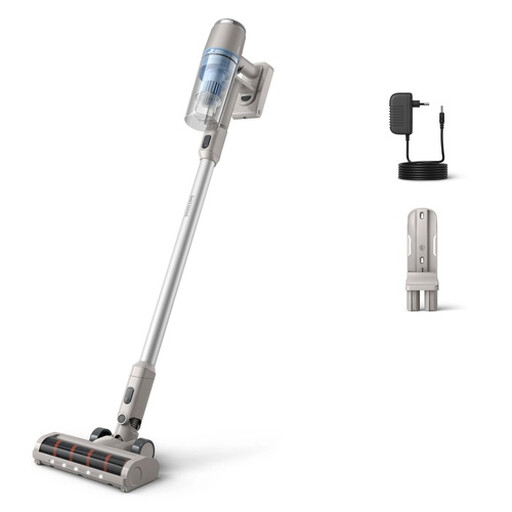
Why This Fits Their Persona: Ideal for small to medium-sized homes that need a reliable and straightforward cleaning solution for daily use. The combination of a stick and handheld vacuum provides the necessary flexibility for floors and furniture.
The device offers a realistic runtime of up to 40 minutes and relies on proven cyclonic filter technology, which ensures consistent suction power and bypasses the typical weaknesses of simple filter systems.
Flexibility thanks to the detachable handheld unit; lightweight and compact design for easy handling and storage.
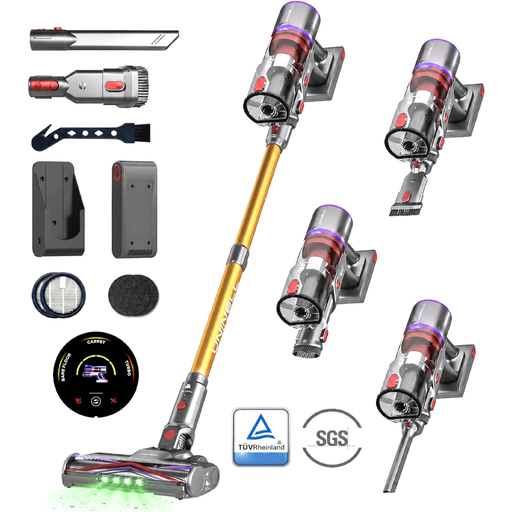
Why This Fits Their Persona: Designed for the challenges of households with pets. Its high suction power and specialised brush are engineered for the efficient removal of pet hair from carpets and hard floors.
This model provides a concrete suction power figure of 60 kPa and combines it with an anti-tangle brush that actively tackles the problem of tangled hair. The 7-stage filtration system also addresses the fine dust issue.
Specialised brush technology for pet hair removal; long runtime of up to 65 minutes and intelligent AI battery management.
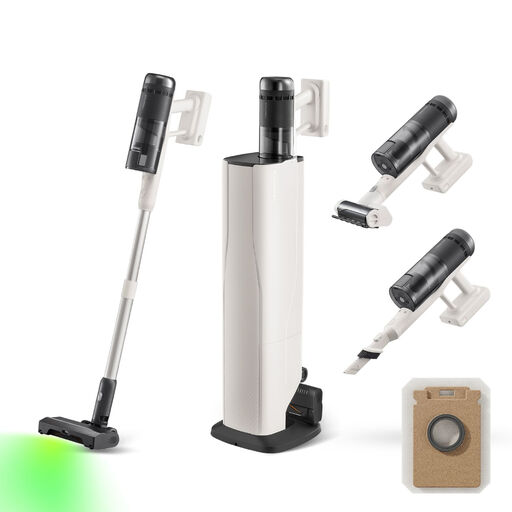
Why This Fits Their Persona: Perfect for users who value minimal maintenance and maximum efficiency. The combination of a long runtime and an automatic self-emptying station is ideal for large living areas and tech-savvy users.
The automatic self-emptying station solves the problem of frequent and unhygienic dustbin emptying. The stated 80-minute runtime is a top-tier figure that avoids the pitfall of insufficient usage time.
A vacuum with a self-emptying station for weeks of cleaning without manual emptying; high suction power of 170 AW for a deep clean on carpets and hard floors.
Some models also offer an integrated vacuum and mop function, which saves time, especially on hard floors, by vacuuming and mopping in a single pass.
We have compiled a complete, real-time list of products that fully satisfy these strict selection criteria and UK safety regulations.
1. How long does the battery of a cordless vacuum really last? The actual runtime depends heavily on the selected suction mode and the floorhead used. In normal mode on hard floors, many devices achieve 30–45 minutes. In turbo mode, which is necessary for carpets, the runtime can drop to 10–15 minutes. Pay attention to the battery capacity (mAh) and check if the model has a swappable battery to extend the usage time.
2. Is a cordless vacuum suitable for pet hair? Yes, many modern cordless vacuums are very well-suited for pet hair. The crucial factors here are high suction power and a motorised brush with special anti-tangle technology. This prevents long hairs from wrapping around the brush roller and impairing cleaning performance. A good filtration system is also important to filter pet allergens from the air.
3. What is more important: a high Pascal figure or a specialised brush? For practical cleaning performance, the floorhead is often more important than an extremely high Pascal value. A well-designed, motorised brush actively loosens dirt and hair from carpet fibres and directs them to the suction tube. While high suction power is necessary to pick up the loosened debris, a lot of dirt will be left behind, especially on carpets, without an effective brush. The combination of both yields the best result.