
Lieferung heute & morgen

Qualitätsgarantie

Willkommens-Angebote freischalten: KOSTENLOSE Lieferung | Bis zu 80 % RABATT | Kostenlose 30-Tage-JoyPlus-Testphase
App herunterladen
A device that vacuums and mops simultaneously promises to be a significant time-saver for household chores. For families, pet owners, or homes with large hard floor areas, a cordless wet-dry vacuum seems like the ideal solution. However, the market is flooded with devices whose marketing promises often fall short in practice. Before you make a purchase, it's crucial to understand the common pitfalls that can lead to disappointment and an unused appliance collecting dust in a corner.
This guide will show you the three most common design flaws that severely limit functionality and which technical specifications you should focus on instead to find a model that truly fits your needs.
Manufacturers often advertise impressive performance specs, but the devil is in the details. These three issues are the most frequent sources of user dissatisfaction:
To avoid the problems mentioned above, you should focus on the fundamental technical design. The following three parameters are far more important for everyday performance and handling than pure marketing metrics.
An absolute must-have for any wet-dry vacuum is a dual-tank system. This ensures that fresh water and cleaning solution are kept separate from the collected dirty water. Devices with only one tank or an inadequately separated system will increasingly spread contaminated water across the floor as you clean. Only a true dual-tank system continuously mops the floor with clean water, which is essential for a hygienic result.
Instead of being swayed by the maximum runtime claim, you should consider the battery capacity in milliampere-hours (mAh) or watt-hours (Wh). A higher capacity (e.g., over 4000 mAh at 25V) is a more reliable indicator of practical, real-world runtime, even in standard or turbo modes. Also, pay attention to the charging time. A device that needs four hours to charge for 25 minutes of effective cleaning can be impractical for daily use.
The design of the cleaning head determines its thoroughness. Look for models that explicitly advertise edge-to-edge or borderless cleaning. On these devices, the brush roller is designed to reach one or both sides of the housing. This significantly minimises the dirty strip left along walls and furniture. Some devices also use a dual-brush system to improve debris pickup. For households with pets, an anti-tangle brush is also beneficial, as it reduces the tangling of long hair.
Instead of naming a single "best" device, it's more useful to consider models based on specific needs and living situations. Here are three recommendations tailored to different user profiles.
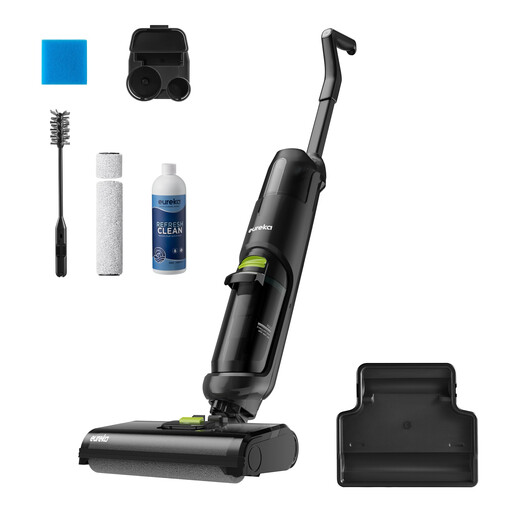
Why This Fits Their Persona: This model is designed for the typical challenges of a busy household: spills, sticky messes, and pet hair. Its self-propulsion feature makes it easy to handle and reduces the physical effort required for cleaning.
The consistent dual-tank system ensures that pet hair and dirt are not spread across the floor with the mopping water, guaranteeing a hygienic result.
The self-cleaning function flushes the brush and internal pipes at the touch of a button, reducing manual maintenance. The self-propelled function makes cleaning less strenuous.
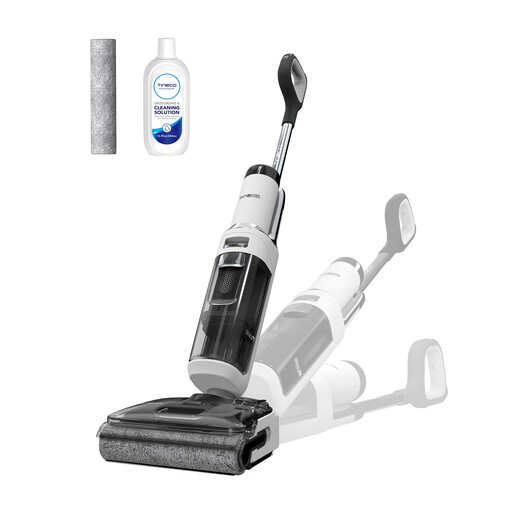
Why This Fits Their Persona: Ideal for users who want uncompromising cleaning, even under low-profile furniture like sofas, beds, or cabinets. Its lay-flat design solves a problem where many standard wet-dry vacuums fail.
This model counters the pitfall of poor edge cleaning with a 3-sided, edge-to-edge design. Additionally, its 180° lay-flat capability allows it to clean in places that would otherwise remain inaccessible.
The ability to lay completely flat on the floor (13 cm height) is a clear standout feature. The FlashDry self-cleaning system uses 70°C hot water (according to the manufacturer) and then dries the brush to minimise odour build-up.
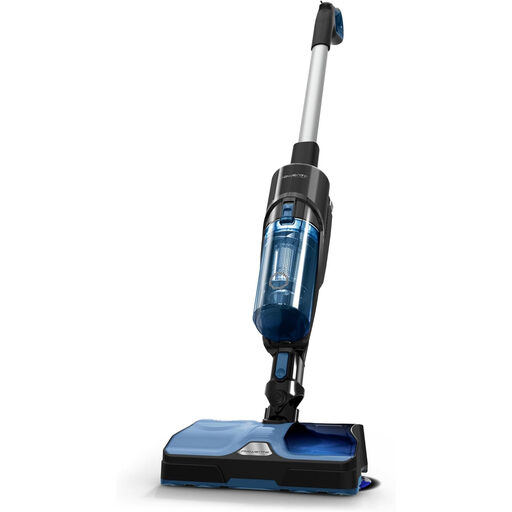
Why This Fits Their Persona: For users looking for an exceptionally lightweight and nimble device for daily maintenance cleaning. It's designed less for tackling major messes and more for quickly removing dust and light dirt in a single pass.
This model avoids the pitfall of being cumbersome to handle thanks to its extremely low weight of only 3.1 kg. Combined with its long battery life of up to 60 minutes, it's ideal for quick use without the battery becoming a limiting factor.
The ultra-lightweight design makes it especially easy to manoeuvre and store. The rotating mop pads are designed for active stain removal and are machine-washable.
We've compiled a full, up-to-date list of products that fully meet these strict selection criteria and UK/EU safety regulations.
The vast majority of cordless wet-dry vacuums are designed exclusively for use on sealed hard floors such as tile, laminate, vinyl, or sealed wood. The rotating, wet brush is unsuitable for carpet fibres and can damage them. A few hybrid models offer interchangeable brushes for a vacuum-only function on carpet, but their primary function as a wet-dry vacuum is limited to hard floors.
Most devices use washable filters (often HEPA filters). Manufacturers generally recommend rinsing the filter under running water after each use, or at least once a week. It is crucial to let the filter dry completely (for at least 24 hours) before reinserting it to prevent mould growth and a loss of suction power. Replacing the filter is recommended every 3 to 6 months, depending on the model and frequency of use.
No. The self-cleaning function is a great help, but it is not a complete substitute for manual maintenance. It effectively flushes the brush roller and the direct dirt channels. However, you must still empty and rinse the dirty water tank after every use to prevent odours. Additionally, you should regularly (e.g., weekly) inspect the brush cover and the areas around the roller for stubborn build-up or tangled hair and clean them manually.