
Lieferung heute & morgen

Qualitätsgarantie

Willkommens-Angebote freischalten: KOSTENLOSE Lieferung | Bis zu 80 % RABATT | Kostenlose 30-Tage-JoyPlus-Testphase
App herunterladen
A cordless air pump is useful when there is no power socket available. It can save time when topping up a car tyre, inflating a bicycle tyre or preparing a campsite. However, the devices vary considerably: an electric air pump for air beds works with a high air volume, while a cordless tyre compressor needs to build up higher pressure.
If you focus only on wattage, the maximum PSI rating or particularly compact dimensions, you may end up buying a device that is unsuitable for its intended use. The following criteria can help you avoid common purchasing mistakes.
A high flow rate in litres per minute sounds convincing at first. It is relevant for air beds, inflatable boats and other inflatables. For a car tyre, however, the achievable pressure in BAR or PSI is also important. A portable air pump with a high airflow but low pressure is not automatically suitable as a car air pump.
For tyres, you should therefore check:
Manufacturers’ battery capacity specifications do not always show how many tyres can actually be inflated. Temperature, tyre pressure, tyre size and the initial pressure all affect runtime. A mini compressor with 2,000 mAh may be sufficient for occasional top-ups, while inflating a completely flat tyre requires significantly more energy.
Specific usage information is helpful, such as an approximate inflation time, the number of tyres supported or an additional power supply option.
A device without the right connection is of limited use when you are out and about. Car tyres usually require a Schrader valve connection, while bicycles may use a Presta connection depending on the model. Balls, air beds and inflatables require additional nozzles.
You should therefore check that the hose, adapters, nozzles and charging cable are included before buying. A digital tyre pressure gauge or automatic shut-off can also help prevent the set target value from being exceeded. The tyre pressure recommended by the vehicle manufacturer remains the key reference and should be checked when the tyres are cold.
The pressure range should suit the intended use. For many passenger cars, the recommended tyre pressure is approximately between 2.0 and 3.5 BAR, depending on the vehicle, load and tyres. A device with an adjustable target value and automatic shut-off is practical for repeated top-ups.
Specifications such as ±0.05 BAR or ±0.01 kg/cm² describe the stated pressure accuracy. They do not replace checking with a separate gauge when particularly precise measurement is required.
An electric bicycle pump or battery-powered tyre inflator should not be judged solely by its maximum flow rate. For a tyre, a balanced combination of pressure build-up, air volume and operating time is crucial. An air bed pump, on the other hand, primarily needs to deliver a large volume of air at comparatively low pressure.
Check whether the manufacturer distinguishes between inflation and deflation. This function is relevant for camping equipment, but is not available on every cordless tyre compressor.
For storage in the glove compartment, compact dimensions and low weight are important. A USB-C connection makes charging in the car easier, provided a suitable power adapter or power bank is available. Some devices also offer a 12-volt cable function. This is useful when several tyres need to be inflated one after another and the battery capacity is not sufficient.
When storing the device, follow the manufacturer’s instructions regarding temperature, humidity and direct sunlight. Battery-powered devices should not be kept in interiors that become excessively hot for long periods.
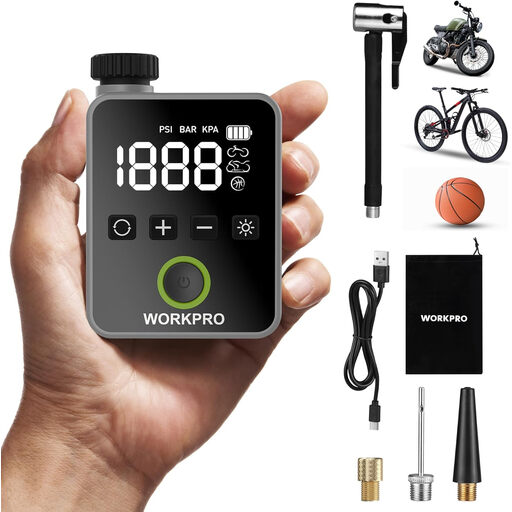
Why this product suits this profile: Weighing 270 g and measuring a compact 10.5 × 7.3 × 3.5 cm, this model offers four operating modes and four nozzles, making it suitable for occasional use in the car, when cycling or while camping.
The pressure range of 3 to 140 PSI, the PSI, BAR and KPA units and the automatic shut-off make the adjustment options clear and easy to understand. The device is explicitly not suitable for lorry or trailer tyres.
Display showing real-time pressure, battery level and mode; plus a torch, SOS function and power bank function.
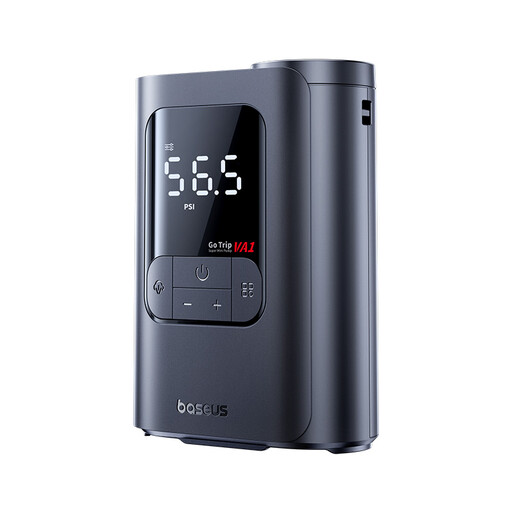
Why this product suits this profile: This model combines a maximum motor output of 82 W, five inflation modes and a stated pressure accuracy of ±0.05 BAR. It is designed for passenger cars, SUVs, light commercial vehicles, motorbikes, bicycles and balls.
The intended applications and the recommended passenger-car pressure range of around 2.0 to 3.5 BAR are described transparently. The device is not designed for heavy lorry tyres.
2500 mAh battery at 7.4 V, USB-C input at 5 V and 2.4 A, plus three nozzles supplied.
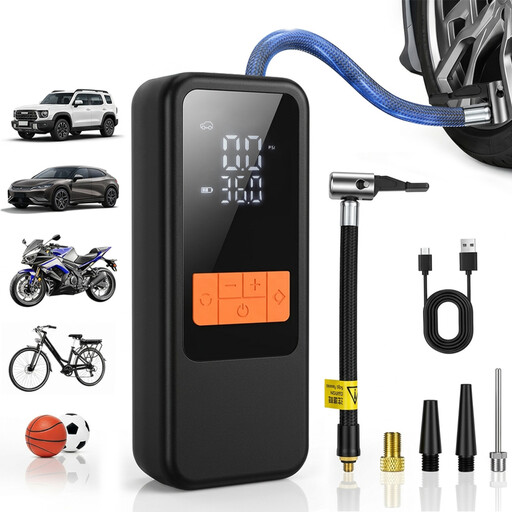
Why this product suits this profile: With a 4000 mAh capacity, five preset modes and a stated runtime of up to 25 minutes, the Q16 is designed for repeated use on car, motorbike and bicycle tyres.
The product specifications state specific times: around 7 to 8 minutes for a flat tyre and approximately 30 seconds for a top-up. This makes it easier to compare usage with the battery life.
150 PSI maximum pressure, stated detection accuracy of ±0.01 kg/cm², USB-C connection, plus power bank and SOS light functions.
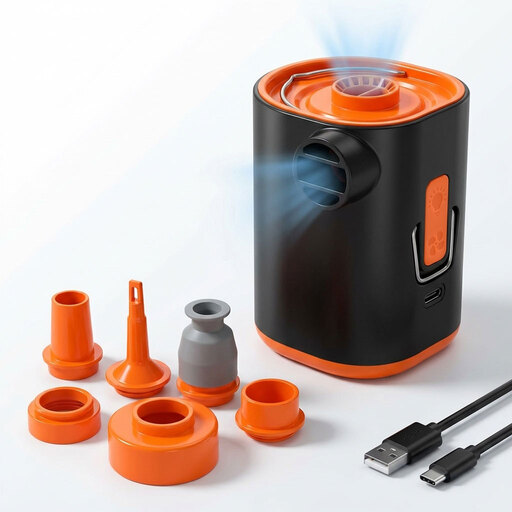
Why this product suits this profile: This electric air pump has a stated inflation and deflation performance of 300 l/min and is fitted with a light. It is therefore particularly suitable for air beds, camping equipment and other high-volume inflatables.
The specifications of 300 l/min and 4800 Pa make it clear that the focus is on air volume rather than the typical tyre pressure of a passenger car. For tyres, you should therefore choose a compressor specifically designed for that purpose.
Two 1800 mAh batteries connected in series, an approximately three-hour charging time and 12 white LED lights with a stated illumination time of up to five hours.
We have put together a complete, regularly updated list of products that fully meet these strict selection criteria and the safety regulations applicable in the EU.
Runtime depends on the pressure difference, tyre size, outside temperature and operating mode. A smaller capacity is often sufficient for occasional top-ups. If you want to inflate several tyres or completely flat tyres, you should consider specific manufacturer information on inflation time and an alternative power supply.
That depends on the device. An air bed pump usually works with a high air volume and low pressure. A tyre compressor with a narrow hose is not always suitable for this purpose. Models with separate nozzles and a specified inflation or deflation function may be better suited to camping applications.
Power consumption mainly comes from charging the battery. For individual pressure adjustments, the ongoing energy consumption is normally low. If you use the device frequently, you should also check whether the battery is replaceable, how long charging takes and whether the device may be operated while charging.