
Lieferung heute & morgen

Qualitätsgarantie

Willkommens-Angebote freischalten: KOSTENLOSE Lieferung | Bis zu 80 % RABATT | Kostenlose 30-Tage-JoyPlus-Testphase
App herunterladen
A cordless impact wrench can make tire changes, vehicle repairs and many assembly tasks considerably easier. However, tools vary significantly in torque, battery platform, tool holder and included accessories. A high figure on the packaging does not automatically mean that the impact wrench is suitable for every task.
The following buying criteria help vehicle owners, DIY enthusiasts, workshops and mobile roadside-assistance professionals assess marketing claims objectively.
Many manufacturers prominently highlight the maximum breakaway torque. This describes the force with which a seized connection can be loosened under specific conditions. The fastening torque may be considerably lower.
There is also an important point to remember when working on wheel nuts: An impact wrench does not normally replace the final use of a torque wrench. After power-assisted tightening, the nuts should be checked and tightened to the specified torque in accordance with the vehicle manufacturer’s instructions.
When purchasing an impact wrench with battery, check carefully whether a battery and charger are actually included. Models such as the Greenworks IWG406 are supplied without a battery and charger according to the product information. This can make sense if you already own compatible batteries from the same platform. Otherwise, beginners should factor in additional costs.
A USB charging cable should not be confused with a powerful fast charger, either. Charging time and the availability of a spare battery have a direct impact on how practical a cordless impact wrench is in everyday use.
A high revolutions-per-minute figure can be useful for fast workflows. When tightening sensitive connections with precision, however, finely adjustable speed control is more important. Multiple speed settings, a variable-speed trigger and an easily accessible forward/reverse switch provide greater control.
For wheel nuts and socket attachments, a 1/2-inch cordless impact wrench with a square drive is generally the more suitable design. The drive is intended for standard impact-rated sockets and is suitable for many jobs on passenger cars, vans and, in some cases, trucks.
A 1/4-inch hex drive, by contrast, is commonly found on compact impact drivers for screws and lighter assembly work. According to its product description, the Makita TW060DZ features a 1/4-inch hex drive and a maximum torque of 60 Nm. It is therefore intended more for convenient screwdriving tasks than for heavy-duty wheel nuts.
The required torque for an impact wrench depends on the vehicle, fastener size, corrosion and working environment. For occasional passenger-car work, tools delivering around 200 Nm may be sufficient. Seized connections, vans and truck wheels require greater performance reserves.
It is important to distinguish between the manufacturer’s specification and real-world performance. Figures such as 1,000 or 1,800 Nm should be treated as nominal maximum values. The socket, battery condition, temperature and state of the connection all affect the result.
Capacity is specified in Ah. Two batteries can be useful during longer sessions, as one battery can power the tool while the other is charging. Higher capacity, however, often also means greater weight.
A brushless impact wrench can offer design-related advantages in terms of maintenance requirements, energy efficiency and overall size. These features are not, however, definitive proof of a particular service life. Also look for overload protection, temperature monitoring, a battery-status indicator and the availability of compatible replacement batteries.
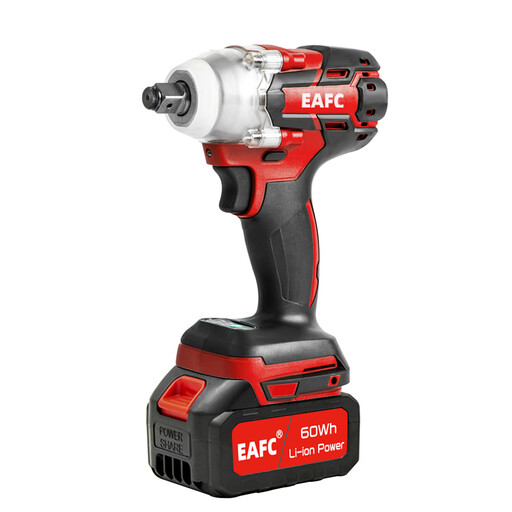
Why it fits: An option for occasional passenger-car work, minor repairs and DIY projects when you are looking for a compact cordless tool with essential features.
The stated maximum torque of 200 Nm and the included battery and USB charging cable are clearly specified. For regular truck work, however, the tool’s performance should be assessed carefully.
According to the product information: brushless motor, LED work light, variable-speed control and a 60-Wh lithium battery.
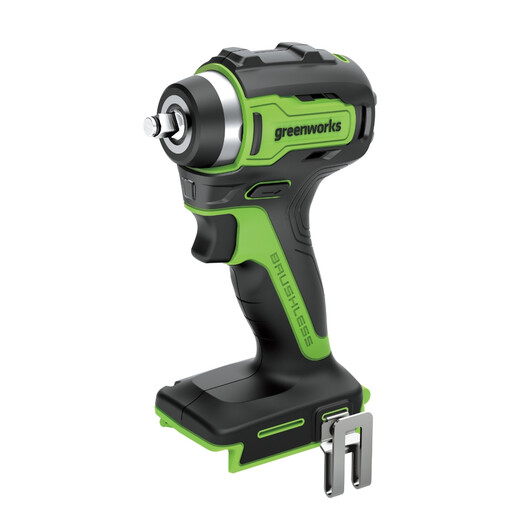
Why it fits: Suitable for users who already work with the Greenworks 24V platform and want to add a lightweight tool for vehicle, construction or assembly work.
The battery is explicitly listed as not included. This makes it easier to calculate the total cost realistically if compatible Greenworks batteries are already available.
200 Nm of torque, 1/2-inch square drive, brushless motor, LED light and a weight of 0.95 kg according to the product information.
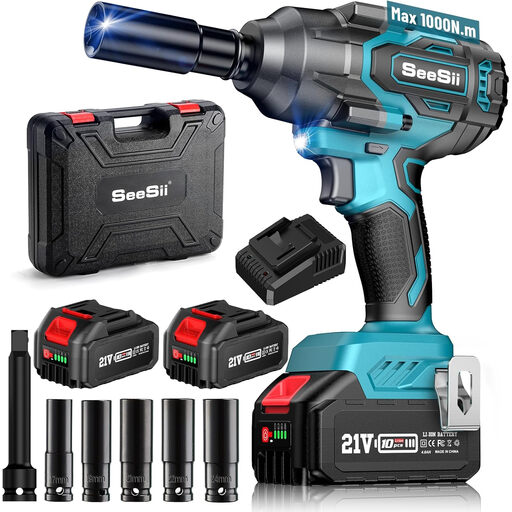
Why it fits: For users looking for an impact wrench for tire changes, seized fasteners and varied work on passenger cars, vans or in assembly environments.
The package contents specify two 21V batteries rated at 4.0 Ah each, a charger, five sockets and a case. This makes it easier to identify any missing accessories before purchase.
The stated specifications include 1,000 Nm of breakaway torque, 800 Nm of fastening torque, three speed settings and a 1/2-inch drive. These figures come from the manufacturer’s specifications.
Our complete selection of cordless torque impact wrenches makes it easier to compare torque, battery platforms, accessories and tool design.
For many passenger-car applications, tools in the region of 200 Nm are used. Heavily corroded fasteners, vans and trucks may require greater reserves. The actual breakaway torque, a suitable 1/2-inch socket and the battery condition are decisive. Final tightening should be carried out with a torque wrench in accordance with the vehicle manufacturer’s specifications.
Runtime depends on battery capacity, load, temperature, fastener size and work intervals. In principle, a 4.0-Ah battery offers more energy reserve than a smaller battery with the same voltage. Manufacturer runtime figures should be treated as guidelines. For workshop or roadside-assistance use, two batteries and a fast charger are practical.
A kit can be cost-effective if you do not yet own a compatible battery platform. When comparing options, look beyond the price to battery capacity, charging time, socket sizes, carrying case and spare-parts availability. If you already own batteries from Makita, Greenworks or another platform, a bare tool may be the more economical choice—provided that the voltage and battery series are compatible.