
Lieferung heute & morgen

Qualitätsgarantie

Willkommens-Angebote freischalten: KOSTENLOSE Lieferung | Bis zu 80 % RABATT | Kostenlose 30-Tage-JoyPlus-Testphase
App herunterladen
Cordless tools make repairs, model-making and car care easier, without an extension lead getting in the way. However, cordless tools for DIY and car detailing vary considerably in speed, tool holder, battery system and accessories. A tool suitable for metal is not necessarily suitable for delicate paintwork.
A high speed can be useful for engraving or sanding. But when polishing delicate surfaces, speed control, the polishing attachment and the type of movement matter just as much. A rotary polisher works differently from a dual-action polisher. Without the right settings, too much friction can build up.
A set with 35 or 77 pieces sounds comprehensive. What matters is whether the attachments fit the collet system and are suitable for the material you plan to work on. For example, the Fanttik F2 Master is listed with a 3/32-inch or 2.3 mm collet. Accessories with a different shank diameter are not automatically compatible.
Some tools come with a battery and charger, while others do not. According to the product details, the 24V BL 3S Angle Grinder 125mm 700W Tool Only, No Batteries Included comes without a battery or charger. Before buying, check the battery voltage, platform and what’s included. A tool body that looks like a bargain could end up costing more.
For sanding, polishing, drilling and engraving, variable speed is more practical than a tool with just one setting. A USB-C rotary tool with several speed settings is suitable for small adjustments to wood, plastic, metal or model-making components. For a cordless car polisher, low and medium speeds are important for applying polish with control.
Look out for:
Maximum speed alone tells you little about how suitable a tool is for the job. A mini multi-tool with speeds of up to 25,000 rpm is designed for precise, small-scale work, not for polishing large areas of a car.
Compare battery voltage, capacity in Ah, charging time and the availability of replacement batteries. Two 12 V batteries can allow you to work for longer, while a built-in USB-C battery is particularly handy for small jobs on the go.
Also check:
For longer jobs, allow time for the tool to cool down. Stated runtimes often refer to specific conditions, such as no-load operation or light use.
For a 125 mm cordless angle grinder, the disc must be the stated diameter and have the correct fitting. According to its product details, the Greenworks angle grinder takes 125 mm discs and reaches speeds of up to 8,500 rpm. A guard, safe disc-changing mechanism and sturdy auxiliary handle are all important for practical use.
With a mini polisher, the backing plate sizes determine the working area. Small pads can reach door handles, areas around wheels and narrow edges; larger backing plates cover more ground. A dual-action drive can help deliver a more even movement, but it is no substitute for the right polishing technique and pad.
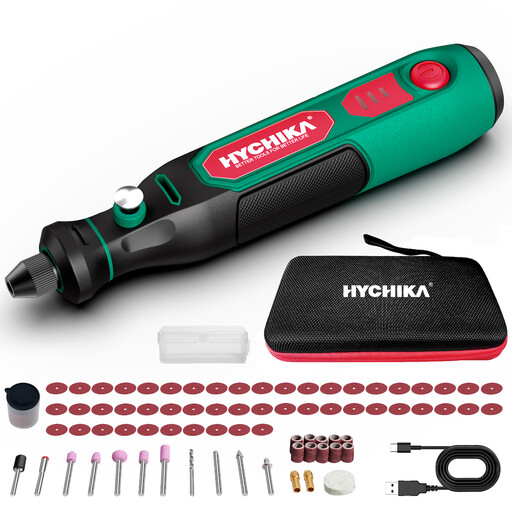
Why it suits this user: This compact set combines a 3.6 V tool with 77 accessories, three speed settings and a USB-C charging cable. It’s well suited to occasional repairs, model-making and light craft projects.
The three clearly stated speed settings make it easier to choose the right one for different small jobs. Even so, check that the included attachments are suitable for the material you plan to work on.
77-piece accessory set, 250 g weight and USB-C charging port, according to the product description.
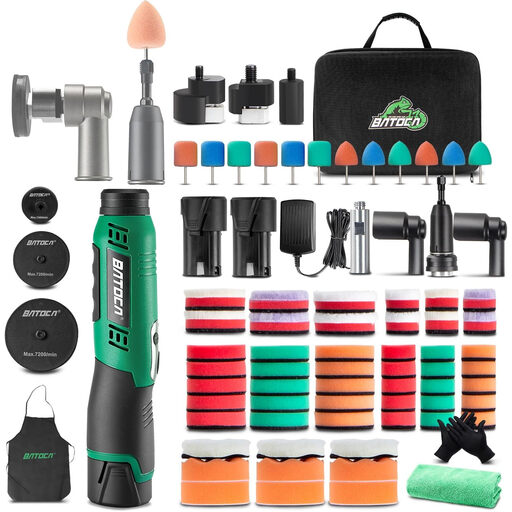
Why it suits this user: According to the product details, this mini polisher has a switchable RO/DA system, two 12 V batteries and several backing plate sizes for detailing a car.
The separate RO and DA speed details, along with the 25, 50 and 75 mm backing plates, make the intended uses clearer than a maximum speed figure alone.
Two 12 V batteries, each with a 2.0 Ah capacity, and 3 mm and 12 mm dual-action drives, according to the product description.
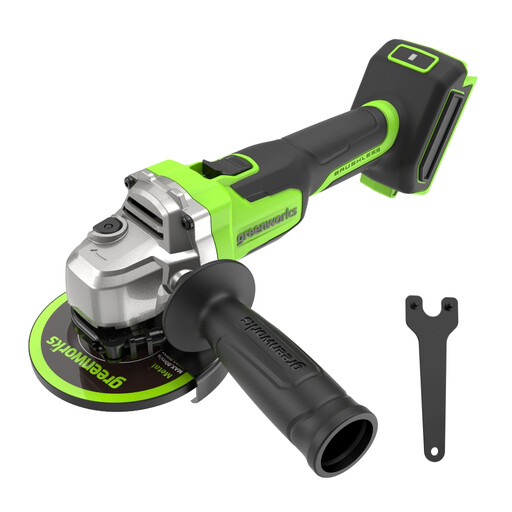
Why it suits this user: For working with metal, removing rust and preparing surfaces, a 125 mm cordless angle grinder is more practical than a precision tool. This model is designed for the Greenworks 24 V battery system.
The product name clearly states that the battery is not included, making it easier to work out the total cost before buying.
125 mm disc fitting, brushless motor, spindle lock and speeds of up to 8,500 rpm, according to the product details.
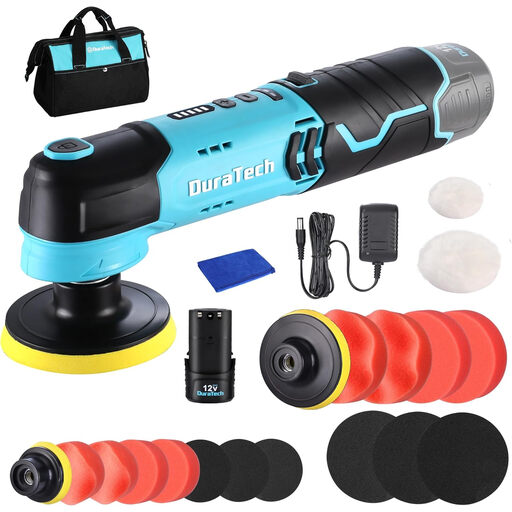
Why it suits this user: This compact tool is listed with 50 and 80 mm polishing pads and a 2.0 Ah battery. It’s designed for detailed work on cars, furniture and metal.
The two pad sizes are clearly specified, reducing the risk of choosing a large-area polisher for tight spaces. A larger backing plate may be more efficient for polishing an entire car.
Five adjustable settings from 600 to 3,000 rpm, a weight of 810 g and 50/80 mm pads, according to the product description.
We’ve put together a complete, regularly updated list of products that meet these strict selection criteria and fully comply with the safety regulations in force in the EU.
When sanding, polishing, drilling and engraving, match the attachment, material and speed to the task. When using an angle grinder, essential equipment includes safety glasses, hearing protection, suitable gloves and a correctly fitted guard. Secure workpieces firmly. Remove the battery before changing a disc or carrying out maintenance.
When working on car paint, start on an inconspicuous area, using a clean pad and a low speed. Use polishing compounds and pads in line with the manufacturer’s instructions. A cordless polisher is no substitute for careful preparation: dust, sand and coarse dirt can cause additional scratches during polishing.
A cordless rotary tool with several speed settings and suitable accessories is ideal for engraving, drilling, deburring and light polishing. Before buying, check the shank size of the attachments, the tool’s weight and how it charges. A USB-C model can be particularly handy for very small jobs.
The two systems work differently. A rotary polisher moves the pad in a circle and is suitable for controlled work if you have the right experience. A dual-action polisher combines rotation with an eccentric movement. Speed, pad, polishing compound and correct technique all remain important. Neither type can be considered suitable for every paint finish.
As well as the purchase price, you may need to budget for replacement batteries, polishing pads, abrasives and cleaning accessories. If the tool doesn’t include a battery, you’ll need to buy one separately. A cordless polisher with a replaceable battery may be more practical for regular use, while a built-in USB-C battery requires fewer accessories for occasional small jobs.