What should you look for when buying?
First decide whether you want a crunchy corn snack, then compare it with the amount you’d actually eat. The options below differ in shape and ingredients; no product description can replace checking the nutritional information.
Corn and amaranth wafers
A good fit if: you’re looking for a dry, crunchy snack you can take out one piece at a time.
Bear in mind: Alnatura Corn and Amaranth Wafers with Rosemary, listed by EDEKA24, contain 381 kcal per 100 g. That’s above the threshold at which the German Nutrition Society classifies foods as having a high energy density.
Corn and peanut maize snacks
A good fit if: you fancy peanut maize snacks and want to compare different options in this category.
Bear in mind: Lorenz promotes ErdnußLocken Leicht as containing less fat than conventional peanut maize snacks. This doesn’t mean that it’s lower in energy per portion in every case, nor is it suitable for anyone with a peanut allergy.
Corn tortillas
A good fit if: you like the texture of tortillas or want to serve them with a dip.
Bear in mind: If you’re having a portion with dip, consider the total amount you eat, not just the nutritional information for the tortillas.
| What to consider |
What to check when buying |
Who it matters most to |
| Energy and portion size |
Compare kcal per 100 g with your planned amount in grams; if a product is described as ‘lower fat’, compare its energy content too. |
If I only want a small bowl to nibble on, the amount I serve myself needs to match my plan. Around 50% of consumers prioritise the energy content of their snack portion. |
| Product type and ingredients |
Check the ingredients list and allergen labelling on the specific pack; don’t treat corn wafers, tortillas and peanut maize snacks as the same thing. |
If you’re specifically looking for a corn snack or need to avoid peanuts, you need to know what’s in the recipe. Ingredients and allergens come first for around 30% of consumers. |
| Salt and accompaniments |
Use the salt per 100 g figure to work out the amount in your portion, and consider dips or other ingredients separately. |
If I’m having a dip with my snack, I want to assess the whole combination, not just the tortillas. Around 20% of consumers prioritise checking salt and accompaniments. |
Brands to help you choose
The product ranges mentioned here cover different types of snacks. What matters is the nutritional and ingredients information for the specific variety, not the brand name.
Lorenz
ErdnußLocken combine corn and peanuts, while ErdnußLocken Leicht is one option in this product category.
- Lorenz promotes ErdnußLocken Leicht as containing 30% less fat than conventional peanut maize snacks.
- The fat content isn’t a substitute for comparing energy per 100 g and in your planned portion. The product contains peanuts.
Chio
Chio describes its tortillas as toasted corn tortillas.
- This product type fits the bill if you’re looking for crunchy corn tortillas.
- Compare the nutritional information for the variety you choose and remember to account for any dip separately.
Lidl / Snack Day
Snack Day Maissnack Bio is a corn snack product listed by Lidl.
- The specific product name makes it easier to compare with other corn snacks.
- A product claim or organic label doesn’t tell you how many kcal are in your portion. The nutritional information on the pack is what counts.
funny-frisch
The popchips Red Paprika and Ofen Chips Paprika mentioned here are alternatives for snacking, but they aren’t corn snacks.
- funny-frisch lists 135 kcal for a 30 g portion of popchips Red Paprika.
- A serving size for a different product can’t be applied to corn tortillas, maize snacks or wafers.
Corn-based products at Joybuy
These two tinned products give you corn you can portion out, but they won’t have the crunch of crisps, maize snacks or wafers. If you’re considering them as an alternative, check the nutritional information on the pack and note what the per 100 g figure refers to.
 No image available
Nong Sao Sweetcorn Kernels, 400 g
Tinned sweetcorn is worth considering if you’d like a portion of corn you can serve yourself, rather than a crunchy snack. The product description recommends draining and rinsing it; check what the nutritional information on the pack refers to when working out your portion.
View at Joybuy
 No image available
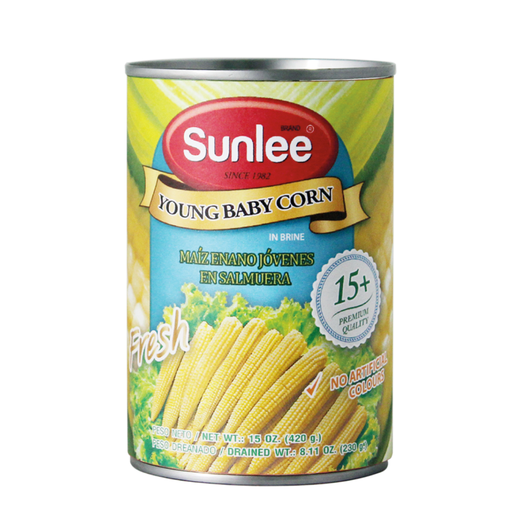
Sunlee Baby Corn, 420 g
Baby corn is an option if you want to portion out corn without expecting a crunchy snack. The product description says to drain and rinse it before eating; check the serving size and basis for the nutritional information against the pack.
View at Joybuy
Frequently asked questions
Are corn snacks automatically low in calories?
No, you can’t tell from the presence of corn alone. The German Nutrition Society classifies foods containing more than 225 kcal per 100 g as having a high energy density; Alnatura Corn and Amaranth Wafers with Rosemary, listed by EDEKA24, contain 381 kcal per 100 g. Also compare this with the amount you plan to eat.
Does ‘less fat’ in corn snacks also mean fewer calories?
Not necessarily. A comparative claim about fat doesn’t, on its own, tell you how much energy a portion contains. For the specific variety, check both the fat and kcal per 100 g, then work out the energy in your portion.
What should I look for if I have a peanut allergy?
Check the ingredients list and allergen labelling on the pack you’re planning to buy. Lorenz ErdnußLocken Leicht contains peanuts; the presence of corn doesn’t make peanut maize snacks peanut-free.
How do I compare salt in a snack served with dip?
Use the salt per 100 g figure to work out the amount in your tortilla portion, and consider the dip separately. The German Nutrition Society recommends that adults have no more than 6 g of salt per day; the salt content of the plain snack doesn’t reflect the whole combination.


