Commuters with a lunchbox
If you only want to take one bag to enjoy with your coffee, look for individually wrapped portions and check the weight of each bag. That way, you won’t have to pack an opened large bag in your rucksack.


For a quick coffee break on the train, individually wrapped portions are an obvious choice: take one sealed bag with you and leave the rest unopened. Several larger bags are better for sharing or for multiple journeys. The key things to check are the weight of each individual bag and the ingredients and allergen information for the flavour you choose.
If you only want to take one bag to enjoy with your coffee, look for individually wrapped portions and check the weight of each bag. That way, you won’t have to pack an opened large bag in your rucksack.
Separate larger bags can be a good choice for sharing over coffee or taking on several journeys. Before sharing, check that the heat level, ingredients and allergen information are suitable for everyone.
If milk ingredients or possible traces of certain allergens matter to you, read the labelling for the specific flavour. Information for another flavour or a pack you bought previously is no substitute for checking the one you’re choosing.
First, decide whether you need a small bag for one journey or larger bags to share. Then check the flavour and whether the total quantity suits how much you’ll use.
A good choice if: You want to take just one small, sealed bag on a journey. A Fonzies multipack listed by Amazon.de contains eight 23.5 g bags.
Worth bearing in mind: This particular offer includes ten of these multipacks. The recipe contains milk ingredients and mentions possible traces of wheat and peanuts.
A good choice if: You want to share a bag or take sealed bags on several journeys. A Takis offer listed by Amazon.de includes three 100 g bags.
Worth bearing in mind: Each bag is still a larger size, and the flavour on offer is explicitly described as spicy.
A good choice if: You want to try just one flavour or share a bag. Chio states that Tortillas Salted comes in a 110 g bag.
Worth bearing in mind: The 110 g bag isn’t a multipack of small individual portions; Chio says the flavour may contain wheat.
| What to consider | What to check | Who it matters to |
|---|---|---|
| Individual portions | How many individual bags are there, and how many grams does each contain? | For a coffee break on the train, I want to pack just one small, sealed bag. Around 33% of consumers prioritise individual portions. |
| Flavour and ingredients | Check the specific flavour, its ingredients and any allergen information on the pack. | When sharing a snack, I want the seasoning to suit everyone and to be able to spot any relevant ingredients beforehand. Around 27% of consumers prioritise this. |
| Sharing and stocking up | Compare the number of separate bags with the weight of each one. | If several people are sharing or I want to save bags for later journeys, I need them to be individually packed. Around 20% of consumers prioritise this option. |
| Right overall quantity | Compare the total weight and unit price; check the best-before date and storage instructions. | I only want to buy a larger quantity if I can store and use it. For around 20% of consumers, this is their top consideration. |
A multipack might contain a few 100 g bags rather than lots of small individual bags. These formats aren’t the same when you want something for a single coffee break.
Before choosing a pack for your lunchbox, check how many individual bags it contains and how much each one weighs.
Other ingredients and possible traces vary by flavour. For example, Chio says that Tortillas Salted “may contain wheat”.
Check the ingredients list and allergen information for the specific pack, rather than relying on the description “corn snack”.
Chio lists 148 kcal and 0.38 g of salt per 30 g serving for Tortillas Salted; the bag contains 110 g. So the values for one serving don’t apply to the whole bag.
When checking nutritional information, see whether it’s given per 100 g or per serving, and compare the serving size with the contents of the bag.
Separate bags are only practical for future journeys if you can store them properly until you’re ready to use them.
Check the best-before date, the condition of the packaging and the storage instructions. Seal any opened bag carefully before storing it.
Chio makes corn tortillas in a range of flavours. For Tortillas Salted, the manufacturer lists a 110 g bag.
A Fonzies multipack listed by Amazon.de is aimed at shoppers looking for small, separate portions, with eight 23.5 g bags.
A multipack of Takis Blue Heat listed by Amazon.de contains three separate 100 g bags, for shoppers looking for a flavour that’s explicitly described as spicy.
In June 2023, Lidl Germany reported on an ÖKO-TEST review of its Snack Day organic corn snack.
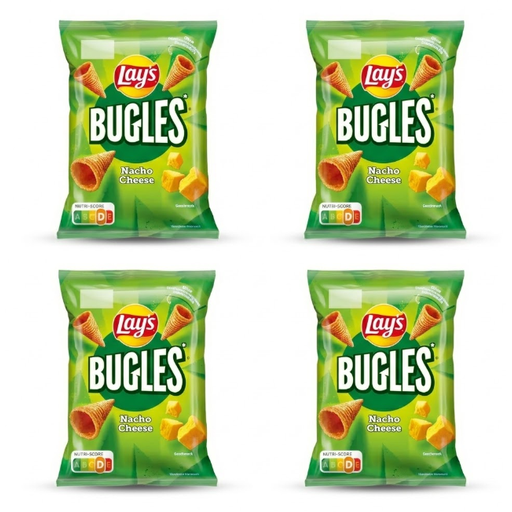
This four-pack contains separate bags for several journeys or sharing. Check whether a 75 g bag fits your lunchbox and the amount of space you have.
 No image available
The separate bags are handy for several snack breaks or sharing. At 75 g per bag, this isn’t specifically described as a small-portion format for a lunchbox.
Four bags with nacho cheese seasoning. The product description mentions gluten and possible traces of soya and wheat; check the labelling on the pack you buy.
Look for the stated number of individual bags and the weight of each one. Eight 23.5 g bags, as in the Fonzies multipack listed by Amazon.de, are a different format from the three 100 g bags in the Takis offer listed there.
No. You can’t tell whether a specific pack is gluten-free just because it contains corn. Chio labels Tortillas Salted with the warning “May contain wheat”, so check the information for the flavour you want to buy.
Before you buy, read the ingredients and allergen information for the specific product, then check it against the packaging when it arrives. Especially when flavours differ, don’t assume that the labelling for another one applies.
Not necessarily. The Verbraucherzentrale distinguishes between a best-before date and a use-by date, and points out that food stored correctly in sealed packaging is often still safe to eat after its best-before date. Check the packaging, storage conditions and the food itself in each case.