
Lieferung heute & morgen

Qualitätsgarantie

Willkommens-Angebote freischalten: KOSTENLOSE Lieferung | Bis zu 80 % RABATT | Kostenlose 30-Tage-JoyPlus-Testphase
App herunterladen
A corner desk is a smart solution for transforming unused corners into a productive workspace. Whether for a home office, study area, or gaming station, the L-shape provides an expansive work surface without dominating the room. However, the selection process has its pitfalls, and what looks like a bargain can quickly turn into a purchase you'll regret. Before you make a decision, you should be aware of the most common flaws that often only become apparent after assembly.
Many models look appealing online but disappoint in practice due to design flaws. Pay close attention to these three points to avoid a poor investment:
To avoid these problems, focus on a few crucial technical features. These define the longevity and functionality of your new workspace.
The foundation of any good desk is its frame. A sturdy metal frame is often the most reliable choice here. Look for additional supports, especially X-shaped crossbars at the back, as they significantly improve lateral stability. For the tabletops, P2-grade engineered wood is a common standard that offers a good balance between durability and weight. The board thickness should be at least 15 mm to prevent sagging under the weight of monitors.
A reversible build is a key advantage. This means you can mount the longer section of the desk on either the left or the right. Measure your corner precisely before buying and compare the dimensions with the product specifications (length x width x height). Also, consider the space you need for sitting and for your chair. For smaller rooms, a small corner desk with side lengths around 120 x 100 cm is often a good choice.
Think carefully about what you need to store. A desk with drawers and shelves offers a combination of concealed and open storage. Open shelves are ideal for binders, books, or a PC tower, while drawers help keep stationery and small items organised. For an ergonomic workspace, an integrated monitor stand can be beneficial. It promotes better posture and creates additional space on the main work surface.
Here are some models tailored to specific user profiles that successfully avoid the pitfalls mentioned.
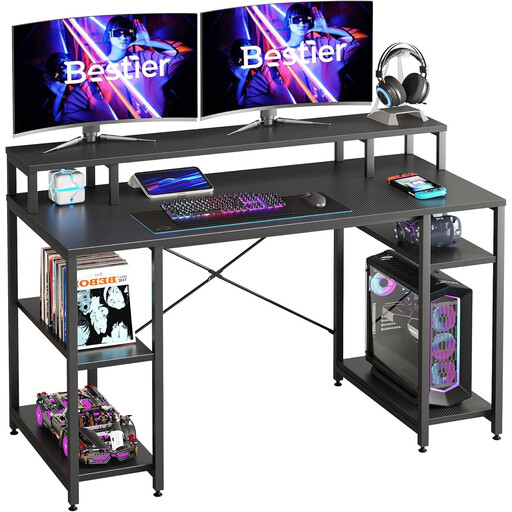
Why This Fits Their Persona: Ideal for a multi-monitor setup. The 140 cm wide surface, separate monitor stand, and modern black gaming desk look with a carbon fibre finish meet the demands of a high-performance gaming and workstation.
The robust metal frame with X-bracing actively prevents wobbling. The adjustable shelves offer flexible space for a PC tower or consoles, thus avoiding the impractical storage trap.
Integrated monitor stand for better ergonomics; generous 140 x 60 cm work surface.
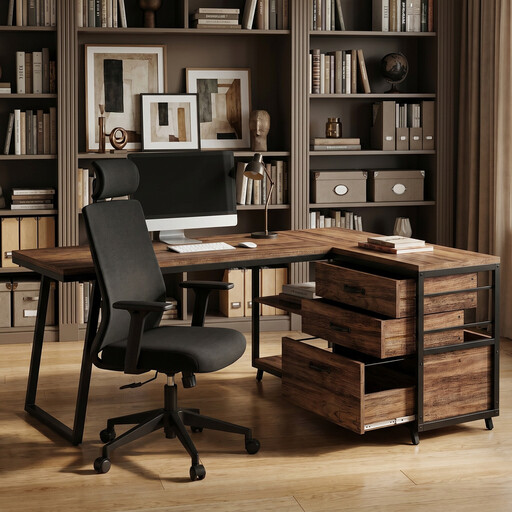
Why This Fits Their Persona: Perfect for users seeking a functional home office workstation with maximum integrated storage. The industrial-style office desk combines aesthetics with practical organisation for documents and office supplies.
This model solves the problem of inadequate storage with three drawers (including one for files) and two open shelves. The reversible design also provides the necessary flexibility for room layout.
Reversible design for left or right corner; combination of open and closed storage.
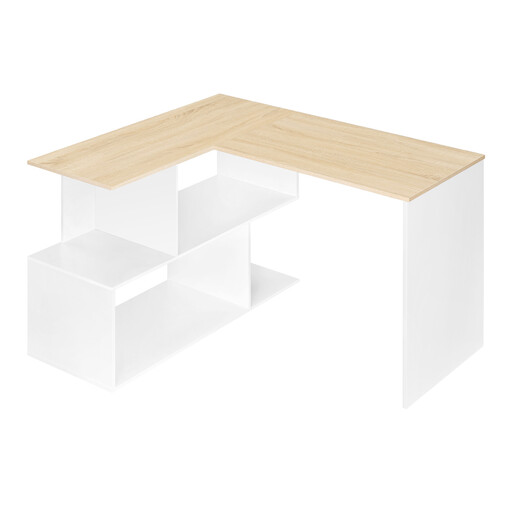
Why This Fits Their Persona: A compact and budget-friendly small corner desk that is ideal for student dorms or small study nooks. It makes optimal use of space without appearing bulky.
The design is explicitly focused on space efficiency. Despite its compact dimensions, the four open shelves provide essential storage for books and materials, avoiding the trap of a desk with no storage at all.
Very space-saving design; non-slip, adjustable feet for levelling on uneven floors.
We have compiled a complete, up-to-date list of products that fully meet these strict selection criteria and UK safety regulations.
Measure the two walls where the desk will be placed, starting from the corner. Compare these measurements with the length and width of the desk's two sides. Additionally, plan for at least 60-70 cm of space for your chair to move freely.
A reversible L-shaped desk can be assembled in a mirror-image configuration. This means you can decide during assembly whether the long part of the desk will be on the left or right side. This offers maximum flexibility in adapting to your space.
Typically, all necessary assembly hardware, including a simple screwdriver or Allen key, is included. The instructions are illustrated, and the parts are numbered. Assembly can usually be done by one person, though a second person can be helpful for larger models.