
Lieferung heute & morgen

Qualitätsgarantie

Willkommens-Angebote freischalten: KOSTENLOSE Lieferung | Bis zu 80 % RABATT | Kostenlose 30-Tage-JoyPlus-Testphase
App herunterladen
A corner desk is an efficient solution for transforming unused room corners into a productive workspace. Whether for a home office, study area, or gaming station, the L-shape provides a generous work surface without dominating the room. However, the selection process has some pitfalls that can quickly turn a supposed space-saver into an impractical purchase. This guide will help you avoid common mistakes and find a model that meets your requirements.
Many models look appealing in product photos but only reveal their weaknesses during daily use. Pay close attention to these three points to avoid a poor investment:
To avoid the problems mentioned above, you should check a few technical parameters before buying. These objective criteria are more crucial than purely design aspects.
The durability of a desk is directly linked to its construction. A sturdy metal frame, often found in an industrial-style desk, typically offers higher load capacity and stability than constructions made purely of engineered wood. Pay attention to the desktop thickness; values over 2 cm indicate more robust quality. Additional reinforcements, such as X-frame bracing or a third support leg at the corner, significantly increase the overall stability of the table.
A good L-shaped desk adapts to you, not the other way around. Check the product description to see if the model can be reversibly assembled. This flexibility allows you to position the longer side of the desk on the left or right, depending on your room's layout. For a corner desk with drawers and shelves, it is also advantageous if the shelves are height-adjustable to accommodate binders or larger equipment.
Measure the intended space precisely—from the corner along both walls. Take into account windowsills, radiators, or doors that could obstruct the setup. A computer desk for small spaces should not only fit physically but also offer enough workspace. For a dual-monitor setup, a depth of at least 50-60 cm on the main work surface is recommended to ensure a comfortable viewing distance.
Here are some recommendations tailored to specific user profiles that take the above criteria into account.
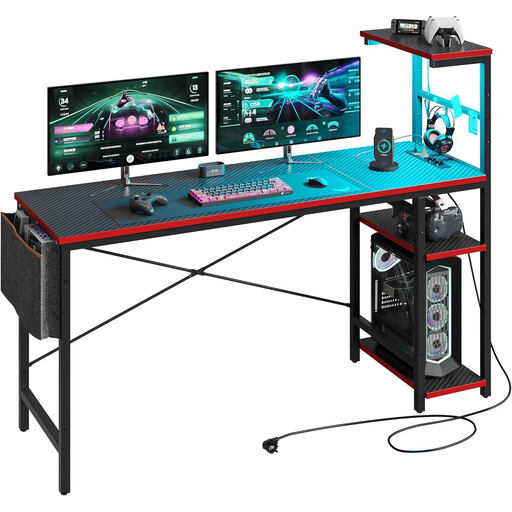
Why This Fits Their Persona: Ideal for users with limited space who are looking for a functional and modern solution. The compact dimensions make optimal use of small corners, while the additional features enhance work comfort.
The reversible design bypasses the pitfall of inflexible layouts. The X-frame bracing provides the necessary stability often lacking in compact desks.
Integrated power outlets and LED lighting offer practical added value. The side storage bag creates additional, easily accessible storage space.
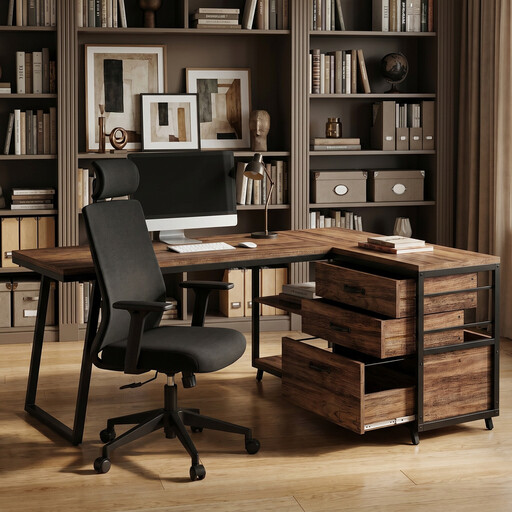
Why This Fits Their Persona: Perfect for home office users who need ample storage for documents, binders, and office supplies, and who value a tidy workspace.
This model solves the problem of impractical storage with a thoughtful combination of three drawers (including one for files) and two open shelves. The sturdy metal frame ensures the necessary stability.
The combination of closed drawers and open shelves offers flexible organization options. The reversible design allows it to be adapted to the room.
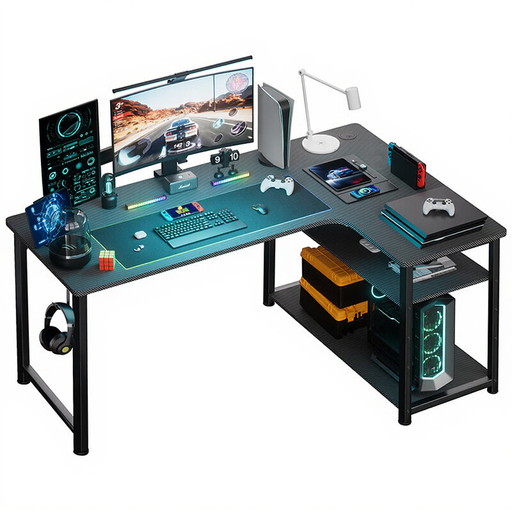
Why This Fits Their Persona: Designed for gamers and tech-savvy users who operate multiple devices simultaneously and need a simple charging infrastructure directly at their workspace.
The integrated ports are a thoughtful, functional addition, not just a marketing gimmick. The steel frame provides the necessary stability for often heavy gaming setups and prevents wobbling.
Integrated USB charging ports and power outlets reduce cable clutter. The shelf provides space for accessories or gaming consoles.
We have compiled a complete, up-to-date list of products that fully meet these strict selection criteria and all relevant safety standards.
Measure from the corner out along both walls to determine the maximum length the desk can occupy. Compare these measurements with the side dimensions of the desk from the product description. Also, pay attention to the height, especially if the desk is to be placed under a window or a sloped ceiling.
Not all, but many modern models offer this feature. It is an important feature for flexibility. Look for terms like "reversible," "reversible assembly," or "can be assembled left/right" in the product description. If this information is missing, the assembly is likely fixed.
In common usage, these terms are often used interchangeably. Corner desk is the general term for desks designed to be placed in a corner. Angled desk or L-shaped desk more precisely describes the shape of the desk, which consists of two work surfaces set at an angle to each other.