
Lieferung heute & morgen

Qualitätsgarantie

Willkommens-Angebote freischalten: KOSTENLOSE Lieferung | Bis zu 80 % RABATT | Kostenlose 30-Tage-JoyPlus-Testphase
App herunterladen
A well-designed workspace is the foundation for productivity and focus, especially in a home office. The corner desk is often hailed as the ideal solution to make smart use of unused room corners and create a generous work surface. However, the market is flooded with models that look great at first glance but prove impractical in daily use.
As your Joybuy Product Recommendation Officer, I'll help you navigate the common pitfalls. Instead of falling for marketing hype, we'll focus on the objective features that define a quality home office desk.
Many buyers regret their decision within a few months. This is often due to design flaws that only become apparent with daily use.
To avoid a bad buy, you should focus on three verifiable core parameters. These define the durability and functionality of your new workspace.
The stability of a desk is directly linked to the quality of its materials. Pay attention to the material thickness of the tabletop and the frame. A tabletop thickness of at least 18 mm made from a solid engineered wood (e.g., PB or MDF with an E1 emission rating) is a good benchmark for stability. A sturdy base, whether made of metal or also engineered wood, prevents the dreaded wobble and ensures a high load capacity.
A crucial feature for long-term usability is the option to assemble the desk reversibly. This means the longer wing of the L-shaped desk can be positioned on either the left or the right. This flexibility is invaluable if you plan to move or rearrange your office. Explicitly check the product description to see if this option is mentioned.
A well-designed desk with storage makes the daily work routine much easier. Instead of being dazzled by the number of compartments, check their internal dimensions. Will your binders fit? Do the drawers offer enough depth for office supplies? Open compartments are ideal for quickly accessible items, while closed cupboards and drawers create a tidy, uncluttered look. Thoughtful cable management, such as integrated cable routing, is an added bonus.
Based on these objective criteria, we have identified several models that are well-suited for different user profiles.
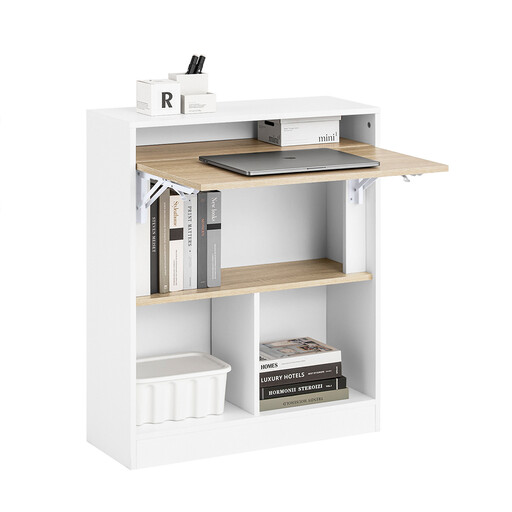
Why this model is a great fit: Ideal for studio apartments or multi-functional rooms where a permanent desk would take up too much space. It provides a full-featured workspace that disappears when not in use.
This model bypasses the instability pitfall through its secure wall-mounted design. It doesn't pretend to be a freestanding giant; instead, it perfectly serves its purpose as a space-saving and, when correctly installed, very stable solution.
The work surface folds down to free up floor space. Integrated shelves provide permanent storage for small items.
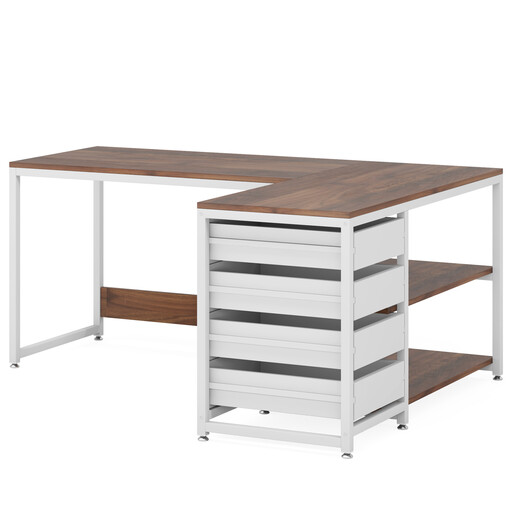
Why this model is a great fit: For professionals and students who need to keep documents, books, and accessories organised and within easy reach. The generous L-shape clearly separates the computer area from the analogue workspace.
This model counters the insufficient storage pitfall with four full-sized drawers and two open shelves. At the same time, it is reversibly assemblable, thus avoiding the problem of a rigid design.
Extensive, clearly structured storage and a flexible, reversible assembly option for maximum room adaptability.
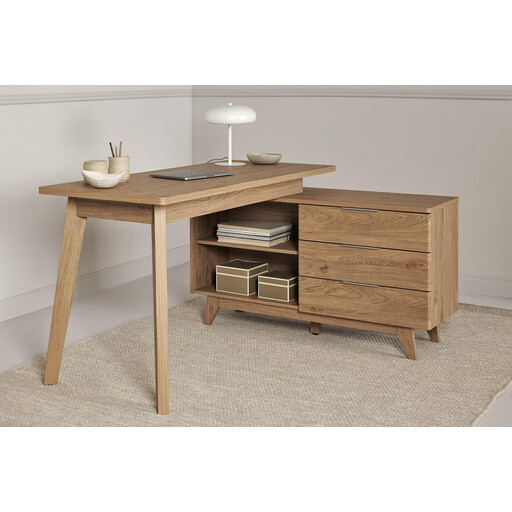
Why this model is a great fit: For users who value a modern **wood-effect desk** and are looking for a solution that blends seamlessly into a stylish living environment while remaining highly adaptable.
This model directly counters the rigid design pitfall, as it is explicitly designed for universal, reversible assembly. The solid construction and the thick, rounded tabletop ensure the necessary stability.
Fully reversible assembly for maximum freedom in room planning. The modern Scandi design with flared legs and rounded edges is both aesthetic and functional.
Our selection focuses on corner solutions. However, if you need extremely space-saving alternatives for alcoves or narrow walls, we have compiled a full list of products that also meet these strict selection criteria.
1. How stable is a reversibly assembled corner desk? Stability is not affected by the reversible assembly option. The decisive factors are the quality of the fasteners, the material thickness, and the construction of the frame. A well-designed modular desk is just as stable as a fixed-configuration model, as long as it is assembled carefully according to the instructions.
2. What are the ideal dimensions for a home office desk? The ideal size depends on your available space and work requirements. A depth of 60-80 cm is recommended to ensure an ergonomic distance from your monitor. The width should provide enough space for your monitors, keyboard, and additional work surface. An L-shaped desk with wing dimensions of, for example, 140 x 120 cm offers a good balance between a compact footprint and a generous workspace.
3. How do you properly care for a wood-effect desk?Wood-effect desks are typically finished with a melamine or foil coating, making them very low-maintenance. A soft, slightly damp cloth is sufficient for cleaning. Avoid harsh cleaning agents or abrasive sponges, as these can damage the surface. Using desk mats and coasters is recommended to prevent scratches and heat damage.