
Lieferung heute & morgen

Qualitätsgarantie

Willkommens-Angebote freischalten: KOSTENLOSE Lieferung | Bis zu 80 % RABATT | Kostenlose 30-Tage-JoyPlus-Testphase
App herunterladen
A well-organised workspace is the foundation of productivity, whether in a home office or a personal study. A corner desk with drawers promises to make optimal use of corners while keeping things tidy. But the market is flooded with models that vary widely in quality and functionality. Before you make a decision, it's crucial to know the common flaws that can quickly turn a supposed solution into a source of frustration.
This guide will show you what to look for to avoid costly mistakes and find a model that meets your needs for storage and flexibility.
Many desks look appealing online but only reveal their weaknesses after assembly. Pay close attention to these three points to avoid disappointment.
To avoid these issues, you should check three core features before buying. These will define the longevity and practical utility of your new workspace.
A desk's stability is directly dependent on the materials used. Look for a desktop made of MDF (E1 grade) or thick particleboard with a durable melamine coating. This is not only resistant to scratches but also easy to clean. A solid frame made of powder-coated metal or solid wood provides the necessary foundation for a stable home office computer desk that can easily support the weight of multiple devices.
A reversible corner desk is the solution to the fixed orientation problem. With these models, the side extension (the L-shape) can be assembled on either the left or the right. This flexibility is crucial for perfectly adapting the desk to your space or reconfiguring it if you move or redesign the room. Measure your available space carefully and compare it with the product dimensions to ensure the L-shaped office desk is a perfect fit.
Storage shouldn't just be present; it should be well-designed. Check the internal dimensions of the drawers and the height of the compartments in a desk with shelves. Smooth-gliding metal runners for the drawers are a clear sign of quality compared to simple plastic guides. Open shelves offer quick access to frequently used items, while drawers help maintain a tidy, distraction-free work surface.
Here are some models tailored to specific user profiles and their requirements.
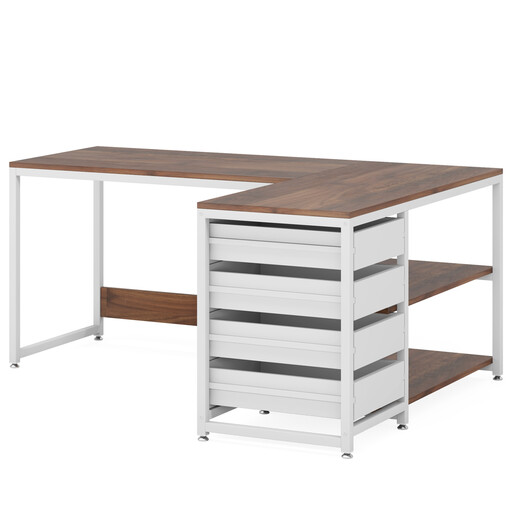
Why This Fits Their Persona: Ideal for users setting up a full-fledged home office who don't want to compromise on workspace and organisation. The generous L-shape provides space for multiple monitors and work documents, while the combination of drawers and shelves ensures clear structure. The modern walnut and white desk complements many interior design styles.
The reversible design completely solves the problem of inflexible orientation. Its engineered wood construction and the thoughtful combination of four drawers and two shelves address the pitfalls of instability and impractical storage.
The combination of a reversible L-shape and a comprehensive storage concept (4 drawers, 2 shelves) makes this model exceptionally adaptable and functional.
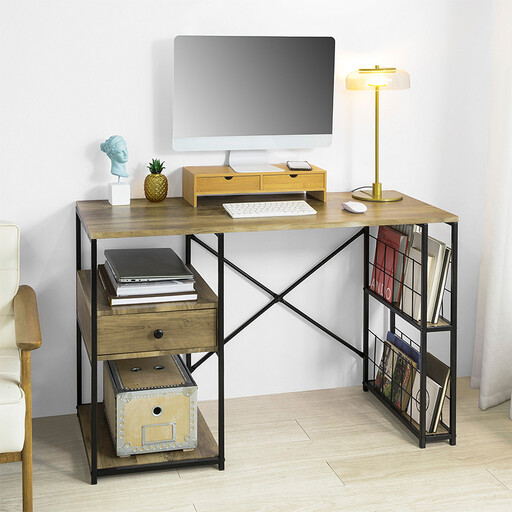
Why This Fits Their Persona: Perfect for students or professionals with limited space who still want an organised work area. This model makes use of vertical space, offering ample storage for books, binders, and office supplies on a small footprint.
The sturdy metal frame and MDF (E1) desktop counteract the problem of instability. The combination of a drawer and four shelves provides well-designed vertical storage that is far more practical than many other compact desks.
The space-saving design with plenty of vertical storage is its main advantage. According to the manufacturer, the storage compartments and drawer can be assembled on either the right or left, offering additional flexibility.
We have compiled a complete, up-to-date list of products that fully meet these strict selection criteria.
1. How do you correctly assemble a reversible corner desk? Read the assembly instructions carefully before you begin. Decide on your desired orientation (left or right extension) before starting the assembly. Most manuals have separate sections for each configuration. Assemble the desk on a soft surface, like a carpet, to avoid scratches.
2. What depth should a home office computer desk have? A depth of at least 50 cm is recommended, but 60 cm or more is ideal. This ensures enough distance from the monitor for an ergonomic posture while also providing ample space for a keyboard, mouse, and handwritten notes.
3. How do you care for a walnut and white finish desk? For daily cleaning, a soft, slightly damp cloth is sufficient. Avoid harsh chemical cleaners, as they can damage the surface. To prevent water rings and heat damage, always use coasters for hot or cold drinks.