
Lieferung heute & morgen

Qualitätsgarantie

Willkommens-Angebote freischalten: KOSTENLOSE Lieferung | Bis zu 80 % RABATT | Kostenlose 30-Tage-JoyPlus-Testphase
App herunterladen
A well-organized workspace is the foundation of productivity, whether for a home office, studying, or gaming. A corner desk with storage seems like the ideal solution to transform unused corners into functional areas. However, the market is flooded with models whose practical value only becomes apparent after purchase—and often after tedious assembly. Before you make a decision, it's important to know the common pitfalls that can lead to frustration and an unsuitable piece of furniture.
Many buyers focus on design or price, overlooking crucial construction details. The most common problems include:
To avoid these problems, you should focus on the fundamental features that separate a good desk from an unsuitable one.
A functional L-shaped computer desk is more than just two panels joined together. Pay attention to the following three core parameters to ensure your new workspace meets your needs.
The longevity of your desk depends directly on its material and frame construction. Most desktops are made of engineered wood, such as MDF or particleboard, finished with a melamine coating. This coating protects against scratches and is easy to clean.
However, the base is crucial for stability. A robust metal frame, ideally made of powder-coated steel, provides a solid foundation. Look for additional cross-bracing or a well-designed screw system that prevents the desk from swaying. This is particularly important if you plan to place multiple monitors or other heavy equipment on your home office desk.
A truly reversible desk offers the option to mount the longer side section on either the left or the right. A well-designed model features symmetrical drill holes and a construction that allows for both configurations without compromising stability or appearance. This is a key advantage if you move or need to adapt the office desk for small rooms to a new layout. Check the product description to see if reversibility is explicitly listed as a flexible feature with no drawbacks.
Think carefully about what you need to store. A corner desk with shelves offers quick access to books, boxes, or frequently used documents. Open compartments can make a workspace feel more airy but require more tidiness.
Drawers, on the other hand, create a clean look and protect private documents or small accessories from dust and prying eyes. For a gaming corner desk, a tall, open compartment for the PC tower can be useful, while a deep drawer for hanging files might be beneficial in a home office. A combination of both—open shelves and closed drawers—often offers the greatest flexibility.
Based on these criteria, we have identified several models that are particularly well-suited for different user profiles and room situations.
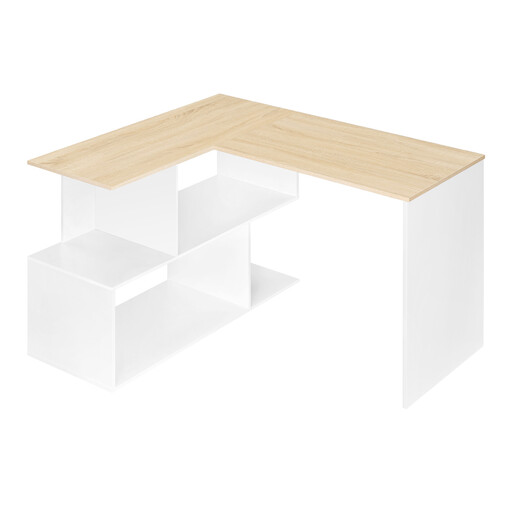
Why it's a great fit: Ideal for students or small apartments where every inch counts. The compact L-shape makes optimal use of corners, while the four open shelves provide direct access to books and study materials without visually cluttering the space.
This model avoids the impractical storage trap by focusing on a clear function: four well-proportioned, open compartments for quick access, rather than integrating poorly designed drawers.
Maximum space efficiency on a compact footprint thanks to the smart L-shape and integrated shelving. Non-slip feet ensure stability even on uneven floors.
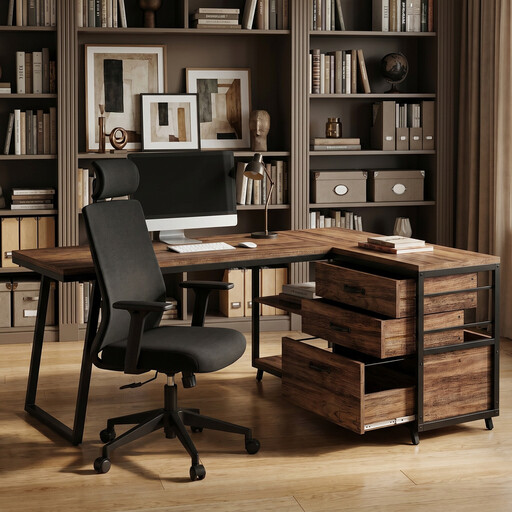
Why it's a great fit: For professionals who need an adaptable workspace. The reversible design allows for flexible positioning in the room. The mix of drawers (including one for files) and open shelves offers a balanced solution for organization and quick access.
This model solves the "pseudo-reversible" trap with a thoughtful design that allows the storage unit to be assembled on the left or right side without any aesthetic compromises.
True flexibility through its reversible design and a versatile storage combination. The sturdy metal frame provides the necessary stability for a busy workday.
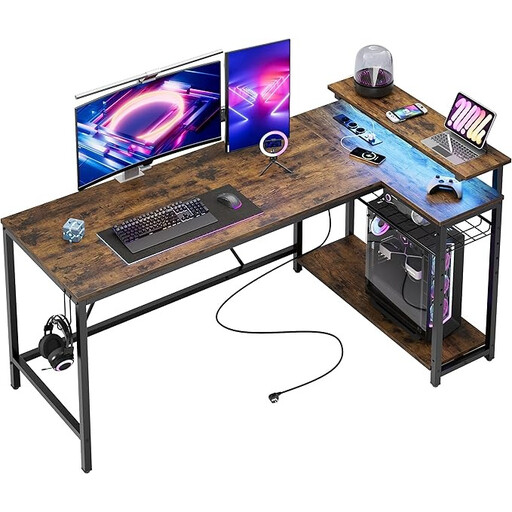
Why it's a great fit: Designed for demanding setups. The integrated power outlets and USB ports reduce cable clutter. The RGB LED lighting creates atmosphere, while the large work surface and monitor stand provide space for multiple screens and accessories.
This model avoids the instability trap with a reinforced metal frame. It also addresses impractical storage by offering tech features like power supply and an adaptable shelf structure for a PC tower and accessories.
Integrated power supply (3 outlets, 2 USB ports) and customizable RGB LED lighting built right into the desk. The reversible design adds extra flexibility for setup.
We have compiled a complete, up-to-date list of products that fully meet these strict selection criteria and UK safety regulations.
1. How much weight can a corner desk with storage hold? The load capacity varies by model and construction. Always check the manufacturer's specifications. Models with a solid steel frame and thick desktops (e.g., 2-4 cm) can often support between 50 kg and 100 kg. The capacity of individual shelves is typically lower than that of the main work surface.
2. Is a reversible desk complicated to assemble? Assembly is generally no more complicated than for a non-reversible model, but it does require more attention. A good instruction manual will show with clear diagrams which parts to use for a left or right-hand setup. Lay out all the parts before you begin and identify the mirrored components to avoid mistakes.
3. How do I care for the surface of my industrial-style desk? Most surfaces in an industrial design are made of melamine-coated engineered wood, which is very easy to maintain. A soft, slightly damp cloth is usually sufficient for cleaning. Avoid aggressive cleaning agents or abrasive sponges, as they can damage the surface. Stains should be removed promptly to prevent them from setting into the material.