
Lieferung heute & morgen

Qualitätsgarantie

Willkommens-Angebote freischalten: KOSTENLOSE Lieferung | Bis zu 80 % RABATT | Kostenlose 30-Tage-JoyPlus-Testphase
App herunterladen
Unused corners are wasted space in many homes. A corner shelf seems like the obvious solution to create storage while adding a decorative accent. However, the market is flooded with products whose quality and functionality only become apparent after purchase and assembly. Many shelves turn out to be unstable, don't fit precisely into the corner, or their material fails to withstand daily use.
This guide will help you identify the crucial features. We'll show you the three most common pitfalls to watch out for and which parameters truly matter, so you can make an informed decision for your home.
Before you decide on a model, you should be aware of the typical flaws that are often noticed too late.
To avoid these pitfalls, focus on objective, verifiable criteria. These three parameters are crucial for the longevity and functionality of your corner shelf.
The material determines not only the look but also the stability and suitable location for the shelf.
Always check the manufacturer's stated maximum load capacity per shelf. This value is a critical indicator of the structure's stability.
The choice between a freestanding and a wall-mounted shelf depends on your available space and the condition of your walls.
Measure the intended corner precisely before making a decision. Consider not only the height and width but also the depth of the shelf. A deep shelf offers more storage but can look bulky in small rooms. A small corner shelf, on the other hand, is excellent for decorative items or as a ledge in the kitchen, but offers little space for books or binders.
Here are some recommendations tailored to different needs and living situations.
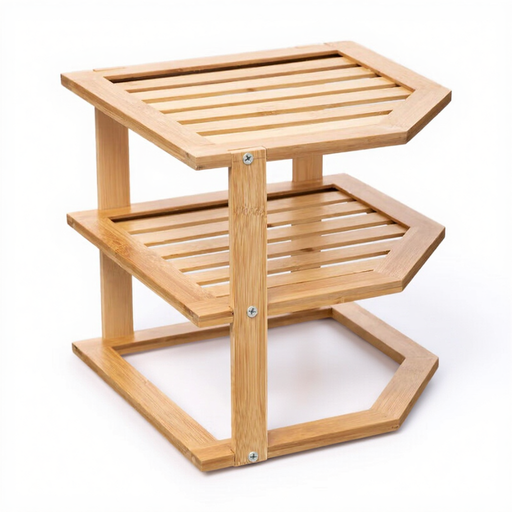
Why This Fits Their Persona: Ideal for students or a first apartment. This compact shelf utilizes space on a kitchen countertop or in the bathroom to organize spices, cosmetics, or small plants without requiring a large budget.
The bamboo material is naturally more resistant to moisture than uncoated particleboard, thus preventing swelling in the kitchen or bathroom (avoids Pitfall 3).
Made from FSC-certified bamboo; very compact dimensions (25 × 25 × 22.8 cm) for small nooks.
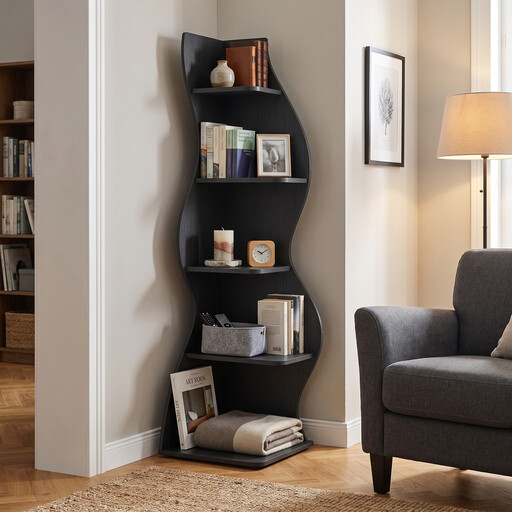
Why This Fits Their Persona: For anyone looking for a functional piece of furniture that also makes a visual statement. The S-shape and matte black finish make it an eye-catcher in a modern living room or office.
As a tall freestanding shelf, it comes with an anti-tip kit to anchor it to the wall. This directly addresses the stability problem (Pitfall 1). The surface, described as scratch-resistant, counteracts the issue of low-quality coatings (Pitfall 3).
Modern S-shaped design; high storage capacity with 5 tiers (178 cm height); includes an anti-tip kit for enhanced stability.
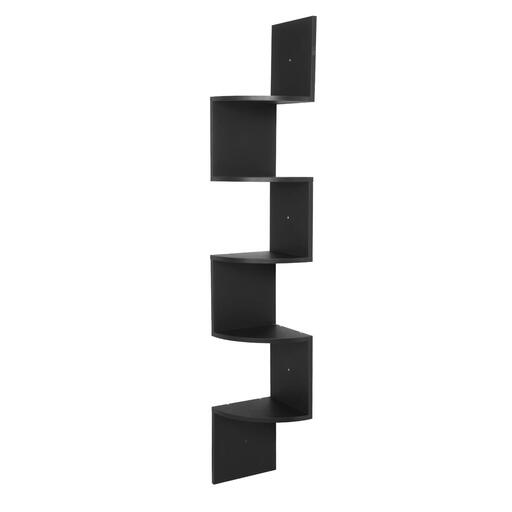
Why This Fits Their Persona: Perfect for anyone who wants to create vertical storage without sacrificing valuable floor space. This wall shelf is ideal for hallways, small living rooms, or offices to stylishly display books, decor, or CDs.
The product description explicitly states it is not suitable for drywall, preventing installation errors (Pitfall 2). The E1-grade MDF board with PVC veneer is described as waterproof and scratch-resistant, which counteracts material wear (Pitfall 3).
Space-saving wall-mount design; 5 tiers for ample storage on a small footprint; integrated, invisible hanging system.
We've compiled a complete, up-to-date list of products that fully meet these strict selection criteria and rigorous safety standards.
The load capacity varies greatly depending on the model, material, and construction. Always check the manufacturer's stated maximum load capacity per shelf. For a freestanding corner unit, the lower shelves can often support more weight than the upper ones. For a wall-mounted corner shelf, the capacity also depends on the wall's structure and the quality of the mounting.
Most corner shelves are designed for self-assembly and come with instructions. Freestanding models are generally easier to build than wall-mounted ones. When installing a wall shelf, you should ensure you have the right tools and that your wall can support the load. If in doubt, it is advisable to seek professional help.
For humid environments like the bathroom, materials that are resistant to water vapour are crucial. Bamboo, stainless steel, plastic, or specially sealed wood are good choices. Avoid unsealed particleboard or MDF, as they can swell and lose their shape and stability.