
Lieferung heute & morgen

Qualitätsgarantie

Willkommens-Angebote freischalten: KOSTENLOSE Lieferung | Bis zu 80 % RABATT | Kostenlose 30-Tage-JoyPlus-Testphase
App herunterladen
Unused corners in living spaces are wasted potential. A corner shelf can be a functional and stylish solution to create storage or display decorative items. However, the selection is vast, and not every model delivers on its promise. Many buyers are frustrated by wobbly structures or improper dimensions. This guide will help you avoid common pitfalls and make an informed decision.
Before you invest, you should be aware of the weak points that often only become apparent after assembly.
To avoid these problems, focus on three essential technical features.
The durability of a corner shelf depends directly on the materials used. For wood and metal corner shelf models, the combination is crucial. Look for shelves made from E1 or E0-grade particleboard. These emission classes signify lower formaldehyde release and often a higher density and sturdiness compared to unclassified boards. The metal frame should ideally be powder-coated. This type of surface finish is more resistant to scratches and corrosion than a simple paint job.
A tall corner shelf or a freestanding corner standing shelf must be perfectly stable. Two features are essential for this:
Measure the available space precisely before making a decision. Consider not only the height but also the side lengths (the depth and width along the walls). For very tight spaces, a narrow corner shelf that utilises the room's height is a good choice. For more storage, such as a corner bookshelf in the living room, an L-shaped model might be the better option as it offers more surface area. Such a space-saving shelf can transform an unused living room corner shelf into a functional focal point.
Here are some recommendations tailored to specific user profiles that meet the quality criteria mentioned.
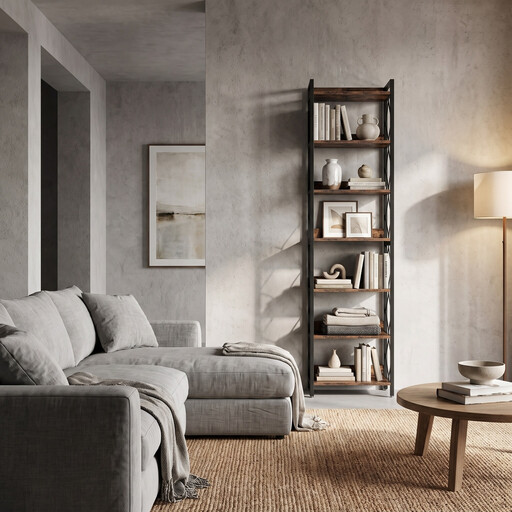
Why This Fits Their Persona: Ideal for those looking to maximise vertical storage in smaller apartments or rooms. With a height of 200 cm and a footprint of just 35x35 cm, it makes optimal use of height without taking up valuable floor space.
The construction, featuring a solid metal frame and high-quality particleboard, offers a high load capacity of up to 18 kg per shelf. The included anti-tip kit and adjustable feet directly address the problem of instability.
Maximum vertical space utilisation on a minimal footprint. The open design feels airy and is well-suited for books, plants, or decorative items.
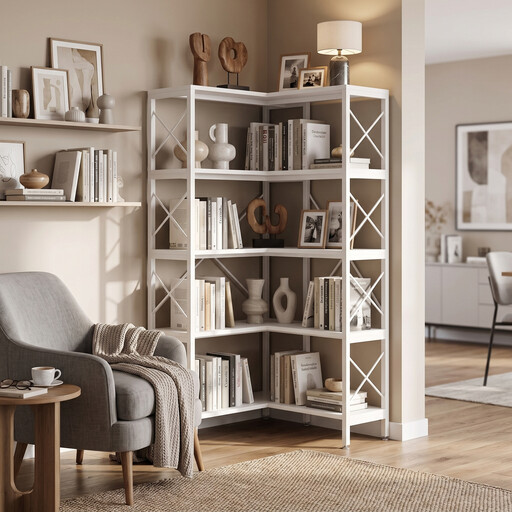
Why This Fits Their Persona: Perfect for anyone seeking a functional piece of furniture with a strong character. The industrial corner shelf, with its matte black metal frame and distinctive X-braces, is a statement piece for a living room or home office.
The X-braces are not just for aesthetics; they significantly increase structural stability. The high load capacity of 20 kg per shelf and the scratch-resistant surfaces prevent the common problems of sagging and rapid wear.
Offers a great deal of storage with 10 open compartments in an L-shape. The combination of design and durability makes it a long-lasting investment.
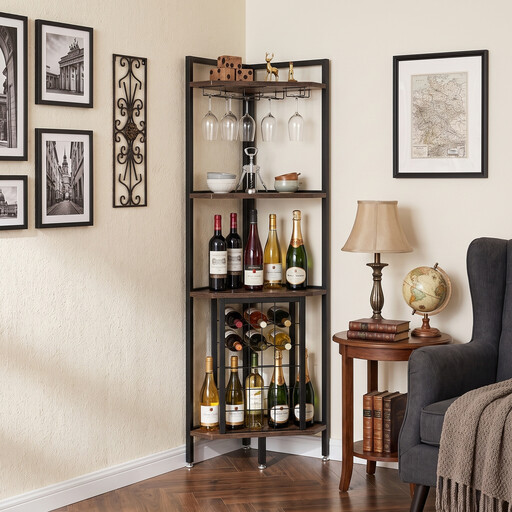
Why This Fits Their Persona: For wine lovers or hosts looking for a dedicated, space-saving solution for their home bar. This shelf combines bottle storage, a glass holder, and additional shelving in a single, compact corner unit.
The structure is specifically designed to support the weight of up to 18 wine bottles. A sturdy metal frame and the included safety strap for wall mounting prevent instability, even when fully loaded.
A highly specialised all-in-one solution that combines multiple functions (wine rack, bar shelf, glass holder) while efficiently using a corner.
We have compiled a complete, up-to-date list of products that fully meet these strict selection criteria and safety standards.
The load capacity varies greatly depending on the model, material, and construction. Simple wall shelves often only support up to 5 kg per shelf, whereas a sturdy corner standing shelf with a metal frame and high-quality wood panels can have a load capacity of 20 kg or more per shelf. Always check the manufacturer's product specifications to avoid overloading.
Most corner shelves are designed for self-assembly and come with illustrated instructions and the necessary tools. The process is generally straightforward and takes between 30 and 60 minutes, depending on the model. It is crucial to follow the instructions carefully, especially when attaching the anti-tip device to the wall.
Starting from the corner, measure along both walls the maximum width and depth the shelf can occupy. Also, measure the available height up to the ceiling. Compare these measurements exactly with the dimensions in the product description. Pay attention to whether the specified dimensions refer to the outer edges of the shelf.