
Lieferung heute & morgen

Qualitätsgarantie

Willkommens-Angebote freischalten: KOSTENLOSE Lieferung | Bis zu 80 % RABATT | Kostenlose 30-Tage-JoyPlus-Testphase
App herunterladen
Unused corners are a common problem in many apartments and houses. They often look empty and just collect dust, even though they hide valuable storage potential. The right corner shelf not only makes this lost space functional but can also become a stylish element of your decor.
As a Joybuy Product Recommendation Officer, my goal is to help you make an informed decision. This article introduces different types of corner shelves and provides you with practical criteria to find the perfect solution for your needs—whether it's for the living room, kitchen, or home office.
Before you decide on a model, a few fundamental aspects should be considered. The right choice depends on your individual needs, the available space, and your desired interior design style.
The material determines not only the durability and load capacity but also the visual impact of the shelf.
The type of installation is a crucial factor for functionality and the room's overall feel.
Before buying, measure the corner precisely: the depth and width along both walls, as well as the available height. Compare these measurements with the product dimensions to ensure the shelf will fit perfectly.
Consider what you want to store on the shelf.
Here is a selection of different corner shelf models, each suited for various applications due to their specific features.
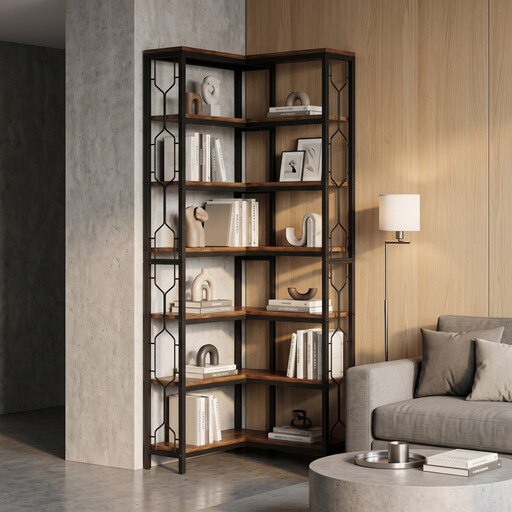
Why it stands out: With its L-shape and seven tiers, this tall freestanding shelf makes optimal use of the corner while offering maximum stability thanks to a reinforced metal frame.
Pros:
Who is it for? For those looking to maximize vertical storage in a living room, home office, or larger space, and who appreciate the functional style of wood and metal.
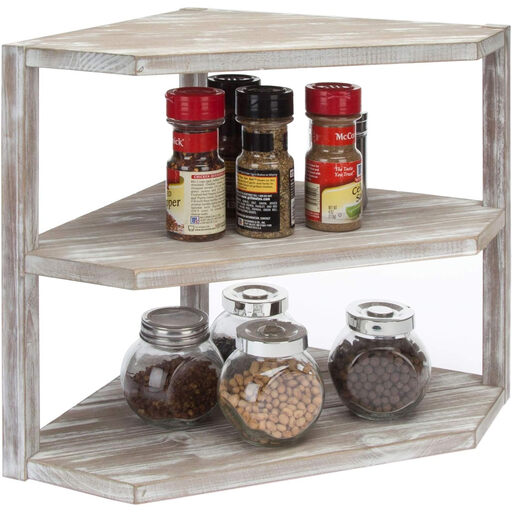
Why it stands out: This compact solid wood shelf with a rustic wash finish is specially designed for use on countertops in the kitchen or bathroom.
Pros:
Who is it for? For users seeking a stylish and practical storage solution for their kitchen or bathroom countertop who appreciate a rustic interior style.
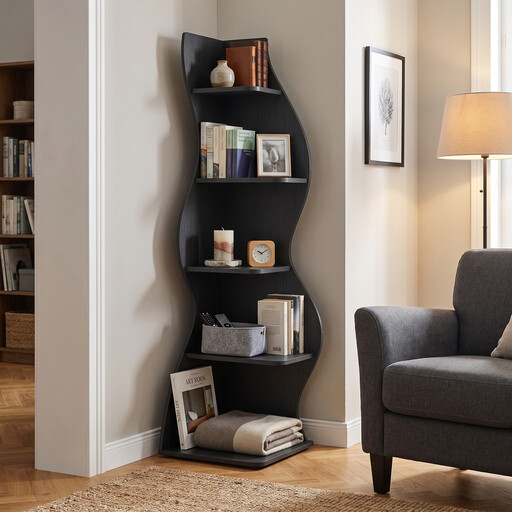
Why it stands out: The unique S-shaped design makes this shelf a modern eye-catcher, combining functionality with a sculptural aesthetic.
Pros:
Who is it for? For design-conscious individuals looking for a functional piece of furniture with a modern character to stylishly fill an empty corner in their living room or office.
Wasn't the perfect model for your needs among these recommendations? Every home is different, and the requirements for storage and design are diverse. Sometimes a different size, another material, or a combination with cabinet doors is the better choice.
Explore our entire range of corner shelf cabinet units and find the ideal solution that perfectly matches your space and style.
The load capacity varies greatly depending on the material, construction, and installation method. A solid freestanding corner shelf made of metal and wood can support significantly more weight than a delicate wall-mounted corner shelf. Always check the manufacturer's specifications for the maximum load capacity per shelf. As a general rule, place heavier items like books on the lower shelves to increase stability.
Starting from the inner corner, measure the desired width (or depth) along the left wall and repeat for the right wall. Also, measure the maximum available height. Compare these three measurements (width left, width right, height) with the dimensions provided in the product details (often listed as L x W x H or D x W x H) to ensure the shelf will fit.
A freestanding shelf stands on the floor, is usually larger, and offers more storage space. It is flexible as it doesn't need to be permanently installed (although wall anchoring is recommended for safety). A wall-mounted shelf is attached directly to the wall, saving floor space and creating a visually lighter look. It is well-suited for smaller rooms or as a decorative element but often has a lower load capacity than a freestanding shelf.