
Lieferung heute & morgen

Qualitätsgarantie

Willkommens-Angebote freischalten: KOSTENLOSE Lieferung | Bis zu 80 % RABATT | Kostenlose 30-Tage-JoyPlus-Testphase
App herunterladen
A corner sofa bed combines seating, a place to sleep and often extra storage. That makes it a practical choice for families, couples, single people and guest rooms. However, many models look similar at first glance. It’s not just colour and shape that matter: dimensions, mechanism, upholstery construction and how well the sofa works in everyday life are all important.
An L-shaped sofa bed needs more than just enough space for its footprint. Before you buy, check how far the seat pulls out and whether doors, radiators or walkways will be blocked. A stated width of 247 cm, for example, doesn’t automatically tell you the size of the usable sleeping area.
Names such as cord, chenille and velvet don’t tell you much about durability on their own. More useful details include the weave, care instructions and – where available – abrasion resistance. For example, the CARLOS model is listed as having POSO fabric with more than 35,000 Martindale cycles. This is a technical point of comparison, but it doesn’t guarantee a particular lifespan. Pets, zips, direct sunlight and incorrect cleaning can also affect how long the fabric lasts.
A soft surface doesn’t automatically mean good support. Check whether the manufacturer specifies the upholstery construction: zigzag springs, pocket springs, foam or a combination. Seat height and depth matter too. A very deep sofa may be ideal for lounging, while people with shorter legs may prefer a shallower seat.
Measure the available wall and floor space, including doorways. If the sofa has a chaise, check whether it’s fixed on the left or right. A reversible corner sofa with a choice of sides gives you more flexibility when assembling it.
Also check:
A model with a 200 × 130 cm sleeping area may be suitable for occasional overnight stays. For regular use, buyers should also check the upholstery comfort, ventilation and the strength of the frame.
Zigzag springs with T30 foam feel different from pocket springs or high-density foam. Look for a product description that gives specific details. General claims such as “extra comfortable” are less useful when comparing models.
For a sofa bed for everyday use, sturdy joints, a smooth pull-out mechanism and an even surface across the sleeping area are also important. Use the sofa only as directed by the manufacturer. Jumping, climbing or sitting on the arms or backrest can damage the frame.
Chenille and cord feel different and don’t respond in the same way to friction or stains. Check whether the cover is removable and what cleaning methods the manufacturer recommends. Cleaning with a damp cloth isn’t the same as machine washing.
A sofa with storage can hold bedding, blankets or cushions. Make sure the storage is easy to reach without having to move nearby furniture. Watch out for pinch points when opening it, and keep children away from moving mechanisms.
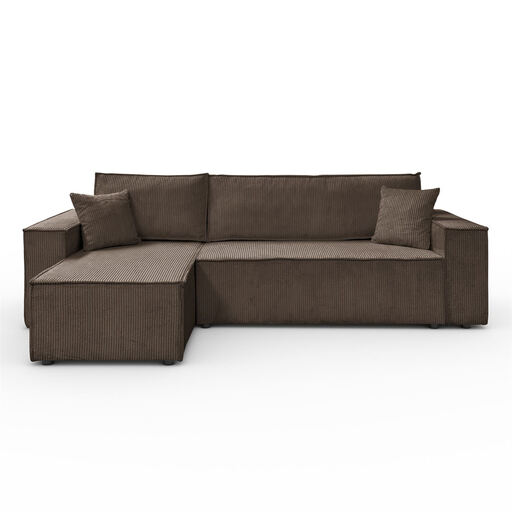
Why this product suits this profile: The model has a reversible chaise, a stated sleeping area of 200 × 130 cm and a storage compartment. It’s a good option for homes where a guest bed needs to double as a sofa and storage space.
The product details specify the upholstery construction, sleeping area, chaise orientation and abrasion rating. This makes it easier to check the key features before you buy.
Zigzag springs and T30 foam; POSO cord fabric rated at over 35,000 Martindale cycles; storage compartment.
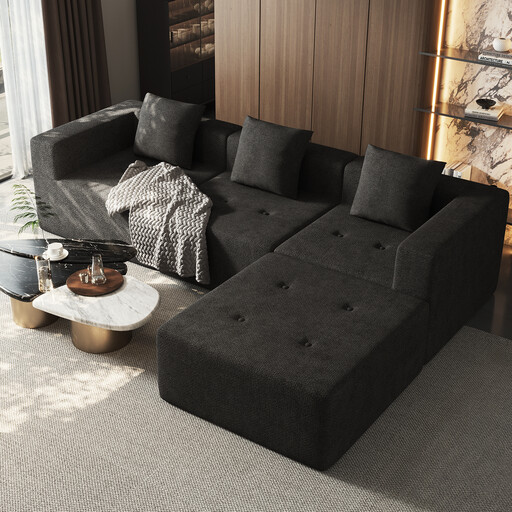
Why this product suits this profile: Its stated sleeping area of 183.5 × 258.5 cm and sprung core will appeal to households looking for a spacious seating and sleeping area for regular use.
The sprung core is specifically mentioned. The product details also list the dimensions, warranty period and optional reversible chaise.
Pocket-sprung core according to the product description; spacious sleeping area; freestanding design; 24-month warranty.
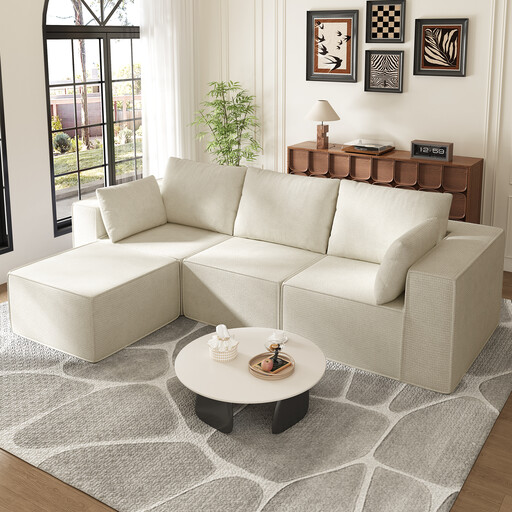
Why this product suits this profile: According to the supplier, its modular design allows for different layouts. This could make it a good fit for open-plan living areas, family rooms or seating arrangements that change over time.
Depending on the room layout, the individual modules can be arranged in an L-shape, as a straight seating arrangement or in a corner configuration. Even so, check the room and module dimensions against each other before you buy.
Modular design; five cushions that can be positioned separately; chenille cover according to the product description.

Why this product suits this profile: With seat dimensions of 132 × 90 × 88 cm and a stated bed size of 184 × 132 cm, it’s a compact alternative to a large corner sofa bed.
It converts using a pull-out mechanism on wheels. That means you won’t have to move heavy seat cushions every day, but remember to measure the space needed to pull it out.
Adjustable backrest; side pockets; steel frame according to the product description; pull-out sleeping area.
We’ve put together a complete, regularly updated list of products that meet these strict selection criteria and fully comply with the safety regulations in force in the EU.
When assembling a corner sofa bed, follow the assembly instructions and guidance on the mechanism carefully. At least two people should move heavy pieces of furniture. After assembly, check the screws, joints and connectors regularly.
For care, we recommend:
In homes with children or pets, keep sharp objects and naked flames away from the sofa, and don’t let children play unsupervised with the pull-out mechanism.
It depends on the upholstery construction, sleeping area and frame. Many models are designed primarily as seating, with the option of occasional overnight use. If you plan to sleep on one every night, look for a level sleeping surface, suitable mattress or upholstery details, and follow the manufacturer’s recommendations.
As well as the sofa’s footprint, you’ll need to allow for the depth of the extended sleeping area. Make sure a walkway remains clear, too. Measure the space with the sofa pulled out and check that cupboard doors, radiators and windows are still accessible.
A storage compartment is useful if you want to keep blankets, cushions or bedding close at hand. Before you buy, check the opening direction, internal dimensions and how easy it is to access. In a very small room, a mechanism that opens upwards or to the side may be more practical than a pull-out.