
Lieferung heute & morgen

Qualitätsgarantie

Willkommens-Angebote freischalten: KOSTENLOSE Lieferung | Bis zu 80 % RABATT | Kostenlose 30-Tage-JoyPlus-Testphase
App herunterladen
Unused corners can provide valuable storage space, but buying a corner shelf comes with particular requirements. A model that looks compact in the product photo may be too deep for your home, fail to hold securely on the wrong wall or have insufficient load capacity for the items you intend to store. Purchase mistakes are especially common because of three typical marketing traps.
1. Appearance is mistaken for stability
A delicate-looking corner wall shelf may be suitable for photo frames, small plants or lightweight decorations. For books, provisions or tools, however, the construction is what matters: material thickness, mounting method and even weight distribution are crucial. An eye-catching shape alone says nothing about the permitted load.
2. Measurements are only checked at the front
With a corner shelf, you need to consider not only its width and height, but also its depth and the angle of the corner. Skirting boards, radiators, doors and windows can restrict assembly or use. For a corner shelf for the living room, a bookcase corner or a freestanding corner shelf, it is therefore advisable to measure beforehand and allow a little extra clearance.
3. “No drilling” does not work on every wall
A no-drill shower shelf with suction cups requires smooth, non-porous surfaces. Grout lines, textured tiles, wallpaper or rough walls can affect adhesion. The condition of the wall is also important for wall shelves: according to the product information, for example, the WOLTU model is not intended for plasterboard walls.
A wall-mounted corner shelf saves floor space, but it requires suitable fixings. Check the following before buying:
For the bathroom, a corner shelf for the bathroom with drainage holes is practical, as less water collects on the shelf. With suction-cup models, the surface should be clean, dry and free from grout lines. A kitchen corner shelf for a worktop or cupboard usually does not require wall mounting, but it must stand securely and must not obstruct your everyday work area.
Always compare the maximum load capacity with the actual weight of the items you plan to store. Books, tins, tools and drinks bottles put considerably more strain on a shelf than towels or decorative objects.
Look for the specified capacity per tier as well as the total load capacity. Weight should also be distributed evenly. With a freestanding corner shelf, heavy items should be placed on the lower tiers. For tall furniture, an anti-tip device is advisable and should be used according to the instructions.
For damp rooms, smooth surfaces and a design with drainage are advantageous. For a heavy-duty corner shelf in a garage or cellar, on the other hand, load capacity, stability and protecting the MDF shelves from prolonged moisture are the key considerations.
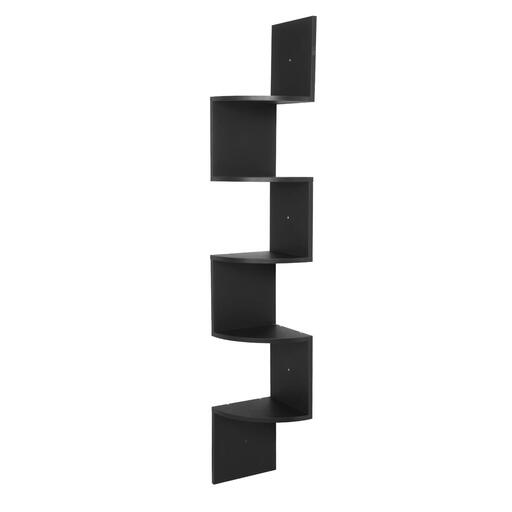
Why this product suits this profile: This slim wall shelf makes use of a corner with a 25 × 25 cm footprint and provides five tiers for books, CDs, photo frames or lightweight kitchen utensils.
The product details state a maximum total load of around 15 kg and explicitly point out that it is unsuitable for installation on plasterboard walls.
Five tiers, integrated hanging hardware and a compact height of 156 cm; according to the product details, the shelf is supplied pre-assembled.
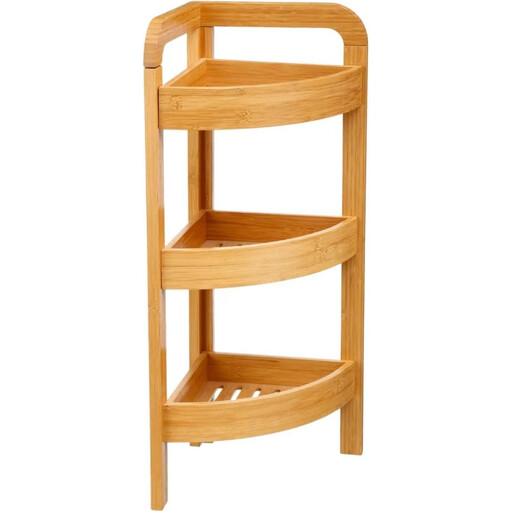
Why this product suits this profile: This three-tier bamboo corner shelf is suitable for living spaces and for storing bathroom essentials, provided it is kept dry and properly maintained.
The product data specifies a maximum load of 15 kg, three tiers and bamboo as the material. This makes its usage limits easier to assess than with a purely design-focused description.
Bamboo construction, a height of 61 cm and FSC information in the product details; self-assembly is required.
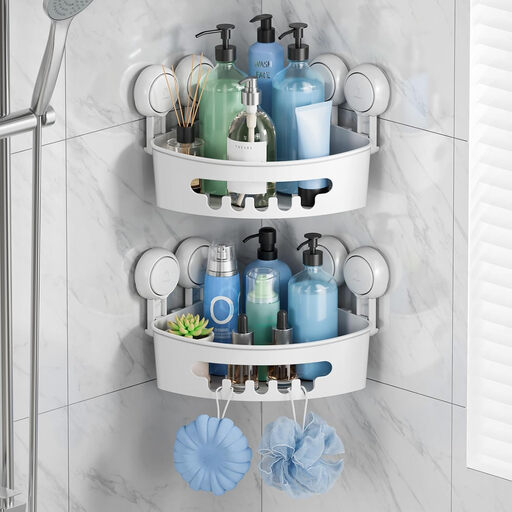
Why this product suits this profile: This two-piece corner shelf is designed for the bathroom or kitchen and can be fitted to smooth, non-porous 90-degree corners without screws or adhesive.
The product details clearly define its limitations: it is unsuitable for grout lines, rough surfaces, wood and wallpaper. Drainage holes help the shelf dry out.
ABS basket with TPE suction cup, removable design and a stated capacity of 22 lb; the shelf can be repositioned.
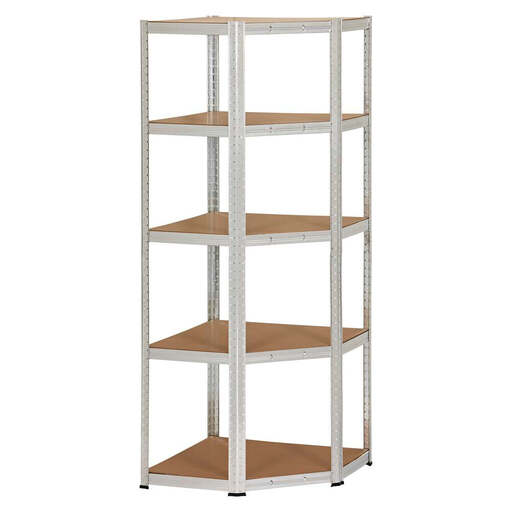
Why this product suits this profile: This steel corner shelf is designed for garages, workshops or dry storage areas and provides five tiers for heavier goods.
The specifications state 175 kg per tier with even weight distribution and 875 kg as the total load. Wall mounting for additional tip protection is recommended.
Galvanised steel, a tool-free slot-together system and five MDF shelves at a height of 180 cm; intended for dry indoor areas.
We have compiled a complete, regularly updated list of products that fully meet these strict selection criteria and the safety regulations applicable in the EU.
Before assembling a wall-mounted corner shelf, measure the entire corner carefully. For drill-mounted installations, you need wall plugs suitable for the wall type in question. The shelf must be level and secured according to the instructions. With tall freestanding shelves, an anti-tip device prevents the furniture from leaning forwards when it is loaded unevenly.
To maximise its service life, distribute loads evenly, store heavy items on the bottom and do not exceed the permitted load. Surfaces made from wood-based materials should be cleaned with a dry or only slightly damp cloth. With a no-drill shower shelf, you should also regularly check that the suction cup is still fully adhered.
A suction-cup model is attached to a smooth, clean and non-porous surface. Grout lines, rough tiles, wallpaper and uneven walls are generally unsuitable. Before loading the shelf, check that the suction cup is firmly attached all the way around.
For books, choose a shelf with sufficient tier depth, a sturdy wall-mounted or freestanding construction and a clearly stated load capacity. A slim corner wall shelf is suitable for smaller collections of books; for larger collections, a freestanding corner shelf with tip protection is the more practical choice.
Its service life depends on the material, installation, moisture and load. Correct mounting, evenly distributed weight and regular checks of the connections help reduce typical stresses. Wood-based materials should be protected from prolonged moisture, while steel shelves are suitable for dry storage areas.