Keeping fibre in mind during your weekly shop
You’re looking for a cereal to enjoy at several breakfasts and are considering wholegrain flakes or porridge oats, rather than sticking to cornflakes.


If fibre is a priority in your weekly shop, it’s worth looking beyond classic cornflakes to wholegrain flakes and porridge oats. Under Regulation (EC) No 1924/2006, the claim ‘high in fibre’ requires at least 6 g of fibre per 100 g or 3 g per 100 kcal. Sugar, ingredients and pack size then help you decide which option suits your household.
You’re looking for a cereal to enjoy at several breakfasts and are considering wholegrain flakes or porridge oats, rather than sticking to cornflakes.
You want to choose something your household will enjoy, while also checking its sugar content. A higher fibre value alone doesn’t tell you how much sugar it contains.
You prefer classic cornflakes or specifically need foods labelled gluten-free. In that case, check the product type and labelling before choosing based on fibre.
For the specific product, compare the fibre information first, then look at the other features that matter to your household.
| What matters | What to check | Who it matters to |
|---|---|---|
| Fibre | Fibre per 100 g or per 100 kcal in the nutrition table for the specific product. | I want to buy a product with a clear fibre content for several breakfasts, rather than relying on the word ‘wholegrain’. This would be the top priority for around 36% of consumers. |
| Sugar and taste | Compare sugar and fibre per 100 g; check the ingredients and flavour. | My household needs to enjoy the product, but its sugar content should also inform the buying decision. Around 29% of consumers would put this balance first. |
| Weekly supplies | Pack size, serving information and storage advice after opening. | I buy in advance and want to choose a pack we can use up and store properly. This would be the priority for around 21% of consumers. |
| Corn and gluten | Product type and ingredients; if needed, the explicit ‘gluten-free’ label on the pack. | My first priority is that they’re cornflakes or that the pack is explicitly labelled gluten-free. Around 14% of consumers would see this as their main concern. |
These descriptions don’t replace the fibre information. Müller states that Alnavit Bio Cornflakes contain 5 g of fibre per 100 g – below the 6 g per 100 g threshold set out in Regulation (EC) No 1924/2006.
Check the nutrition information on the specific pack. The regulation also allows the ‘high in fibre’ claim for products containing at least 3 g per 100 kcal.
According to Nestlé Cereals, Cini Minis contain 6.4 g of fibre and 24 g of sugar per 100 g. REWE lists Kölln Vollkorn-Haferfleks Klassik as containing 7.5 g of fibre and 17 g of sugar per 100 g.
Compare both nutrients on the same basis and decide which product your household would actually like to eat.
REWE sells Kölln Vollkorn-Haferfleks Klassik in a 750 g pack. Whether this size suits your weekly shop depends on how much your household gets through and how you’ll store the opened pack.
Choose a pack size that suits your household’s consumption and storage space, and reseal the bag securely after opening.
The fact that a product contains corn doesn’t tell you whether the finished product is explicitly labelled gluten-free. Check the information on the specific pack when making your choice.
If a gluten-free label is essential, check for it alongside the ingredients and allergen information before buying.
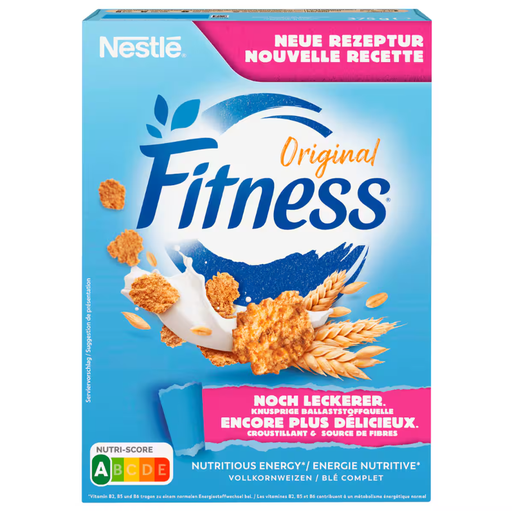
Nestlé Fitness is an option if you’re looking for wholegrain flakes: REWE lists the 375 g variety as containing 58% wholegrain, 10.3 g of fibre and 8.8 g of sugar per 100 g.
Kölln Vollkorn-Haferfleks Klassik are an option if you’d prefer baked oat flakes to cornflakes. REWE sells this variety in a 750 g pack.
Kellogg's Corn Flakes are a useful point of comparison for classic cornflakes. REWE sells the variety reviewed in a 500 g pack.
EDEKA Bio Cornflakes ungesüßt are worth considering if you’re looking for unsweetened organic cornflakes.
Alnavit Bio Cornflakes are a cornflake option that Müller describes as having a gluten-free and lactose-free recipe.
This selection includes wholegrain flakes and oats for households looking for a flake-based breakfast option for their weekly shop. Porridge oats aren’t cornflakes, so if you’re after crunchy cornflakes, bear this difference in mind before choosing.
 No image available
For a weekly shop featuring porridge oats instead of cornflakes: this pack contains 500 g of coarse porridge oats.
To compare fibre content, check the nutrition information on the pack. If gluten is a concern, check the ingredients and allergen information too.
 No image available
If you’re planning to have coarse porridge oats for several breakfasts, this 500 g pack is an alternative to baked cornflakes.
Check the fibre and sugar per 100 g on the pack, along with the ingredients if gluten is a factor in your choice.
 No image available
For households that prefer fine porridge oats to coarse oats or cornflakes: this pack contains 500 g.
The size of the oats doesn’t determine their nutritional values. Compare the information per 100 g on the specific pack.
 No image available
If you’d prefer wholegrain cereal to loose porridge oats, you could consider this 375 g variety.
Check the fibre content on the specific pack, as well as the sugar, ingredients and allergens. Don’t assume that the nutrition values for other Fitness products also apply to this variety.
 No image available
If you’d like to stock up on fine porridge oats, this multipack contains four 500 g packs.
Choose a quantity that suits your consumption and storage space. Check the nutrition and allergen information on the packs rather than relying on values for a different Kölln variety.
Under Regulation (EC) No 1924/2006, the ‘high in fibre’ claim requires at least 6 g of fibre per 100 g or 3 g per 100 kcal. Check the nutrition information for the specific variety: ‘organic’, ‘wholegrain’ and ‘unsweetened’ are not substitutes for these values.
Nestlé Cereals lists Cini Minis as containing 6.4 g of fibre and 24 g of sugar per 100 g. If you’re considering them for their taste and fibre content, make sure you take the sugar value into account too.
Choose a quantity based on how much your household actually eats, not just the pack size. REWE lists a 30 g serving for the 750 g pack of Kölln Vollkorn-Haferfleks Klassik, but your serving size may be different.
Keep the flakes somewhere dry and away from heat, and reseal the bag securely after opening. If you’re buying a larger pack, make sure you have enough storage space for it.
No. Corn as an ingredient doesn’t replace an explicit gluten-free label on the finished product. If this is essential, check the label and the current ingredients and allergen information on the specific pack.