Households that eat them regularly at weekends
If several people eat the same cornflakes, you’re more likely to get through a larger pack. What matters is how much you’ll actually need before your next shop.


A large pack works well for weekend breakfasts if everyone in your household regularly eats the same variety and you’ll use it all. If people have different preferences or you get through less, a smaller pack is easier to plan for. It’s also worth comparing the specific varieties: classic cornflakes, cinnamon cereal and unsweetened cornflakes differ in their ingredients and nutritional values.
If several people eat the same cornflakes, you’re more likely to get through a larger pack. What matters is how much you’ll actually need before your next shop.
If you want to keep track of sugar, salt or certain ingredients, compare the information for each specific variety. Even with corn-based cornflakes, it’s important to check the ingredients list and allergen information.
If not everyone likes the same variety, a smaller pack can help avoid leftovers. A variety pack may offer a selection, but make sure its contents suit your household.
First, decide which variety your household will eat and how much you’ll need over the coming weekends. Then check the ingredients, nutritional information and storage instructions on the specific pack.
| Criteria | What to check when buying | Who it matters to |
|---|---|---|
| Pack size and how much you eat | Compare the pack size in g with how much your household will eat over the next few weekends. | If we have several breakfasts coming up, I want to buy the amount we need without having lots left over. Around 33 % of consumers make this comparison a priority. |
| Ingredients and nutritional values | Compare the ingredients, allergens, and sugar and salt per 100 g on the current pack. | If the recipe matters to me, the name ‘cornflakes’ alone isn’t enough to help me choose. For around 27 % of consumers, ingredients and nutritional values are the main concern. |
| Stocking up and storage | Check the storage instructions and best-before date; seal the pack carefully once opened. | If I only eat cornflakes occasionally, I want to be able to store what’s left until my next breakfast. Around 20 % of consumers make this their main consideration. |
| Household preferences | Check whether everyone likes the variety or whether smaller packs of different varieties would be a better fit. | If everyone has different preferences, I don’t want to be left with a large pack of a variety no one likes. Around 20 % of consumers prioritise choosing a variety everyone agrees on. |
625 g will last longer than 500 g, but it could be too much if you only eat that variety occasionally.
Estimate how much you’ll get through over the coming weekends before choosing a larger pack.
Corn as the main ingredient doesn’t tell you what else is in the product or whether there may be traces of allergens. For example, EDEKA lists barley malt extract in its GUT&GÜNSTIG Cornflakes.
If you need to avoid gluten, check the ingredients, allergen information and any gluten-free label on the specific pack.
Nestlé Cini Minis Maxipack is a cinnamon cereal, while Kellogg's Corn Flakes are classic cornflakes. According to REWE’s product information, they contain 24 g and 8 g of sugar per 100 g respectively.
Compare the taste, ingredients and nutritional information per 100 g before choosing between different varieties.
EDEKA points out that the products mentioned may not be available in every shop.
Check what’s available at your chosen shop and read the information on the actual pack before making your selection.
Kellogg's Corn Flakes are classic cornflakes; REWE stocks the variety featured here in a 500-g pack.
Cini Minis are cinnamon cereal; REWE stocks a 625-g Maxipack.
The product ranges featured here include ja! Cornflakes in a 500-g pack and REWE Bio unsweetened cornflakes in a 375-g pack.
EDEKA lists GUT&GÜNSTIG Cornflakes in a 500-g pack and unsweetened EDEKA Bio Cornflakes in a 375-g pack.
Choose between a 500-g pack of classic cornflakes and a smaller pack of unsweetened cornflakes. Decide based on the variety your household eats and how much you need.
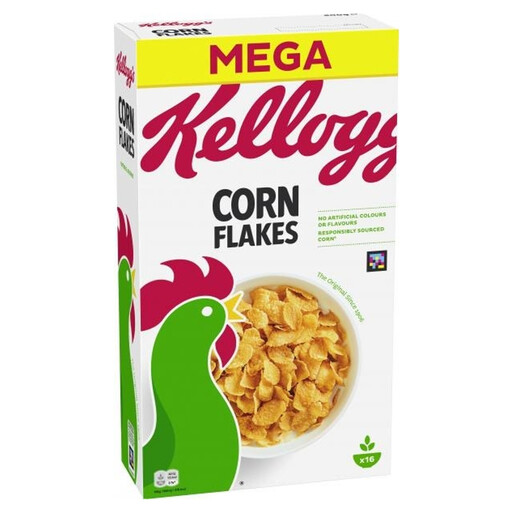 No image available
A good option if your household regularly eats classic cornflakes and 500 g is the right amount for you.
Check the ingredients and allergen information on the current pack before buying.
 No image available
This smaller pack is worth considering if you’re looking for unsweetened cornflakes and 300 g is enough for your household.
If you need to check for allergens, read the label on the current pack.
A large pack is a good fit if several people regularly eat that variety and you’ll use it all. Before buying, think about how many breakfasts you have coming up and whether you can store the pack properly once it’s open.
No. Corn as an ingredient isn’t enough to guarantee that: EDEKA lists barley malt extract in its GUT&GÜNSTIG Cornflakes. REWE explicitly labels Davert Bio Cornflakes as gluten-free; for your own choice, always check the current label on the specific product.
Compare the ingredients list, any highlighted allergens and the nutritional information per 100 g. This makes it easier to spot differences between varieties, even when their packs are different sizes.
The best-before date refers to the quality of unopened products stored correctly; it isn’t an automatic throw-away date. Also follow the storage instructions on the pack and seal it carefully once opened.