If you want to choose wholegrain cereals for your holiday let, check the ingredients and the stated wholegrain content rather than relying on the product name alone. Also compare sugar and fibre per 100 g. Unsweetened cornflakes answer the question about sugar, but they are not automatically a wholegrain alternative. If you have a gluten intolerance or allergies, the labelling on the specific product is what matters.
Who should compare what?
Travellers who prioritise wholegrain
If you want a no-cook breakfast and are specifically looking for wholegrain, check the ingredients list, the stated wholegrain content and the fibre per 100 g. The German Nutrition Society recommends including wholegrain in your choice of cereals; the labelling on the individual pack will show whether a particular cereal suits your needs.
Holidaymakers comparing sugar content
For a quick breakfast, you may want to choose between varieties with different levels of added sweetness. Compare the sugar per 100 g and check whether ingredients such as sugar, syrup or honey are included. A wholegrain claim does not replace this check.
Guests with gluten or allergen requirements
If you need to choose a product carefully because of gluten or other allergens, “made from maize” is not enough to guide your decision. Check the current ingredients list, any allergen information relevant to you and, where appropriate, the product’s explicit gluten-free labelling.
What should you look for when buying?
For breakfast in your holiday let, first decide whether wholegrain, sugar content or a particular product claim is your top priority. Then compare the relevant information on the specific packs.
| Criterion |
What to check when buying |
Who it matters most to |
| Wholegrain and fibre |
Check the stated wholegrain content and ingredients list; compare fibre per 100 g. |
For my no-cook breakfast, I want to know how much wholegrain the cereal contains. This could be the main consideration when shopping for around 46% of consumers. |
| Sugar |
Compare sugar per 100 g and sweetening ingredients; don’t assume that wholegrain means “unsweetened”. |
If I’m looking for a straightforward cereal option, I don’t want to have to guess its sugar content from the product name. It could be the main criterion for around 36% of consumers. |
| Gluten and allergens |
Read the current ingredients and allergen information; if you need to avoid gluten, look for the product’s explicit labelling. |
If I have a gluten intolerance or allergies, the specific pack must meet my needs. This suitability is likely to be the top consideration for around 18% of consumers. |
Common selection mistakes
-
Assuming “wholegrain” means low in sugar
Wholegrain content does not tell you how much sugar a product contains. The product pages published by REWE list 8.8 g of sugar per 100 g for Nestlé Fitness, 24 g for Nestlé Cini Minis and 26 g for Kölln Vollkorn-Haferfleks Honig.
For each variety, compare the nutrition information per 100 g with the ingredients list and the stated wholegrain content.
-
Classing unsweetened cornflakes as wholegrain
EDEKA lists 0.6 g of sugar per 100 g for EDEKA Bio Cornflakes ungesüßt, but does not state a wholegrain content on the product page. “Unsweetened” and “wholegrain” answer different questions.
If wholegrain is your priority, check the cereal ingredients and look for a percentage. If sugar content matters more, compare the nutrition information for the varieties you’re considering instead.
-
Relying on the type of grain alone if you have allergies
The fact that maize is an ingredient does not prove that a product is suitable for people who need to avoid gluten or other allergens. For example, Kellogg's lists barley malt as an ingredient in its Corn Flakes; EDEKA warns that its unsweetened organic cornflakes may contain traces of various allergens.
Read the information on the current pack before buying and eating the product. If you need a gluten-free product, look for its explicit gluten-free labelling.
Brands and product ranges to consider
Kölln
Vollkorn-Haferfleks Honig are an example of oat cereal with a stated wholegrain content.
- According to the ingredients list published by REWE, they contain 69% wholegrain oat flour; the nutrition information states 6 g of fibre per 100 g.
- According to REWE, the same variety contains 26 g of sugar per 100 g. So compare wholegrain content and sugar separately.
Nestlé
Fitness and Cini Minis show why even wholegrain cereals from the same brand shouldn’t be treated as interchangeable.
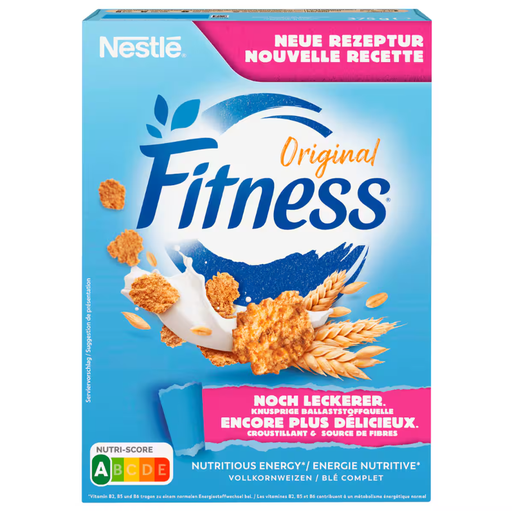
- The ingredients list for Nestlé Fitness published by REWE states 61.3% wholegrain wheat; the nutrition information lists 10.3 g of fibre per 100 g.
- According to the respective REWE product pages, Fitness contains 8.8 g of sugar per 100 g and Cini Minis 24 g. Check the figures for the variety you’re actually planning to buy.
EDEKA Bio
The unsweetened organic cornflakes are a maize-based option for comparing sugar content, not a confirmed example of wholegrain cereal.
- EDEKA lists 99.4% maize in the ingredients and 0.6 g of sugar per 100 g for this variety.
- No wholegrain content is stated on the product page. It also warns that the product may contain traces of various allergens.
Kellogg's
Classic Corn Flakes offer a point of comparison with cereals that are specifically described as containing wholegrain.
- Kellogg's lists maize, barley malt, sugar and salt as ingredients in its Corn Flakes.
- A maize base does not mean the product has a stated wholegrain content or is suitable if you need to avoid gluten. Pay particular attention to the barley malt.
Wholegrain cereals on Joybuy
This selection is for cereals that make a convenient breakfast in a holiday let when you’re specifically looking for a wholegrain option. The information on the specific pack is still important when deciding about sugar and allergens.
 No image available
Nestlé Fitness Original Whole Grain Cereal, 375 g
A wholegrain cereal option for a no-cook breakfast in your holiday let. The pack contains 375 g. Before buying, check the latest nutrition, ingredients and allergen information if sugar or a particular product claim matters to you.
View on Joybuy
Frequently asked questions
Are unsweetened cornflakes automatically wholegrain cornflakes?
No. “Unsweetened” on its own tells you nothing about wholegrain content. EDEKA lists 0.6 g of sugar per 100 g for its unsweetened organic cornflakes, but does not state a wholegrain content on the product page. Check the ingredients list and labelling for other varieties too.
How should I store cereals in a holiday let after opening?
Follow the storage instructions on the pack and seal opened packaging carefully. For Kölln Vollkorn-Haferfleks Honig, the product information published by REWE recommends storing the cereal in a dry place, away from heat, and resealing the bag.
Is maize as an ingredient enough if I need gluten-free cornflakes?
No. Don’t decide based on the maize ingredient alone. Look for explicit gluten-free labelling on the specific product and read the current ingredients and allergen information. For example, the Schär Cornflakes described by REWE are labelled gluten-free; other maize-based cornflakes may contain different ingredients or relevant “may contain” warnings.
What should I look for on a cereal pack if I have allergies?
Check the ingredients list for allergens relevant to you and look out for any “may contain” warnings. Lebensmittelklarheit explains how common allergens are labelled, but ingredients and warnings can vary between products. Always use the current pack for the specific variety to guide your choice.


