
Lieferung heute & morgen

Qualitätsgarantie

Willkommens-Angebote freischalten: KOSTENLOSE Lieferung | Bis zu 80 % RABATT | Kostenlose 30-Tage-JoyPlus-Testphase
App herunterladen
A cosy blanket 150x200 cm is suitable for many everyday situations: on the sofa, as an extra layer on the bed, for an evening in front of the TV or as a travel companion. However, many fleece blankets look very similar in product images. Differences in fabric weight, construction and care instructions are easily overlooked.
If you choose based only on colour or an especially fluffy surface, you may experience unpleasant surprises later. A blanket might be too small for two people, change shape after washing or be noticeably less warm than expected. The following criteria will help you assess marketing claims objectively.
An especially soft surface feels pleasant, but on its own says little about a blanket’s thermal properties. Key factors include material construction, fabric weight and thickness. With a reversible blanket, the two sides can differ considerably: flannel microfibre feels smooth and soft, while Sherpa fleece has a more voluminous structure.
Terms such as “winter blanket” or “extra warm” are also of limited value without specific material details. So check whether the manufacturer states the fibre composition and, where available, the fabric weight.
The standard size 150x200 cm is generally suitable for one person on the sofa or as an extra blanket on a single bed. For two people or greater freedom of movement, a 180x200 cm blanket may be more practical. However, it requires more storage space and is more difficult to handle in the washing machine.
For a sofa blanket, you should also consider the seat width and the desired drop length. A 150x200-cm blanket can be comfortably placed over your upper body; as a complete bedcover for a wider double bed, however, it is usually not large enough.
A washable cosy blanket is easier to use day to day when the temperature, wash programme and drying method suit the equipment you have available. Polyester fleece can often be washed at low temperatures, but 30 °C or a cold delicate wash are not the same for every model.
Avoid bleach and harsh laundry additives if the care label advises against them. High ironing temperatures can damage synthetic fibres. A blanket should be completely dry before it is folded and stored in a cupboard.
A fleece blanket is often made from polyester or microfibre. These materials are lightweight, dry relatively quickly and are usually easy to care for. A fluffy blanket with a Sherpa reverse has a structured, voluminous side, while flannel fleece is generally smoother.
A wool blanket for the sofa differs considerably from a polyester blanket in terms of care, weight and feel. Depending on the design, wool requires a different wash programme and may be more sensitive to friction. The specific fibre composition is therefore more important than the product name alone.
Fabric weight is stated in g/m². It describes how much material is used per square metre, but it is not the only indicator of actual warmth. A multi-layer construction may feel different from a single-layer blanket with a similar weight.
For example, the WOLTU blanket is specified as having 230 g/m² microfibre flannel on the front and 200 g/m² polyester Sherpa fleece on the reverse. These details allow for a more objective assessment than general terms such as “particularly warm”.
Look for even stitching, neatly finished edges and clear care instructions. For a blanket intended for camping or travel, weight, folded dimensions and moisture management are also important. None of the fleece blankets mentioned can be considered waterproof unless this is expressly stated.
Textiles should not be used in the immediate vicinity of naked flames or powerful heat sources. A polyester blanket is not automatically fire-resistant. When choosing a blanket for children, also follow the manufacturer’s safety instructions.
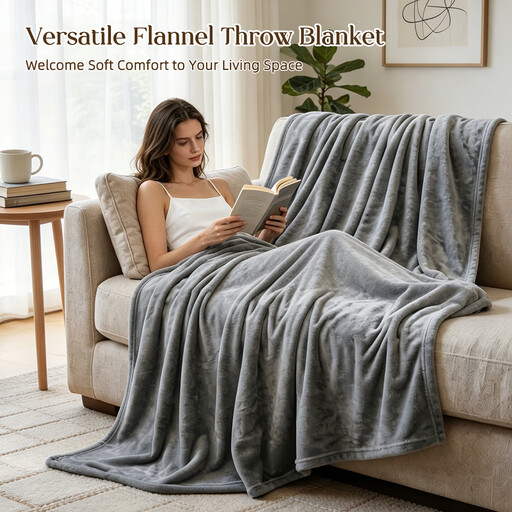
Why this product suits this profile: The 150 x 200 cm size is suitable for one person on the sofa, in the guest room or as an extra layer. The grey colour works well with a wide range of interior styles.
The clearly stated dimensions help prevent a compact sofa blanket from accidentally being planned as a large bedcover.
150 x 200 cm; grey design; described as a flannel fleece blanket for the sofa and living area.
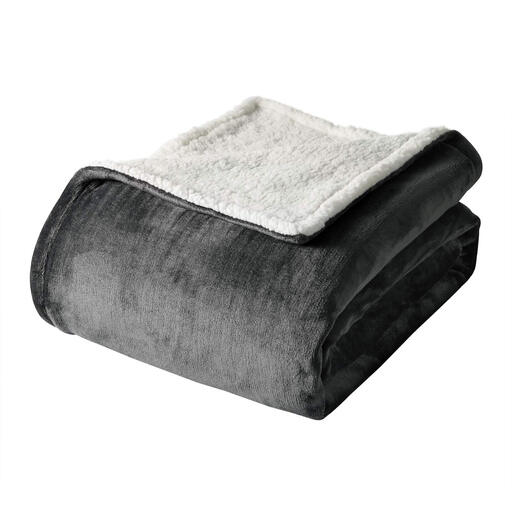
Why this product suits this profile: The reversible design combines a smooth microfibre flannel side with a Sherpa fleece side. This makes the blanket versatile for the sofa, bed, TV evenings and travel.
The product details specify both materials and their respective fabric weights. This makes it easier to assess the construction than with a simple description such as “warm blanket”.
Reversible design; 230 g/m² microfibre flannel and 200 g/m² Sherpa fleece; OEKO-TEX certified according to the product details; machine washable at 30 °C.
We have compiled a complete, regularly updated list of products that fully meet these strict selection criteria and the safety regulations applicable in the EU.
For a warm sofa blanket or TV blanket for one person, 150x200 cm is usually a manageable and sufficient size. If you need plenty of freedom of movement or are looking for a blanket for two people, consider 180x200 cm. For camping and travel, low weight, a straightforward wash programme and a format that is easy to store are particularly important.
A fluffy bedspread should also be suitable for the size of the bed. As a decorative cover, 150x200 cm can work on a single bed; on larger mattresses, the sides may remain uncovered. Always check the actual external dimensions before buying, rather than relying solely on the product type.
That depends on how you intend to use it. For sharing on a narrow sofa, the size may be sufficient. For two people in bed or on a wide sofa, a 180x200 cm blanket generally offers more freedom of movement and coverage.
First, check the sewn-in care label. Many polyester and microfibre blankets are best washed on a delicate cycle at a low temperature. Bleach, high heat and ironing can damage the fibres. After washing, the blanket should be completely dry before it is stored.
Its lifespan depends on how often it is washed, the amount of friction, drying and the quality of the material. Gentle programmes, low temperatures and avoiding harsh products can help preserve the surface and shape for longer. Before buying, details about stitching, material and care are therefore more relevant than general claims about durability.