Individual dresses before packing
You iron individual cotton dresses at home and would rather not set up a larger steam generator system. GINETEX Germany explains that the care label specifies which treatments are allowed.


For individual cotton dresses whose care label allows ironing, a steam iron with adjustable temperature and an easy-to-manoeuvre tip is a sensible starting point. A steam generator iron may be worthwhile if you regularly iron several items and have room for the system. A garment steamer is better suited to freshening clothes and may not replace the flat pressing needed for heavier cotton. The care instructions for the whole dress and the features of the specific model are what matter most.
You iron individual cotton dresses at home and would rather not set up a larger steam generator system. GINETEX Germany explains that the care label specifies which treatments are allowed.
For linings, trims or areas with different levels of sensitivity, the temperature and use of steam should be guided by the care label for the whole garment.
If you regularly iron several garments in one go, you can weigh up a steam generator's tank capacity against the space it takes up. Tefal lists a separate 1.8-l tank for the SV9202E0.
A good fit if: you want to smooth individual iron-safe dresses on an ironing board and reach seams precisely.
The trade-off: You’ll need an ironing board, and the iron has an integrated tank. Settings and steam output vary by model.
A good fit if: you regularly iron larger loads and have room for the generator and ironing board.
The trade-off: A separate tank may mean fewer refills, but takes up more space for use and storage.
A good fit if: you want to freshen up an already fairly smooth dress on a hanger, provided its care label allows steaming.
The trade-off: Philips points out that a garment steamer may not give the same results as an iron on thick cotton.
Start by checking the care symbols for the whole dress: they set the limits on temperature and whether you can use steam at all.
| Priority | What to look for when buying | Who is this particularly important to? |
|---|---|---|
| Precise smoothing | Consider the shape of the iron tip, as well as continuous steam and steam boost separately. | If I want individual cotton dresses to be smooth before packing, I look for an easy-to-manoeuvre tip. Around 40% of consumers are likely to see precise smoothing as their top priority. |
| Protecting delicate areas | Check the care label and make sure you can adjust the temperature and steam to suit. | For linings or trims, I follow the care label and want to adjust the settings accordingly. Around 30% of consumers are likely to prioritise protecting delicate areas of a dress. |
| Short ironing sessions and minimal storage space | Match the appliance's size and tank design to the number of items you need to iron. | If I only iron a few dresses before travelling, I want to put the appliance away without taking up much space. Around 20% of consumers are likely to prioritise short sessions and a compact design. |
| Care and safe handling | Check the full model's manual for descaling, auto shut-off and how to set the iron down. | I want to know how to clean the appliance and exactly which shut-off features this particular version has. Around 10% of consumers are likely to consider maintenance and safe handling first. |
For the Tefal FV6842E0, the manufacturer lists up to 50 g/min of continuous steam and a steam boost of 260 g/min. These figures relate to different settings and don't mean the same thing when it comes to ironing several dresses.
Compare the figures separately and choose settings according to the care symbols.
A travel feature only matters if you also want to iron at your destination. It isn't an essential feature if you're ironing at home before packing.
First decide whether you really plan to take the appliance with you. If so, check the power supply at your destination and the details for the specific model.
Features such as auto shut-off, anti-drip and limescale care can vary between versions. Details for one complete model don't automatically confirm the features of a similarly named appliance.
Before buying, check the full model name and its corresponding manual.
The FreeStyle 3 FI3194BK is one example of a steam iron designed for precise work on seams and details.
The 5000 Series DST5030/80 is a steam iron with anti-drip and Calc-Clean functions.
The FV6842E0 is a steam iron with a limescale collector, while the SV9202E0 is a separate steam generator option for larger ironing sessions.
The First Class DA1610E0 is another option if you also plan to use the appliance at your destination.
The products below include steam irons for pressing clothes flat at home. Check the care symbols for the whole dress and confirm that the specific offer complies with the relevant requirements before buying; model specifications alone don't prove this.
 No image available
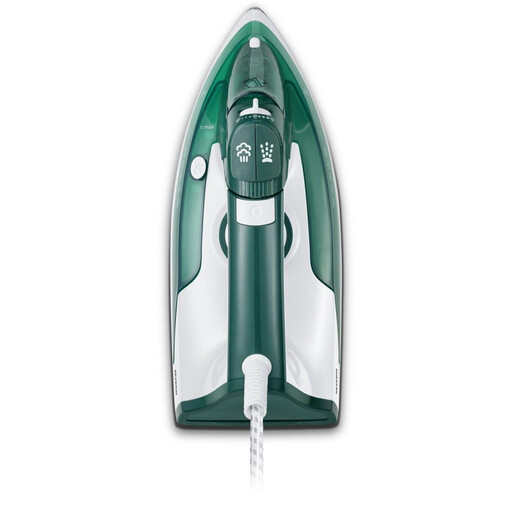
Variable temperature control and adjustable continuous steam may be useful for ironing different areas of a dress that can be ironed. According to the product details, this model has 2400 W, up to 30 g/min of continuous steam and a steam boost of 85 g/min. The removable tank holds 175 ml, and anti-drip and self-cleaning functions are also listed.
 No image available
Five temperature settings give you options to match to the garment's care label. The description also lists a 350-ml tank, spray function, steam boost, continuous steam and the option to iron dry.
 No image available
For flat ironing, the product description lists a stainless-steel soleplate, continuous steam and a steam boost. Specifications include 2500 W, up to 40 g/min of continuous steam, a steam boost of 160 g/min and a 250-ml tank. Anti-drip, an anti-scale system and vertical steam are also listed.
 No image available
The product description lists up to 50 g/min of continuous steam for clothes that can be ironed. It also specifies a steam boost of 280 g/min, a limescale filter, anti-drip and automatic shut-off. Check the care instructions before choosing a temperature or using steam.
 No image available
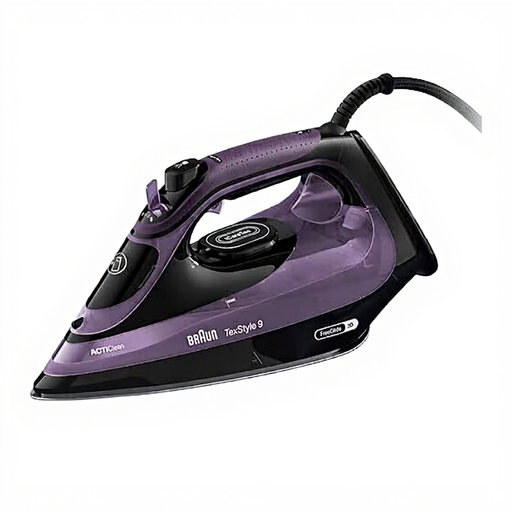
The precision tip may be useful for ironing seams and hard-to-reach areas. Features listed for this model include an iCare setting, adjustable steam, a 330-ml tank, anti-drip, a descaling reminder and automatic shut-off.
No. The care symbols for the whole dress are what matter. GINETEX Germany lists maximum iron soleplate temperatures of 210 °C, 160 °C and 120 °C. The 120 °C symbol explicitly rules out steam, while another symbol indicates that steam may cause irreversible damage. A crossed-out iron means the garment must not be ironed.
Not just because you're packing. If you're ironing at home, a travel feature isn't essential. If you want to iron at your destination too, check that the local power supply matches the specifications for your particular appliance. Rowenta lists switchable 120–127 V and 220–240 V for the DA1610E0.
Follow the instructions for the model you've chosen. Philips lists an integrated Calc-Clean function for the DST5030/80, while Tefal lists a removable limescale collector for the FV6842E0. You can't use this information to determine a single cleaning interval for all appliances.
Mains-powered household appliances covered by the EU Low Voltage Directive must meet its safety and conformity requirements. If conformity has been established, the manufacturer applies the CE marking. According to the European Union, CE is not a certificate issued by a central EU body. Check that the specific offer complies with the relevant requirements before buying.
For new goods, consumers can claim their statutory rights against the seller within two years of delivery, according to Verbraucherzentrale. If a product is faulty, the first step may be repair or replacement. A voluntary guarantee is separate from these rights.