Occasional ironing with limited space
If you only iron individual pairs of shorts, consider whether a separate unit is worth the extra space it takes up in your room.


If you only iron the odd pair of cotton shorts, check the care label first and consider whether an ordinary steam iron will meet your needs without requiring space for a separate unit. A compact steam generator iron may be a better option if you regularly have several ironable items to get through and can comfortably accommodate the base, hose, ironing surface and descaling in a shared household. Focus your comparison on continuous steam output and ease of use. Tefal and Rowenta list continuous steam and steam boost separately.
If you only iron individual pairs of shorts, consider whether a separate unit is worth the extra space it takes up in your room.
If you have several suitable garments to iron, continuous steam, tank capacity and ease of use in a shared household all matter.
If you iron textiles with different care labels, you need controls that make it easy to choose and check the right setting for each item.
First, check that a steam generator iron suits the amount of ironing you do and the space you have available. If you’ll use it regularly, compare the tank, continuous steam output, temperature controls and maintenance requirements.
A good fit if: you mainly iron individual pairs of shorts and don’t want to make room for an additional base unit.
The trade-off: you won’t have a separate unit with a tank and continuous steam supply.
A good fit if: you regularly iron several items, have limited storage space and want to adjust the setting yourself to match the care label.
The trade-off: even a compact unit needs space for the base, hose and ironing surface.
A good fit if: you iron cotton as well as other ironable fabrics and would prefer to switch between settings less often.
The trade-off: appliance programmes don’t replace the care label on the specific pair of shorts.
| What matters | What to check before buying | Who it matters to most |
|---|---|---|
| Space for ironing individual pairs of shorts | Space for set-up and storage, hose positioning and room for a suitable ironing surface. | If I only iron individual pairs of shorts occasionally, I don’t want to keep a base unit permanently in my room. Around 33% of consumers put the space needed to iron individual garments first. |
| Steam for several items | Compare continuous steam output in g/min separately from steam boost, as well as tank capacity and refill options. | If I regularly have a pile of ironing, I want to know how the steam supply and refilling work when tackling several suitable items. Around 25% of consumers prioritise steam supply for regular ironing. |
| Care labels and temperature | Read the care label and check whether the model offers a suitable manual setting or appropriate modes. | If I iron shorts with different care labels, I want to set the temperature according to each one. Around 25% of consumers prioritise fabric protection and temperature controls. |
| Descaling and ongoing costs | Check the descaling instructions for the exact model, as well as the terms of the warranty and your statutory rights. | If the appliance is shared, I want to know how to maintain it and what happens if something goes wrong. Around 17% of consumers prioritise maintenance and their rights if a product develops a fault. |
Steam boost and continuous steam are different specifications. Tefal and Rowenta list them separately in their technical information, so steam boost alone won’t tell you how well a unit suits regular ironing.
Start by comparing how often you iron, the space you have and the continuous steam output. Treat steam boost as an additional consideration.
The care label on the specific pair of shorts sets the permitted temperature range. GINETEX Germany, as provided by Verbraucherzentrale, explains that the dots in the iron symbol indicate temperature ranges. A crossed-out iron means the garment should not be ironed.
Read the label before choosing a setting. If the iron symbol is crossed out, don’t use a steam generator iron.
Descaling methods vary between product ranges. Philips Germany points out that limescale can affect steam output.
Check the instructions for the exact model before buying, and agree with your housemates who will look after it.
According to Philips Germany, limescale build-up can also cause stains or reduce steam output.
The Express Essential SV6115E0 combines a compact steam generator format with manual settings.
The CareStyle range offers different control options: manual thermostat selection on the CareStyle 1 IS 1014 VI and several operating modes on the CareStyle Compact IS 2143 BL.
The Compact Steam Pro DG7623F0 combines a compact design with a transport lock.
The PerfectCare 7000 PSG7200/20 is designed for ironable fabrics without manual temperature selection.
The following Joybuy products are steam generator irons that may be worth comparing for their temperature controls, steam supply and space requirements when you have several ironable garments.
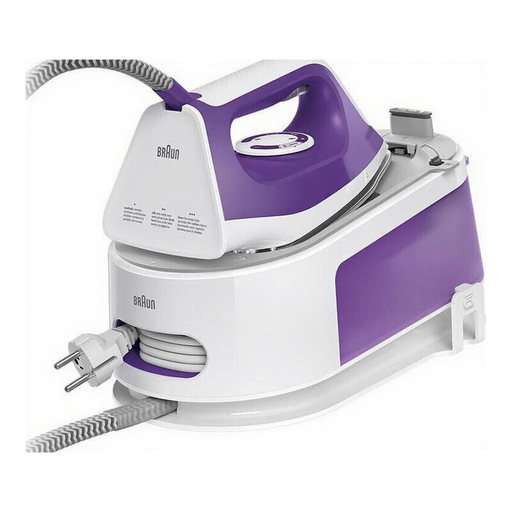 Image unavailable
A relevant option if you want to set the temperature manually to match the care label. Braun Household Germany assigns a thermostat setting for cotton and linen on the IS 1014 VI; the label on the specific pair of shorts should always take precedence.
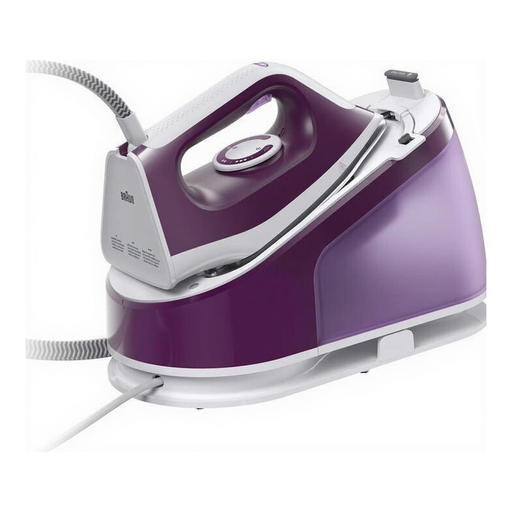 Image unavailable
This model is worth considering if you iron several suitable items and have room for a separate base unit. Before buying, check the temperature controls and descaling instructions for this specific model.
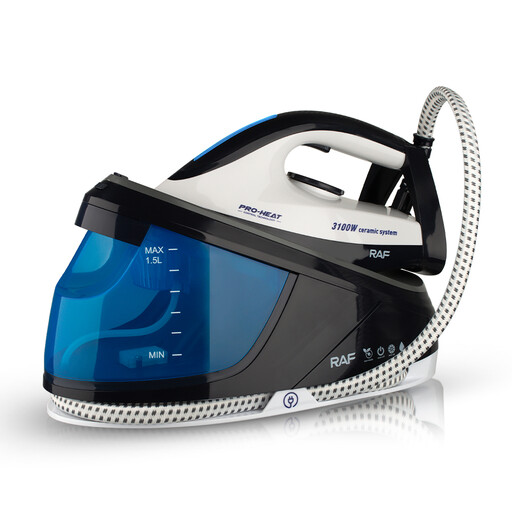 Image unavailable
The product description lists a steam output of 180 g/min, a removable 1.5-l water tank and a ceramic soleplate. Also check the instructions and temperature controls for the specific model to make sure they suit your needs.
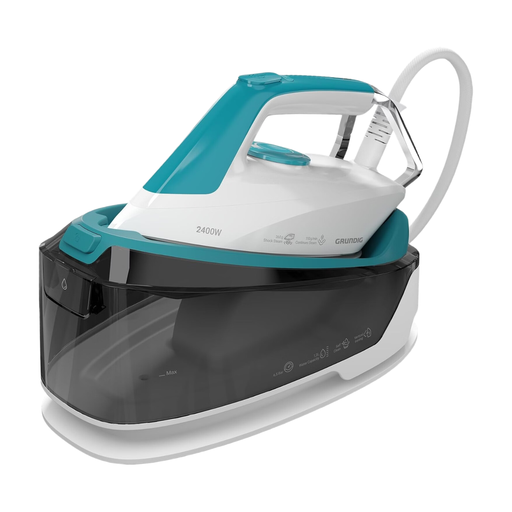 Image unavailable
The product description lists continuous steam output of 110 g/min, a steam boost of 360 g/min, a 1.2-l tank and a ceramic soleplate. Compare continuous steam separately from steam boost, and check that the temperature controls suit the care label.
No. The care label on the specific pair of shorts is what matters. GINETEX Germany, as provided by Verbraucherzentrale, explains that the dots in the iron symbol indicate temperature ranges. Take care when steam-ironing garments marked with one dot; a crossed-out iron means “do not iron”.
As well as the base unit, allow space for a suitable ironing surface, hose and cable. Follow the instructions for the specific model and position the hot appliance where your housemates won’t accidentally touch it.
Follow the instructions for the exact product range, as descaling methods vary. For the EASY DE-CALC process described by Philips, unplug the appliance and let it cool down before opening it; don’t assume these steps apply to other models without checking.
No. Your statutory rights are against the seller; a warranty is an additional, voluntary promise with its own terms. If a product is faulty, you may be able to rely on your statutory rights. Verbraucherzentrale clearly distinguishes these rights from a warranty.
CE marking is relevant for electrical and electronic equipment covered by applicable harmonised EU product rules. The European Union explains that the manufacturer uses it to declare that the product meets the relevant requirements; it is not an independent assessment of ironing performance.