Who is a washer-dryer suitable for?

Households without space to dry laundry

If it’s difficult to find a practical place to hang large tablecloths, check whether a washer-dryer will fit in the space available and work with your existing connections. The Verbraucherzentrale describes washer-dryers as a space-saving alternative to two separate appliances.

Households with large tablecloths

If you want to wash and dry tablecloths in one go, pay closer attention to the stated drying capacity and care label than to the washing capacity. GINETEX Germany and the Industrieverband Körperpflege- und Waschmittel (German Cosmetic, Toiletry, Perfumery and Detergent Association) explain the care symbols for tumble drying.

Households with frequent laundry loads

If you regularly dry other laundry as well as tablecloths, weigh the space saved by a combined appliance against its capacity and energy-use trade-offs. The Verbraucherzentrale notes that washer-dryers use more electricity and water than separate appliances.

What to consider when buying

Washer-dryer

A good fit if: There’s little room for a clothes airer or a second appliance, and your load fits within the drying capacity.

The trade-off: The drying capacity may be lower than the washing capacity. The Verbraucherzentrale also points to higher electricity and water use compared with separate appliances.

Washing machine and separate tumble dryer

A good fit if: You have room for two appliances and regularly dry larger loads.

The trade-off: You’ll need space for both appliances. The Verbraucherzentrale and an appliance test describe the capacity and energy-use trade-offs of washer-dryers.

Washing machine and air-drying

A good fit if: You have a suitable place to dry laundry, or the care label says the item shouldn’t be tumble dried.

The trade-off: Hanging laundry takes up space and time. Always follow the care instructions on the tablecloth itself.

Consideration What to check when buying Who it matters most to
Drying and installation space Measure the available floor space, appliance depth and door clearance; consider connections and alternatives such as a clothes airer. If I have very little room to hang laundry, I want to know whether the appliance and its door will fit in the space available. Around 36% of consumers say a lack of drying and installation space is their biggest concern.
Drying capacity and fabric care Compare the care label and the number of tablecloths with the appliance’s washing and drying capacities. If I want to dry my tablecloths without splitting the load, I check their care symbols and the lower capacity figure. Around 29% of consumers put finding a suitable way to dry their tablecloths first.
Electricity and water use On the EU energy label, distinguish the figures for washing and drying from those for washing alone, and compare like with like. If I tumble dry frequently, I want to factor the consumption of full cycles into my choice. Around 21% of consumers say running costs are their top priority.
Ease of use and programme duration Check how long the full wash-and-dry programme takes for a suitable load. If I don’t want to move wet tablecloths between appliances, I look at the full cycle and how long it takes. Around 14% of consumers put a straightforward, uninterrupted cycle first.

Common buying mistakes

  • Assuming the washing and drying capacities are the same

    For the Bosch WNG24443, the manufacturer lists a capacity of 10,5 kg for washing alone, but 6 kg for washing and drying. So a full washing load won’t necessarily fit in a continuous drying cycle.

    Plan your load according to the stated capacity for washing and drying, not the higher washing capacity.

  • Assuming all cotton is suitable for tumble drying

    The fibre alone doesn’t tell you whether a particular tablecloth can be tumble dried. The care label shows whether tumble drying is suitable and which temperature setting to use.

    Before choosing an appliance, check the care symbols on the tablecloths you actually want to dry.

  • Comparing only the energy rating or washing-only figures

    The figures for a wash-and-dry cycle differ from the consumption figures for washing alone. If you regularly dry a full load, you’ll need the figures for the relevant cycle to make a useful comparison.

    Compare the figures for washing and drying on the same label basis, and consider how often you’re likely to use that cycle.

Relevant brands and models

Bosch

The WNG24443 washer-dryer shows just how much washing and drying capacities can differ.

  • Bosch lists a capacity of 10,5 kg for washing alone and 6 kg for washing and drying.
  • The automatic stain programme is a manufacturer claim; it doesn’t prove that every stain will disappear from every tablecloth.

AEG

The L9WSF80699 and LWR6F96EX models offer a model-specific comparison of different drying technologies and energy-label figures.

  • AEG lists a washing capacity of 9 kg and a drying capacity of 6 kg for both models. The manufacturer states that the L9WSF80699 uses 252 kWh and the LWR6F96EX 307 kWh per 100 operating cycles when washing and drying.
  • These consumption figures apply to the models listed and aren’t independent evidence of a particular result when drying tablecloths.

LG

The W4WR7096YB combines the washing and drying features listed by the manufacturer in one appliance.

  • For this model, LG lists a washing capacity of 9 kg and a drying capacity of 6 kg, as well as features such as Steam and TurboWash.
  • Feature names are no substitute for checking the care label, and don’t tell you whether a particular tablecloth is suitable for tumble drying.

Miele

The WTD160 WCS washer-dryer is listed with a washing capacity of 8 kg and a drying capacity of 5 kg.

  • Separate capacity figures make it easier to check how much laundry can be dried in a complete cycle.
  • Delivery and optional installation or warranty services depend on the offer.

Joybuy products

This selection includes LG washing and drying solutions with space-saving designs. The WT1210EGF has a washing machine and tumble dryer arranged as a WashTower; the other models listed are described as washer-dryers.

LG WT1210EGF WashTower

LG WT1210EGF WashTower, 12 kg washing / 10 kg drying

The stacked washing machine and tumble dryer may suit you if you want to combine washing and drying where floor space is limited.

The listed capacities are 12 kg for washing and 10 kg for drying, and the appliance includes a heat pump tumble dryer. The stated dimensions are 60 × 165,5 × 66 cm. Only tumble dry tablecloths if their care labels allow it.

View at Joybuy

LG WT1210WWF washer-dryer

LG WT1210WWF washer-dryer, 12 kg washing / 10 kg drying

This model may suit you if you’re looking to combine washing and drying in a space-saving appliance.

The listed capacities are 12 kg for washing and 10 kg for drying, and the appliance features a Dual Inverter heat pump. Steam, TurboWash 360° and the ThinQ app are also listed. Check the care label on each tablecloth before drying.

View at Joybuy
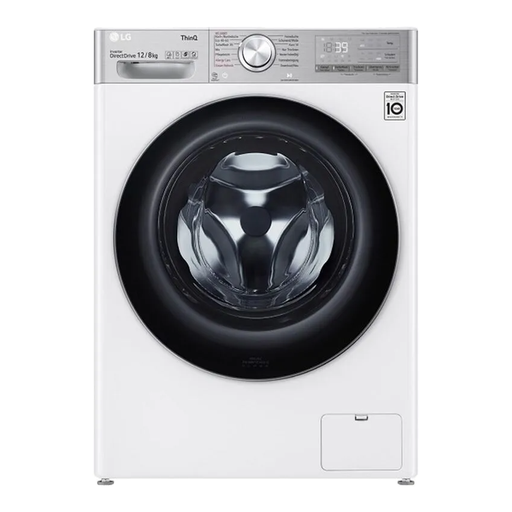
LG V9WD128H2 AI DD washer-dryer

LG V9WD128H2 AI DD washer-dryer, 12 kg

A washer-dryer may suit you if you want to wash and dry in one appliance and have little room for a separate solution.

The product name lists a capacity of 12 kg and AI DD. Before buying, check the washing and drying capacities of the specific model against the tablecloth load you plan to wash. Also follow the care label.

View at Joybuy

Frequently asked questions

Can I tumble dry any cotton tablecloth in a washer-dryer?

No. The care label on each tablecloth is what matters. The tumble-drying symbol and its temperature dots show whether machine drying is suitable; cotton fabric alone doesn’t mean it’s safe to tumble dry.

Is the washing capacity enough for a complete wash-and-dry cycle?

Not necessarily. For the Bosch WNG24443, the manufacturer lists a capacity of 10,5 kg for washing alone and 6 kg for washing and drying. Check your planned load against the combined capacity of the specific model.

Which consumption figures should I compare?

Compare the figures for washing and drying with the same cycle figures for other models, and keep them separate from figures for washing alone. The EU energy label shows, among other things, energy use per 100 cycles and water use per cycle.

What should I check before delivery and installation?

Measure the available space and check the dimensions of the specific model, access to the space, and the required water and electricity connections. Check whether delivery and installation are included or optional in the offer.

How can I prevent unpleasant smells after washing?

Don’t leave the machine closed while it’s still damp, as trapped moisture can encourage unpleasant smells. Also follow the cleaning and care instructions for the model you buy.